So what have I learned since my last post about the colorlessness or otherwise
of gin?
Well, a fair bit.
Darian Af, who according to my Facebook friend
Jonathan Taylor “makes gins various,” says "… true gin isn't an infusion,
it's a distillate. That means that whatever botanicals you want in your final
product are added to a spirit and then the whole thing is distilled: it is
brought to a high enough temperature that it begins to evaporate, then the
vapor is collected and condensed back into liquid. So only the compounds that
are volatile enough to evaporate (things like essential oils and alcohol) end
up in the final product. Those compounds tend to be clear, though there may
well be cases where some distillate has a color to it. I can't think of one
offhand, though."
All that seems fair enough, and
yes, I suppose I did know that “true gin” was a distillate, I just that less
scrupulous gin makers might shove in some artificial (or even real) flavoring
after the fact. So apparently not, or at least only of the colorless variety.
I also learned, and I’m not sure
that I did know this, that whisky is clear when it’s distilled, before it goes
into the barrel, and it’s the wood that gives it its color.
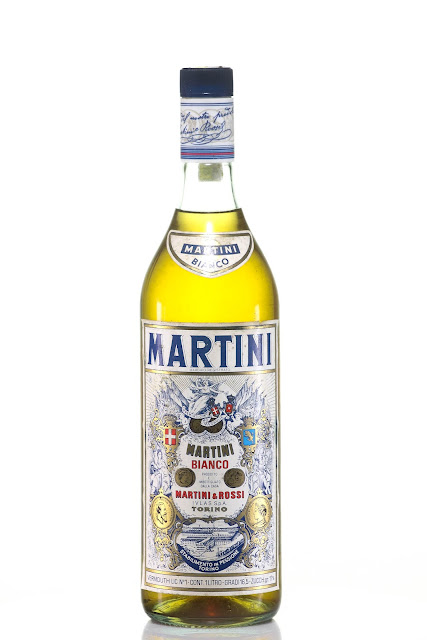
As for the yellowness of Ogden
Nash’s martini, Darian quotes from the blessed Lowell Edmunds’s, Martini, Straight Up: The Classic American
Cocktail: “The vermouth was probably what always made Martinis yellow or
amber up until some point in perhaps the late 1930s, when dry vermouth became
clear."
So, no argument with that.
I also, serendipitously, came across this
in a catalogue issued by my one-time employer, Bertram Rota Limited, a promotional item from Gordon’s Gin:
And who knew that Gordon’s produced Orange, and Lemon Gin? Well, a great many people, no doubt.
Also for sale at Rota's, probably sold by now, this wonderful little item:
Catalogue info as follows:
"30. Carter (John). The Dry Martini.
Illustration. Reprinted from Flash in the Pan by Ernestine Carter, 1963. First
Separate Edition. One of 200 copies, on yellow paper. Stiff wrappers with
printed label. Fine copy. Presentation Copy, inscribed by the author on the
printed label to Bertram Rota and with an autograph correction. £120."
I have to admit I
haven’t read the book, but John Carter is quoted here and there on the
subject. He’s also supposed to have been
a friend of Ian Fleming and his prescriptions for martini making are even more
rigorous than Bond’s. Carter writes:
“Five or ten
minutes before you want to mix cocktails, fill your jug at least three-quarters
with ice, and put a piece or two of ice in each glass. This gives you a running
start on temperature. Then pare a very thin slice of lemon rind for each drink.
When you are ready for action, pour off the water which will have melted in the
jug and pour in gin and vermouth, in the proportion of four to one. Do not be
ashamed to measure (only veterans can safely pour by eye). Mix enough for one
round only. And remember to allow 10 per cent in winter and 20 per cent in
summer for ice-dilution. Stir briskly until the outside of the jug freezes your
hand -- 20 seconds should do, but it may take 40 in warm weather. Empty the ice
from the glasses back into the bucket, shaking out the last drop of water. Pour
out the cocktails. Twist a piece of lemon-rind over each, which sprays a dash
of the oil onto the surface of the martini. And serve. No olive, no onion, no
nonsense. Just the best drink of its kind in the world.”