Showing posts with label PORK. Show all posts

Thursday, January 2, 2025

GOTTA LOVE YOUR MOTHER


I’ve been continuing to read and enjoy Fuchsia Dunlop’s
 Invitation to a Banquet (I admit that my fingers keep wanting to type Invitation to a Beheading).


And I’ve been especially taken with something she describes called “Loving Mother’s Dish.”

The story goes that there was once a woman whose son travelled to Beijing to sit the imperial civil service exams.  While waiting for his return she prepared his favourite dish, a slow cooked stew of pork and eggs.  

But travelling in imperial China was no better than traveling on British railways and the son didn’t get back on the day he was expected.  She took the stew off the stove, went to bed, and got up next day and simmered it some more on the second day. 

Again the son didn’t arrive so she stewed it some more, but he did arrive on this, the third day. Dunlop writes, “the stew had been heated up three times, and the meat was inconceivably tender and unctuous, the sauce dark and profound.’? All of which I can believe.  But what about the eggs?   

         I have never eaten an egg that’s been stewed for three days but I think the end result would not be profound in any ordinary sense of the word.

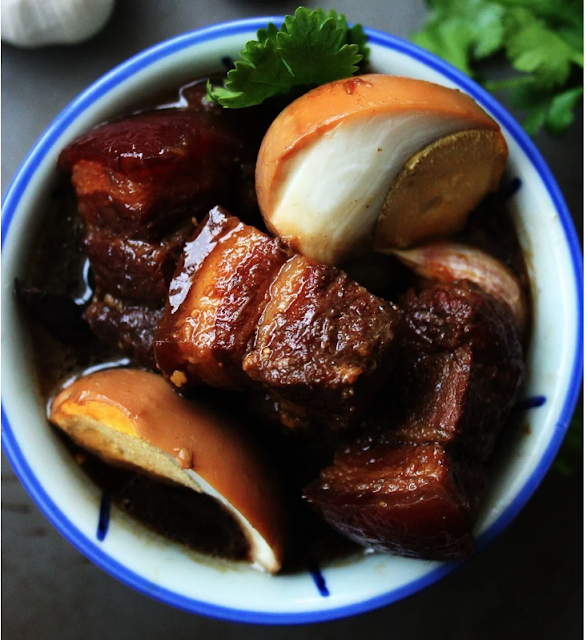
       I haven’t been able to find a recipe for “Loving Mother’s Dish” but I did manage to find this on a website called fooddelicacy.com 


It’s braised pork belly and eggs in soya sauce: the cooking time is an hour and 15 minutes.

Wednesday, October 4, 2023

CRACKLING


Having had the joy of the Pork Belly Bites at the Cricketers in Richmond, the obvious next step was to try making some in the privacy privacy of our own kitchen and in our own frying pan, with the help of my trusty assistant Caroline, who took most of these photographs. 


The local butcher supplied the belly:


It wasn’t as easy as it sounds, if in fact it sounds easy at all.  Cooking the pork was no problem in itself because you could lay it on its side, but the crackling didn’t get as crisp as we wanted because it was so hard to keep it upright in the pan.


Also we had it as a main course with asparagus and home-made apple sauce rather than as a starter so it was more a nodding homage than a recreation of the Cricketers ‘small plate.’


The apples in the apple sauce were from my pal Colin who has an allotment down Colchester way, and fans of pareidolia will note that one of the apples appeared to have a map of India on it (sort of):


Anyway the end result was good, but we concluded that perhaps those Richmond bites were pre-cooked then deep-fat-fried at the last moment to make the crackling really crisp.  And although I used to have a deep fat fryer, and often think about buying another one, I never quite get round to it.


A week later we tried simply to make roast pork, and of course tried to get the crackling right.  This is something that’s been haunting me my whole life, with mixed results, but I have to say this was one of my better efforts. A small triumph but one to be cherished.


My mum, who was not a very good cook and didn’t want to be, did have a way with crackling, and the more I think about it, the more I think it had something to do with the cooking fat she used which i was lard. We were ‘reduced’ to using duck fat.


Tuesday, July 31, 2018

A PLATEFUL OF EUPHEMISM

I understand the need for euphemism in food, of course I do.  We speak of sweetbreads rather than pancreas, we say sausages rather than “unappealing bits of innards chopped up small, seasoned and stuffed into a length of intestine.”  
         And I can see why we don’t want to think about happy little calves when we’re eating our blanquette de veau. We want to dissociate the thing on the plate from the thing gamboling through the field.  The Simpsons covered this pretty well back in the day when they covered things pretty well.


But that doesn’t explain everything.  Part of the explanation is – the French.  After the Norman Conquest of England, high-toned French terms entered the English culinary vocabulary – so that it was a lamb in the field but mutton, as in mouton, when it got to the table.  It was a cow in the field but beef (boeuf) on the plate.

This seems okay as far as it goes.  But why doesn’t it apply to, say, rabbit, which did not become lapin, and chicken only in certain limited cases becomes poulet?  As for oysters and geese – huitres and oies - I suspect there was no change because most Anglophones wouldn’t have known know how to pronounce those words.

I also wonder if it had something to do with size – why bother giving a special name to something as small as a quail?  Or a pigeon which, as I understand it, is the same in both languages.

         The pig however seems a different problem again.  We’re told that the English pig became the Frenchified pork (from porc) – but why didn’t it become cochon?


 All this was going through my mind a week or so back when I was at Franklin and Company, a modest gastro-pubbish neighborhood joint in Los Angeles, and there on the menu was “The Pig Sandwich: Braised garlic pork, gruyere, charred broccolini, balsamic mustard, toasted ciabatta.”  I ordered it: it looked like this and it was pretty tasty:


It came with French fries, which were fine, but I could have substituted them for waffle-cut duck fries (not canard friesand it would only have been $3 extra, so now I think maybe I should have pushed the boat out just that little bit.

The restaurant is on Franklin Avenue in Hollywood, and it’s been through a few conceptual tweaks in its comparatively short history.  In the early days it had a version of this as its logo:


It’s a cartoon often, though not always, attributed to Benjamin Franklin, part of his campaign to remind the colonies that they had a better chance of standing up to the British if they were united rather than sliced into bite-sized chunks.

The restaurant doesn’t seem to use that logo anymore, and as far as I’m aware snake (or serpent as the French would say) was never on the menu, which I think is a shame.

Sunday, February 25, 2018

BEAST


I don’t really know what “natural” means when it comes to supermarket pork – not much I suspect, and I definitely don’t know what “California natural” means (the pigs get to surf?) though I see it is a registered trademark, and I do know there’s some information out there suggesting that Farmer John isn’t very kind to his pigs. 


Nevertheless, industrial consumer that I am, when I saw a chance to buy a reduced price pork shoulder I couldn’t resist.  Then I saw the price – $6.66 – the price tag of the beast, and I hesitated.  But only briefly.


Friday, October 27, 2017

CRACKLING ON


The quest for crispy pork skin never quite ends.  Most recently there was pork belly on sale in the supermarket.


Many hours later, after drying, stabbing,


infusing, 


baking (a salt crust was involved – not shown) and finishing under the grill/broiler, it came out looking like this, and  also like the pic at the top of this post.:


Really it was an excessive amount of faffing about, but really worth it, honest, just about.

Wednesday, April 5, 2017

CRACKLING ON


My previous post about Schweinsstelze, and particularly about crackling, seemed to stir something in the collective bosom.


I was directed to an article in the Guardian by Felicity Cloake, from 2010, in which she cooks pork crackling by seven different methods, most of them \recommendations from “name” chefs.  Some involving doing very little, although one of them, which turns out to be her favorite, involves drying out the skin with a hairdryer before cooking.  I can see the logic of that.


In the end she makes it sound all too easy: she finds that most of the methods work – the only disaster being Prue Leith’s, which involved rubbing the skin with oil, which I think is an absolute no-no.

On a good day I can generally get my crackling there or there abouts but it’s always a bit hit and miss.  My method remains constant but results, as they say, may vary.  Yes, it’s important to have the skin dry, it’s good to have the oven extra hot at the beginning and at the very end of cooking, it’s important that when you score the meat you don’t cut too deep.  I’m personally against pre-salting but I seem to be a bit of a lone voice in that area.  I do my best, but of course there are still failures, and I sometimes don’t understand why.


With this in mind, at the weekend, back home in Los Angeles, I cooked a small “picnic shoulder” – American butchery and terminology is certainly different from British and I assume wildly different from the way the Austrians do things, but you have to work with what you’ve got.   It had a nice piece of skin on it, it had a biggish bone running through it, and the result was as they say “good in parts,” not so good in others. 


Some of the crackling was good and crisp, some of it was too soft and chewy.  I think it could have used more time in the oven, but the pork itself was already getting overcooked.  Maybe a blow torch to crisp up the skin would have been the answer – a method mentioned not quite seriously in Felicity Cloake’s article.  I’m inclined to think the piece of pork was just too small, and the layer of subcutaneous fat was too thin, but I have no absolute answer.


Those folks at Marks and Spencer have found a partial solution.  When I was in England I made a staggering discovery of their “Snacking Crackling” – that's it above - crunchy skin with no meat whatsoever, sold as an eat-anywhere-any-time snack. There is something wonderful but maybe slightly sinister about that.  How do they get them to stay so crisp? My crackling, even the best of it, is soggy the day after it’s cooked.  Ah the wonder of M and S.

And again, back in the southern California saddle, I just bought myself a bag of Baken-ets Chicharrones – that’s the Mexican term for fried pork skins: Chicharrones, not Baken-ets, obviously.  These were “hot n spicy” (which I don’t absolutely need in a pork skin) and it said on the front of the pack in very small letters “colored with paprika.”  Also, according to the list of ingredients on the back, colored with “Artificial Color (Red 40 Lake, Yellow 6 Lake, Blue 1 Lake” – I guess that’s all right, but I really don’t know.  Also containing monosodium glutamate (which I personally find unobjectionable), and Torula Yeast, which I’d never heard of, but having looked it up online I suspect it’s worth a blog in itself – “a type of yeast that is grown for the food industry by feeding on wood alcohols. It is also a byproduct of the paper industry. The end result after drying is a fine tan powder with a meaty flavor” – that’s according to fooducate.com.  
With a beer – actually an Australian Fosters, the hot n spicy chicharrones tasted just fine; without one they’d have been very hard work.  Hands across the sea, right?


Monday, April 18, 2016

PORK ZEPPELIN

Having enthused about the Wurst of Lucky Peach, and having made some claims to be a sausage maker in my review, I reckoned it was probably time to make some more sausages.

As I’ve said before – there’s no mystery about sausage making.   You grind up some cheap meat, pork and turkey in this case:


You season it to taste - I generally under season rather than over season, so I went heavy on the garlic and paprika, but there's onion, cumin, black pepper and a few other things in there too:


You stuff it into a hog casing:


And voila you’re a sausage maker:


Admittedly all this is a lot easier when you have an electric meat grinder, as I now do, but I started out making sausages with a hand grinder, and it was much harder work, but arguably more satisfying for that very reason.
 
Two other bits of sausage lore surfaced while I was digging around.  First this vending machine that sells hotdogs.  I wish I knew more details:


 And then this startling bit of information which was in a New Yorker article about airships, though I’ve subsequently seen that the information has been circulating for a while.  The article runs: “The gas cells of many of the early zeppelins were made from so-called goldbeater’s skin: cow intestines beaten to a pulp and then stretched. It took two hundred and fifty thousand cows to make one airship. During the First World War, Germany and its allies ceased production of sausages so that there would be enough cow guts to make zeppelins from which to bomb England.”


This doesn’t seem to be a hoax, and I don’t want to contradict anyone.  On the other hand I’ve found the photograph below which I believe shows the inside of the Hindenberg, and it sure doesn’t look like cow guts.   Maybe I just don’t understand how the process of beating cow guts to a pulp turns it into a large skin.


I think it also raises the questions of why the Germans didn’t just make (or perhaps continuing making) their sausages using pig guts.