Thursday, March 26, 2020

NOT A HOST


Last year's last olive, with this year's daffodils in the rear - none of them strictly edible.

Saturday, March 14, 2020

WALRUS-RELATED

The oysters don't even know there's a crisis.


Thursday, March 12, 2020

TIED TO THE CRACKLING POST


If you’ve got to panic-buy and stockpile something, and it appears that you do, then why not pork crackling?   They do have a long shelf life.  The 'sharing,' of course is optional.


The above, I think, are of Filipino origin (they were certainly bought in a Filipino supermarket, but the packaging was pretty vague), and what the Filipinos don’t know about pork isn’t worth knowing.

Incidentally I do think that roast pork flavour is the very best flavor for pork crackling.

Tuesday, March 3, 2020

MATTER EATER LAD

The last line - does the fact that he has no SPECIAL girl friend mean that he has lots of not-so-special girlfriends?


Sunday, March 1, 2020

DAMIEN'S DAMIENS

Someone, I think it may have been Terence Conran, once said, ‘Everybody wants to write a novel, and everybody wants to open a restaurant.’


I, of course, am guilty of the first of these, but I’ve never, ever wanted to open a restaurant, and it strikes me that the non-professionals who do it must be more or less insane.  Which brings me to Damien Hirst.


There’s a lively interview with him in the current Idler.  Much of it is actually agonized boasting – he lost so much money because he HAD so much money to lose, and he has indeed opened a restaurant or two.

Hirst says, ‘I remember there was a restaurant of mine that was losing £20,000 a month and I went there and looked at the people eating dinner and I thought: “You c***s.  I’m paying for your food.”  Possibly this is how many restaurant owners feel.


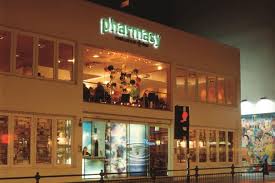
I imagine, though I’m not sure, that Hirst is talking about Pharmacy, the restaurant he opened in Notting Hill in the late 1990s.  I walked past it once in a while when it was open, and I used to think it looked like an interesting place, and it was full of Hirst's art, but it never occurred to me that I would actually want to go there to eat, and I didn’t.  Obviously some others did, but maybe not enough of them, or maybe there were other problems with the business plan.

Digging, around I find that when Pharmacy opened, the Royal Pharmaceutical Society threatened legal action under the 1868 Medicines Act, on the grounds that people might confuse the restaurant with an actual pharmacy.  This sounds pretty bogus to me – I’d guess they just wanted attention - but naming restaurants is a tricky business.


How many people have wandered into the Oxo Tower Restaurant hoping to buy a few Oxo cubes?  How many people have mistaken the Ivy for a garden centre?  How many had their hopes dashed when they went to the Gay Hussar and failed to find gay hussars?

I did, however, once eat at Elaine’s in Manhattan, and was amazed to find Elaine was actually there.


Thursday, February 27, 2020

ONE AFTERNOON A SLAVE


If it’s a Sunday afternoon and a man is in possession of sherry, gin, prosecco, an egg, and a copy of The Savoy Cocktail Book, there’s nothing to stop him following the recipe for a White Slave cocktail, a drink that wasn’t in the original 1930 edition, but can be found in the 1965 version.

The instructions say use equal quantities of sherry, gin, prosecco, and the white of an egg, and then ‘Shake well in ice and strain into a medium-size glass.’

Well, this is madness of course.  Shake prosecco ‘in ice’ and you’ll get an exploding torrent of prosecco. So I shook the other ingredients and added the fizz at the end, which any sane person would do.


It wasn’t bad at all, if not especially enslaving.  However, and this is something I don’t say very often, it could have used a little bit of sweetness, no doubt from the sherry.  I used amontillado – partly in honour of Edgar Allan Poe - but I might have used something less dry.


I don’t suppose white slavery is better or worse than any other kind of slavery, but – while being very respectful - I did give a thought to Tom Bullock, the legendary black bartender at the St Louis Country Club, in Missouri, not a slave at any time as far as we know, but author of The Ideal Bartender, published in 1917, 13 years before the first Savoy Cocktail Book. I wondered whether he gave a recipe for a White Slave – but no.  It would have been very surprising if he had.  


His book however does have a recipe for the Diarrhea Draught (which I must say I read at first as  Diarrhea Delight, but that's me all over): and I suppose it's a cure rather than a cause of diarrhea, but I haven’t made one as yet so I can't be absolutely sure.


Wednesday, February 26, 2020

OLD JAPAN

My favourite ever receipt from a supermarket, in London.


Thursday, February 20, 2020

THE SHROOM AND I


I went to the exhibition at Somerset House titled: Mushrooms: The Art, Design and Future of Fungi curated by Francesca Gavin, which according to the publicity is celebrating ‘the remarkable mushroom, and all the progressive, poetic and psychedelic wonder it evokes’ – i.e. it seemed to be heavily directed towards fans of ‘shrooming, though in fact when I went there quite a few mothers and children, ‘Oh yes, little Fiona just loves psilocybin.’  For obvious reasons I didn't photograph the children.


         The exhibition also, and I’m quoting here, shows ‘ground-breaking experiments in design, textiles and architecture that utilise mushrooms in exciting new ways – from upcycled agro-waste to sustainable shoes made with mycelium.’ I’m no fashion maven but if the shoes in the exhibition are anything to go by, it may take a while before they catch on.


         Fortunately there was art too, lots of ‘emerging artists’ I’d never heard of but also work Cy Twombly, Beatrix Potter, Carsten Höller (who made the mushroom suitcase above), and quite a few others including Takashi Murakami.  


Want to see a picture of me standing next to Takashi Murakami?  Of course you do.  I'm the one on the left.


There were also books in display cases which I always like, 


and this included a copy (actually an artist’s proof) of Mushroom Book, actually more or a folio, by John Cage, Alexander H. Smith, and Lois Long.  Since it was only an edition of 75 this is, as they say, ‘a rare chance to see.’


And frankly I was glad for the presence of Mr. Cage, (I pretty much always am) because given the rest of the exhibition you might never have known that mushrooms were things that people actually eat for food.  Cage used to forage for mushrooms and sell them to fancy New York restaurants.  He even appeared in Vogue with his recipe for ‘dogsup’ – a version of ketchup with mushrooms (type unspecified) brandy, mace, cayenne, allspice and other good things.

I came out of the exhibition wanting to have my consciousness expanded but more urgently with the urge to buy and cook some mushrooms; which I did.

Now mushrooms, as you probably know, are low in calories and fat, and cholesterol-free, they’re rich in copper, potassium, magnesium, zinc and some B vitamins, and antioxidants such as selenium and glutathione. Now I’ve never met anyboy who said, ‘Mmm I’ve really got a hankering for selenium and glutathione,’ but possibly such people exist.


I bought some brown and white shimeji, they were from China, and enoki, they were labeled ‘product of Korea’ - south, I’m assuming.  Did I feel guilty about their lack of localness, well of course I did.


I fried ‘em up with garlic and rocket, and stirred in some cooked gnocchi and a bit of grated cheese – and they weren’t bad at all, though when I do it again there’ll be a LOT more garlic, and perhaps a splash of psilocybin


Friday, February 14, 2020

SUGAR MY SQUID


Since you probably aren’t going to ask, it’s ‘Jane Jane’ Prepared Rolled Squid,
made by the Shin Ho Sing Ocean Enterprise Company of Taiwan.


The ingredients are squid, sugar, salt, lactose, vinegar, red pepper and Preservative E200.
       Of these flavours the most dominant by miles is the sugar.  In general I don’t have much of a sweet tooth, and I definitely don’t want my to squid to taste sugary, but in the name of orientalism I snaffled it down.  Ah international cuisine – bringing nations together.

Wednesday, February 12, 2020

DEVELOPMENTS


It’s an Ossau Iraty from the Largeveau Dairy, by way of Marks and Sparks:  ancient, Franco-Basque, make from sheep’s milk.  The packaging tells us it has a ‘nutty flavour which develops in the mouth.’ Now, I may be naïve in these matters, but y’know that strikes me as the very best place for flavour to develop.

Monday, February 10, 2020

POLICY


I had lunch t’other day in the Bibendum Oyster Bar in London, day with my literary pal Kirsty Allison. 

This is Bibendum (not my picture):


This is Kirsty Allison (my picture):


We didn’t have oysters, they were a bit pricy, and they’d run out of the cheapest ones – from Maldon; although since Maldon oysters are what I buy many weekends at my local farmer’s market I’d have been a bit reluctant anyway. 

I had fish and chips and they were very good, I liked the curl, though not quite as good as Ms. A’s soup of the day which was fantastic – though I forget what was in it. Jerusalem artichoke, possibly.


The restaurant is currently run by Claude Bosi who is a very big deal – French, much travelled, lots of Michelin stars - and there are many rooms in his mansion: i.e. inside the big Bibendum building. 

He runs a tight ship – check this out from the website (and admittedly this applies to the fancy restaurant upstairs, not to the more modest the oyster bar):

“CANCELLATION POLICY: In the event that a booking is cancelled with less than 48 hours notice, a cancellation fee of £85 per person for lunch or £115 per person for dinner will be charged to the card provided at point of booking. PLEASE NOTE: In the event that the party arrive at the restaurant as a smaller group than expected, we reserve the right to charge for the missing guest(s).” 

Jeez.  I’d think this is the kind of malarkey that might make a person hesitate ever to make a reservation at said restaurant, but what do I know?


Above is a picture of me at the end of lunch with a cup of coffee, and I include it not because I particularly like to show my face (and what exactly am I doing with my face?) but because of that olive tree behind me.  There was a sign on it saying it’s for sale – though no price is given, nor any details of how you might get it home – perhaps Mr. Bosi would give you a hand loading it into the back of Subaru.  Perhaps, if the price was right.

FYI, the olive tree pictured at the top of this post is not at Bibendum, it's in my own back garden..


Sunday, February 9, 2020

Mmmm ... SMEARY


Since you ask, it’s truffled Taleggio, bought from the Solo Cheese stand at the farmer’s market in Manningtree. Taleggio is, apparently, a ‘smear ripened’ cheese, traditionally matured in caves and washed with seawater once a week to prevent mould as it forms its crust.  All the sources comment on the fact that it has a strong smell and yet a mild tangy, creamy taste.  Sometimes sources get it about right.

Thursday, February 6, 2020

SIZE IS SOMETHING

The local farmers’ market has lately been selling some big potatoes – 5 for £1.50.  I bought some, obviously.

There’s no arguing that they’re big but they’re just awful.  I was going to say the tasteis just awful, but there really is no taste.  It doesn’t seem to matter what you do to them – mash, roast, fry, whatever  – they continue to taste bland and watery.  Sure, you can pile on the salt and pepper, add the butter, the cream, the goose fat; but then, at best, they just taste of salt and pepper and so on.  Still they do make for a reasonable photo–op


Of course I didn’t grow these monsters and by many standards these aren’t even all that monstrous at all


Above is Mr Peter Glazebrook with a potato he grew in 2010.  It weighed 3.8kg and appeared in the Guinness Book of Records.  I’ve long admired Mr Glazebrook who’s produced all manner of mighty vegetables, though of course I don’t know how his potato tasted.

And  even so it’s perfectly possible to imagine bigger potatoes, and many have, like this:


and this: 


and this:


Sunday, February 2, 2020

SOME LITERARY OYSTERS


Here is Herman Melville in Moby Dick: ‘Methinks that in looking at things spiritual, we are too much like oysters observing the sun through the water, and thinking that thick water the thinnest of air.’


OK, I understand the metaphor, but in what conceivable sense do oysters observe the sun?  Even in 1851 when Moby Dick was published, it must have been common knowledge that oysters don’t have eyes with which to do any observing.


But then in The Walrus and the Carpenter, 1872, Lewis Carroll gave them hands and feet, and I suppose ears.

"O Oysters, come and walk with us!"
The Walrus did beseech.
"A pleasant walk, a pleasant talk,
Along the briny beach:
We cannot do with more than four,
To give a hand to each."


And here’s Raymond Chandler writing in what I think is a faux-self-deprecating way about his first novel The Big Sleep, 1939 ‘My story is just another detective yarn that happens to be more interested in people than in plot, to try to stand on its own legs as a novel with the mystery a few drops of Tabasco on the oyster.’

 And here is the person I consider to be the greatest literary oyster eater: Isaak Dinesen, 


who accrding to legend consumed only oysters, grapes and Champagne, which I thought wouldn be the worst diet, though apparently not - at the time of her death she was suffering from malnutrition (and a few other unpleasant things as well) 

She did write however, in ‘The Deluge at Nordeney.’  

“Do you know a cure for me?"
"Why yes," he said, "I know a cure for everything. Salt water."
"Salt water?" I asked him.
"Yes," he said, "in one way or the other. Sweat, or tears, or the salt sea.”


The last of these is also the brine in oysters.


Saturday, February 1, 2020

MELTINGLY


Since you ask, it’s a standard Asda supermarket ‘Blue Stilton – Strong & Rich. Wonderfully intense and meltingly creamy.’

No provenance – no reference to artisans and affineurs, to happy, environmentally-friendly cows, but I thought it wasn’t bad at all – more convincing on the intensity than the creaminess, but I’m not complaining – hey, it comes from Asda.

Wednesday, January 29, 2020

ME AND MRS WENNA - WE AIN'T GOT A THING GOING ON


Since you ask, it’s a 'Curds Croust Miss Wenna Cornish Brie' – ‘mellow smooth and creamy with a delicate velvety rind’ according to the label, though I thought it was a bit bland.

Monday, January 27, 2020

BLUE BISHOP


Since you ask, it's  a Cropwell Bishop, Shropshire Blue, 

made by Hamish Johnson,  Unit 51 Martlesham Crescent, 

IP12 4SD.  It's a Stilton.  I thought it tasted of ammonia, but 

that my have more to do with the storage than the actual 

quality of the cheese.

Monday, January 20, 2020

THE ANNOTATED CHEESE


I’ve been reading Alice in Wonderland, more correctly Alice's Adventures in Wonderland.  I’d like to be able to say ‘rereading’ but I can’t really, because I’ve never actually sat down and read it from beginning to end.  I suspect not all that many have.  It's one of those books where people pick out their favorite bits.


And it seemed to me that it was food, food, food all the way – the Madhatter’s Tea party (obviously), the Lobster Quadrille, the stolen tarts, the treacle well, the mock turtle, Father William and his goose, 


and of course all the drink me business, and the eating of the mushroom that made Alice change size.  


No doubt this must say a great deal about Victorian tastes and desire for food but I’m not absolutely sure what.  Presumably Lewis Carroll and Alice Liddell were well-fed at a time when not everybody in Britain was.  It seems to be rubbing it in.

To be honest with you I was reading Alice with a plain text in one hand and Martin Gardner’s Annotated Alice in the other.


Much has been said, some of it by me, about the problems of annotation, and Gardner’s special problem as an American explicating for other Americans is that he explains a lot of stuff that doesn’t need explaining for an English reader.  And inevitably there are some things that could do with a lot more explaining.


And one of these things is the Cheshire Cat.  Gardner says ‘We know that Cheshire cheese was once sold in the shape of a grinning cat. One would tend to slice off the cheese at the cat’s tail end until finally only the grinning head would remain on the plate.’

Well, do we know this?  I certainly didn’t.  A lifetime’s obsession with cheese, with Cheshire as one of my favorites, has never brought me this bit of information.  And in any case I can’t picture this cheese cat, was it moulded in three dimension?  It certainly sounds like it from Gardner’s description, but how many cat moulds would a cheese maker need in order to produce them in any quantity?  It's not like a butter mould where you can press one out and move on.  Or was there a whole class of 19th century English cheese carvers?

A root around in the books in the Psychogourmet Library, and indeed the internet, reveals nothing whatsoever about this cat-shaped cheese.   Alan Davidson in the Oxford Companion to Food  has a lot to say about Cheshire cheese (Domesday Book, Gerard, giant American 300 pound political cheeses) but nothing feline.


Anybody got any views or further info on this?