Tuesday, November 9, 2010

JELLYMONGERING


Not all gelatin or gelatine (those are the US and the UK spelling variants) is made from pigs: there’s kosher gelatin and halal gelatin, but much of it is. There’s no such thing as vegetarian or vegan gelatin, but there are non-animal thickening agents which get the job done; agar and carrageen among them.  Bompas and Parr, the Jellymongers, are resolutely carnivorous in their jelly making, there’s a famous interview in the Guardian in which they’re asked “Vegetarians: genius or madness?” Bompas replies, “Madness! Totally rubbish! Why would you deny yourself something so delicious?” Parr adds. “AND they can't eat our jelly.”


Sam Bompas and Harry Parr, since we’re on first name terms, get called various things, from architectural foodsmiths to the future of British gastronomy.  I assume somebody somewhere has called them charlatans, but I’ve ever actually seen a bad review for them. They operate on the borders of art and food, between food as event and as chemical experiment, somewhere between Damien Hirst and the Galloping Gourmet. They’re deeply involved with the history, science and technology of food and taste, but they make it a lot more fun than that sounds.


To date they’ve been responsible for various projects including a “History of Food” banquet, which began by analyzing the guests’ “humors.”  They did a scratch and sniff showing of Peter Greenaway’s The Cook the Thief his Wife and her Lover (bad meat, old books etc), an exhibition of glow in the dark jellies at MOMA in San Francisco, a model of Richard Rogers “gherkin” building made of gingerbread, and they’ve attempted to reproduce, or perhaps reinvent, the shield of Minerva (sans lampreys alas).

I’ve just written about them for Gourmet Live, and that should be coming out soon, so I’ll try not to repeat myself.  But I was keen to meet up with them, since the Venn diagrams of their interests and those of Psycho-gourmet seem to have a certain amount of overlap.


I met them at their “artisanal chewing gum factory,” a pop-up operation they’d set up in Whiteleys in London.  It was a sell out event, in which you paid your money then got to make your own gum, and flavor it with 2 from a choice of 200 flavors.  I went for Hendricks’s gin and ambergris, but much wilder options were possible: wormwood and wasabi, myrrh and hotdog, sea urchin and beer.  Mine looked like this; yes, of course it's strange and misshapen, that's what we mean by "artisanal."


A couple of days later I watched them doing an in-store demonstration at Fortnum and Mason’s food emporium.  They handled the event with great aplomb, but I think I wasn’t really seeing them at their best.  And the fact is, the process of making jelly isn’t much of a spectator sport, since there’s usually a gap of a couple of hours wait while the jelly sets.  The phrase “here’s one we made earlier” comes in handy.


What interested me was that although Bompas and Parr are very concerned with the mystery and mythology of food, they’re also in the business of demystification.   Everything is possible: nothing is too difficult.  So they insisted to the in-store punters that there was no great trick to making jelly, you just pick your liquid, add your gelatin, wait a while and that’s pretty much it.  Of course it helps if you have strange and interesting flavors and it’s even better if you’ve got a few quirky jelly molds such as the one of St Paul's Cathedral that Sam Bompas is holding in the picture above, but in the end it’s food, not rocket, science.  Below are some typical jelly lovers at the event.


So, back in California, over the weekend, in honor of Bompas and Parr, and with a few tips from their rather wonderful book called simply Jelly, I made myself a couple of jellied vodka and tonics.  The lads use leaf gelatin but I used the powdered stuff I got at the local supermarket.  As I understand it, leaf gelatin has to be chopped up and melted in a double boiler, but I just mixed mine in to a cup or so of quickly boiled tonic, made sure it had dissolved, added the vodka, then topped it up with cold tonic, dropped in a slice of lemon, put it in the freezer and in about 90 minutes I had it, though I didn’t have it very long.


I suppose this really isn’t a million miles away from being a Jell-O shot, which isn’t exactly sophisticated, but I liked that it still looked very much like a glass of vodka and tonic, and it tasted not entirely unlike one too, and in some ways it tasted better.  The jelly retained and intensified some of the effervescence of the tonic, so that as the jelly touched the very front of the tongue there was a strange fizzing sensation, quite different from the fizz of an actual mouthful of tonic water, and in many ways far more mysterious and exciting.  I’m not sure if this was what the Jellymongers had in mind, but for a psychogourmet it was just perfect.


Monday, November 8, 2010

SNAX AVAILABLE

Being in England, the home of the curiously flavored potato chip/crisp, I of course ate my way through a few curiosities.  McCoy’s Oriental Ribs and Thai Sweet Chicken (that’s two different flavors) were pretty dreadful despite their “flavour ridges” and didn’t taste either of ribs or chicken.  But the Red Sky West Country Bacon and Cream Cheese (100% natural) which didn’t sound especially promising, turned out to be really very good.


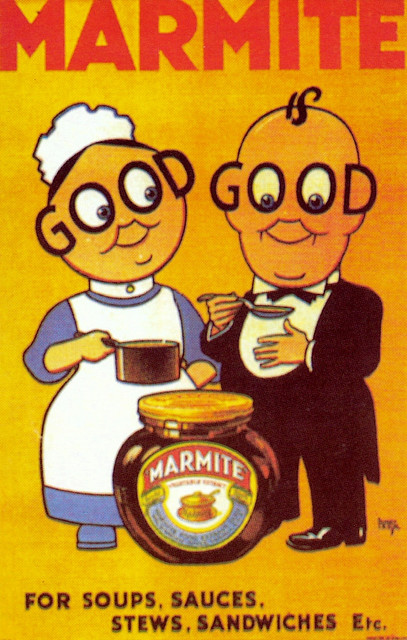
Marmite flavor crisps were also sampled, but they were as nothing compared to Marmite oven baked cashew nuts.  The pack said they were “just for Marmite nutters,” which seemed needlessly apologetic, and isn’t “oven baked” a tautology?   What else can you bake in?


Frankly, it sounded like something you might eat for a bet.  It seemed likely that the Marmite would ruin the taste of the cashews, but you know what, it didn’t.  The Marmite flavor was, well you could hardly say subtle, but more restrained that you might imagine, and cleverly balanced so that it was somehow equal and opposite to the taste of the nuts, so that both flavors came through.  The end result was, of course, very savory and salty, and bad for you in several ways I’m sure, but who doesn’t love that?  I was surprised and pleased by Marmite oven baked cashew nuts: a triumph for the jaded British palate.


I wasn’t in England long, and had other things to do besides explore the wilder shores of British snackery (and let’s be honest, a little goes a long way) but since I was on a pork safari, it only made sense to sample some pork scratchings, or as the packaging has it, pork rinds, or perhaps even pork crackles. 


The manufacturers of Mr Porky obviously feel the need for euphemism: anything to avoid using that indelicate word “skin.” There are at least four versions of Mr Porky but we only tried two: “best ever” and “prime cut.”  The prime cut tasted better and porkier, and maybe that was because they had the extra big pieces, or maybe they just used extra salt. The best thing about them was the warning on the packet: “only recommended for people with strong healthy teeth.”


They were OK, but frankly no pre-packaged pork scratching can compare with the “pork scraps” of my childhood (I’ll try not to get too Proustian here), sold in the pork shops of Sheffield and bought hot and in bulk, and yes, perfectly likely to crack your teeth.  They were also cheap as chips.  My fellow Mr. Porky eaters and I did wonder why these modern versions were so damn expensive: about 70 pence for 35 grammes in the case of the “best ever.”  There are a great, great many pigs slaughtered in the world every day, with a considerable quantity of skin on each pig, so why is skin such an expensive commodity?  And given also that so much of the pork you buy in supermarkets these days comes with the skin taken off so it can be sold as “lower fat,” here ought to be an Everest of pig skin just lying idle waiting for the scratching enthusiast to himself.  But there isn’t.  So where does all that skin go?

One answer is into gelatine, which of late has been much on my mind, chiefly because while I was in London I met up with Bompas and Parr, England’s finest and possibly only “Jellymongers.”  More of that in the next post.


Friday, November 5, 2010

ESSEX PIGS


When I told my friend and British publisher Jeremy Beale (who lives in more or less rural Essex) about my pig experiences in America, he said he knew a couple of people in adjacent parishes who kept pigs, and it would be easy enough to arrange a tour next time I was in England. It sounded like a good idea, though I had to ask whether I’d be visiting some Empress of Blandings style idyll or a factory farm of death.

Jeremy said they’d be neither factory farms of death nor back to the land rare breed fetishists (his term) but fairly middle of the road, responsibly housed pig units where, other than when farrowing, pigs had a bit of space to move around in. He reckoned a visit would give me a pretty good idea of a well managed English pig unit.  When I was in England I took him up on it.


Our first host and tour guide was Tom Pitt from the village of Good Easter. He, along with his sons, keep pigs in three locations around the area, in slightly old fashioned but perfectly respectable facilities, mostly barns of one sort and another. The Pitts are essentially in the business of producing sows.  They first get their sows, Landraces, from a company called Rattlerow Farms, whose website while insisting that they’re family owned, also says they “employ a team of world class geneticists to run and monitor the breeding programs and guide research projects.”  Why did that make me think of Dr Moreau?


Anyway, the Landrace sows arrive and are artificially inseminated with Duroc semen (Durocs are big brown, solid Canadian beasts), they get pregnant, deliver a litter and the resulting Landroc sows (called gilts if you want to be precise) are kept for a while then shipped back to Rattlerow for further breeding. But, of course, nature produces males and females in more or less equal numbers so all the males born on the farm, plus a few imperfect females, become bacon pigs, but Tom and his sons are only in bacon production by default.


I understood Tom to say we’d be looking at about 2000 pigs but it seemed far more than that to me.  Tom reckoned there was no great mystery to keeping pigs but you did have to be scrupulous about mucking them out.  A couple of hours, three days a week with a power hose was what was needed to keep things clean and sanitary.  And certainly his pigs looked clean enough and were as free from smell as any farmyard animals are likely to be.

Tom obviously cared about his pigs, constantly touching them in a friendly reassuring manner, though he kept his fingers well out of the way of their mouths, and he kept an eye out for the ones who were being bullied and not managing to get enough food.  Of course this wasn’t simple altruism: sickly, undersized pigs were a financial liability. Even so his concern seemed genuine.  The pigs in their turn, and maybe I’m projecting here, seemed very reassured by his presence.  They certainly came running across the pens to see him.  In my own case they immediately ran away when they saw me, but then their curiosity got the better of them and they came running back.


As a matter of fact, a mature, pregnant sow is quite the force of nature, and when we went into the sow barn (seen in the picture below) the prospect of being trampled under trotter seemed quite likely. Tom did indeed get knocked over by one of his sows, but I think it was because she was so pleased to see him.

These pigs were neither free range nor organic. The story is that in an Essex winter the clay soil which freezes very hard, and free range pigs damage their feet as they dig around.  These pigs lived largely on concrete and straw and since most of their feed came from local farmers that don’t produce organic crops, inevitably their pig feed wasn’t organic either.  Even so, Tom reckoned his pigs had a pretty good life and it was hard to disagree.  He told us he’d had requests to supply suckling pigs to a local butcher, but he wouldn’t do it.  He wanted his pigs to have some life before they were slaughtered.


Of course it’s all too easy to read character into the faces of dumb animals but I was struck by the extent to which there was great variation in the pigs’ faces, and some looked far more alert, intelligent and endearing than others. The appeal of keeping a pig in the back yard certainly reasserted itself.

Later that afternoon, after Tom had completed his tour, we walked round the local area and went to view a mature Gloucester Old Spot being kept as a pet at a place called Yew Tree Farm.  This pig was undoubtedly free range, he had a ton of room, living in a veritable porcine Xanada.  I also wondered if a lone pig might be rather lonely, since pigs do seem to be social creatures and great snugglers, but apparently there was another companion pig lurking out of sight in the barn. 


Then we went to see another half a dozen Old Spots being kept quite literally in the garden of a house belonging to couple called Nicky and Andy.  As you see, there wasn’t much garden left by the time the pigs had made themselves at home.  If pigs ruled the earth, the whole place would be a quagmire.

Like Tom, Nicky and Andy also made pig-keeping sound a pretty straightforward activity, though they admitted for them it was less a business than a hobby, but as hobbies go it definitely beats stamp collecting.  They hadn’t been raising pigs long and so far had barely made a profit, but the demands for their pigs was high: all the ones we were looking at had been presold.  You paid 300 quid, staked your claim, then waited while the pig grew up, and in due course it came to you slaughtered, butchered, cut into portions and plastic-wrapped.  The biggest problem they said was loading the pigs onto the trailer before you took them to the slaughterhouse.  Maybe they didn’t want to go.


We had roast pork for dinner that evening, though obviously it wasn’t from any of the pigs we’d seen (I was going to use the word “met”) that day.  The link between the pig on the farm and the pork on the plate doesn’t strike me as a particularly problematic one, though of course the actual process of slaughtering remains unseen and mysterious, and we’d much prefer it that way. Needless to say, I don’t do my own slaughtering, and I don’t want to, but you know, I don’t do my own plumbing or oil changes either.  Of course we don’t want to make pets of the animals we eat, that are killed in our name, but it’s not bad to be able to look your pig in the eye and be assured that if his death is inevitable, and for your benefit, his life was pretty good, at least up to the moment he got loaded onto the trailer.


Tuesday, November 2, 2010

THE BIG SPLEEN


I’ve been away on a small jaunt that took me to New York, London and High Easter, which is a village in rural Essex, outside Chelmsford.  It wasn’t a foodie tour per se, but of course a man’s got to eat, and eat I did.

In New York, naturally enough, I found myself questioning that name “the big apple.”  I kept looking at maps of Manhattan and thinking it looked more like “the big buffet,” with Central Park as a salad bar right in the middle.  Or perhaps it was “the big open sandwich” such as this one below that I had at Au Pain Quotidian in SoHo. 


Actually it called itself a “tartine” with “Rustic tuna, hummus & white Bean with tomatoes and basil pesto.”  I’m glad the tuna was rustic: best to stay away from that urban tuna.  It was served on a strange chopping board type thing instead of a plate, the bread was soft and the tuna and beans, of course kept falling off the bread and then off the chopping board thing, but I reckoned I could turn this into a metaphor for the way that so many people come to Manhattan and then fall off the edge and end up in Brooklyn or Hoboken or Jersey City.  Maybe this was trying too hard.

Then I thought that perhaps Manhattan should be called “the big tongue,” though that was partly because the most interesting thing I had to eat in New York was a grilled tongue sandwich, at Breslin which is the bar and restaurant attached to the newly hip and fabulous Ace Hotel at Broadway and 39th.


As you see, the tongue came with a bowl of borscht, which was good, but what really made it great was a creamy dressing, which I think was horseradish in sour cream,, though the menu description didn’t specify.

The “chef-partner” April Bloomfield was quoted in New York magazine as saying the restaurant takes philosophical inspiration from Fergus Henderson, of London’s St. John, though these days what restaurant doesn’t?  Fairly safe to say however, that Henderson would never serve a three cheese grilled sandwich (good though it was), nor boiled peanuts fried in pork fat (which sounds a good idea but were in fact pretty horrible).

I was able to do some comparing and contrasting a few days later when I got to London and hurried to St John.  It’s my favorite restaurant.  There’s a clean austerity to the place which I find beguiling; white walls, white table clothes, plain white crockery.  And in contrast to this the food is rich, dark, decadent, ancient.

For starters my “companion” and I shared dishes of rabbit offal with chard, and rolled pig spleen with bacon and cornichons.  I can absolutely say it was the best pig spleen I’ve ever eaten.  That's it below.


Then for the main course we had “roast Middlewhite and braised red cabbage,” which was very good but I think it was the whitest pork I’ve ever eaten.  The crackling was spot on, which I think is quite a test for a restaurant. 


The Middle White (as it's more usually spelled) is an interesting critter; a 19th century Yorkshire breed, half way in size between a Large White and a Small White, the latter now being extinct, which seems a damn shame.  As regular readers will know, pigs have been much on my mind lately, and as you’ll see in the next post, when I got to Essex, I went hog wild.

Saturday, October 16, 2010

MEAT PUPPETRY


Hard not to love Bruce Willis appearing on the Letterman show wearing a meat toupee.  The fact that it was meant to be an homage to Lady Gaga made it even better, and it would have been better still if Bruce could actually have remembered her name.  And I really don’t get why people thought it was “so gross” when Letterman ate some of it, though Letterman apparently felt the same way.  Have these people never heard of steak tartar?


I like to think the meat hair might also have been an homage to the Kevin Bacon sculpture that’s been doing the rounds, a head of Kevin Bacon made out of bacon, created  by Mike Lahue, commissioned by some organisation called J&D Foods.

The problem here is that the head doesn’t look much like Kevin and it doesn’t look much like bacon.   To me it looks more like Conan O’Brien made out of ground beef, though that in itself opens up all sorts of possibilities.  Why not a bust of Conan made of potatoes O’Brien?


A bust of Meatloaf made of meatloaf?


Or perhaps a figure of Jello Biafra made of Jello.


And finally how about an effigy of  Vanilla Ice made out of dog poop?  Sorry Vanilla, we love you really, but the easy jokes are always the hardest to resist.  Wide open indeed.

Thursday, October 14, 2010

AS I LAY DRINKING


Dwight Garner of the New York Times has posted the following archive news clipping about William Faulkner.


I think it rather confirms what we know about many serious drinkers, they don’t much care what they put in their mouth so long as it’s alcoholic.  Croquettes made from canned salmon were one of Faulkner’s favorite foods, apparently.

In fact Faulkner didn’t even wanted to go to Stockholm to receive the Nobel Prize itself, but under pressure from his own family and the US State Department, he did eventually accept the invitation.

Thanks to the amazingly detailed records of the Nobel Prize folk we’re actually able to know what Faulkner had, or at least was served, for dinner that night.  The menu was as follows;

Potage aux champignons


Filet de bœuf béarnaise

Fonds d´artichauts princesse


Glace Nobel
 Friandises

And I think you could certainly argue that Stockholm is a very long way to go for mushroom soup, at least the wines were good, Kressman Monopole Rouge
, and Champagne Perrier-Jouët & Cie.  Faulkner would have had no objections to those surely.

Things have apparently got a bit more interesting, and more localivore over the years.  The menu for Barak Obama’s Peace Prize dinner included cured reindeer fillet, elk marinated in juniper berry and thyme, and aquavit sorbet.  I’d go a reasonable way for any of those things.

Incidentally, it's almost impossible to find a photograph of Faulkner with a drink in his hand; almost impossible to find one without a cigarette.  Obama evidently has no such inhibitions.


Ultimately of course we know that Faulkner preferred something harder than wine: maybe Scotch, corn liquor, or moonshine.  He’s also the man who said, rather opaquely it seems to me, “There is no such thing as bad whiskey. Some whiskeys just happen to be better than others. But a man shouldn't fool with booze until he's fifty; then he's a damn fool if he doesn't.”

Come on Bill, if you have to wait till you’re 50 it’s way too late to start foolin.

Below is a picture of Faulkner at table.  His plate looks ominously empty.


Thursday, October 7, 2010

DID YOU BURN THE BOOK OF BEER?


Still briefly with The Cook’s Oracle, in it William Kitchiner is a bit sniffy about sandwiches. “Properly prepared,” he writes, they’re “an elegant and convenient luncheon or supper, but have got out of fashion, from the bad manner in which they are commonly made: to cut the bread neatly with a sharp knife seems to be considered the only essential, and the lining is composed of any offal odds and ends, that cannot be sent to table in any other form.

“Whatever is used must be carefully trimmed from every bit of skin, gristle, &c. and nothing introduced but what you are absolutely certain will be acceptable to the mouth.”  That sounds like pretty reasonable advice: nobody wants a gristly sandwich. He then suggests various “materials” you might like to use for making good sandwiches.  The include potted or grated tongue, anchovy, German sausage, “hard eggs, pounded with a little butter and cheese,” and “various forcemeats.”


Well, I guess sandwiches are no longer entirely out of fashion since the first round of the Food Channel’s “Next Iron Chef” had contestants making a sandwich that expressed their personalities, that was “You between bread.”  Is it just me, or does that sound dirty?  The winner came from Duskie Estes, of Zazu restaurant in Santa Rosa, who made a lamb meatball sandwich with cherries two ways, in the meatballs and on the side, pickled. 


 One of the losers, why bother to name the poor chef, was a tempura oyster sandwich on cornbread with pickled radishes and yellow tomato soup.  Yikes.  That’s really not someone I’d want to meet between bread.  But the basic idea that a great chef ought to be able to make a great sandwich is a good one.  If a restaurant can’t serve a decent steak, they’re definitely not going to be able to make a good beef Wellington.

Now, more or less by chance, I happened to be re-reading Richard Brautigan’s collection of short prose pieces The Tokyo Montana Express.  I used to really like Brautigan, and this book especially, but I did wonder if he was a youthful enthusiasm and I might have gone off him over the years.  That’s him below, holding a birthday cake or possibly a lump of enriched plutonium.


It turns out I still enjoy Brautigan, although naturally enough I barely remembered most of the pieces.  One that did ring a bell was titled “The Menu/1965.”  It’s presented as a piece of non-fiction reportage, about what the prisoners eat on Death Row at San Quentin.  It’s not about the old chestnut of what they have for their final meals but rather what they have day in, day out.  Brautigan visits the prison, gets a menu to take home with him, and reproduces it in the book.  That’s it below but you’ll probably need to click on it to enlarge it and make it readable.


It certainly does look like a lot of high calorie food.  Brautigan shows the menu to his friends and gets their reaction.  One, very smartly, describes it as “Pop Art that hurts” and then he shows it to some “gentle poets,” one of whom gets angry and says they shouldn’t give all that food to criminals, they should give it to poets.  He gets particularly riled that the bacon is described as crisp.

Brautigan’s pals seem to think the Death Row inmates got to have all the food listed, but I don’t think that’s true.  I think the document was a menu just like any other, so that they didn’t get Hungarian goulash, lamb cutlets and tamale loaf all at the same time: they just chose one of them.

But what really interested me were the supper menus: every night a different sandwich: cheese, pimento loaf, olive loaf.  I don’t believe I’ve ever had pimento or olive loaf, though I do come from a foreign country.  And of course you have to wonder if that coffee before bed stopped the prisoners getting a good night’s sleep.


Next, rather less by chance, I aquired a copy of Frederic Girnau’s “Sandwich Book of All Nations,” that's it above.  Will it surprise you that I collect curious old cookery books? Often it’s the lurid illustrations I really enjoy but Mr. Giranua’s book doesn’t show any pictures of food, though it does have illustrations of people in the traditional dress of various, though by no means “all,” nations. 

The book was published in 1945, by Frederic H. Girnau Creations, and of course there’s nothing quite like outdated ideas of cosmopolitanism, and of course it being 1945, there are no recipes for German sandwiches, though a couple are designated Bavarian.  Then we have the horseradish sandwich from Holland, and the mutton and pea sandwich from Syria.  There are cucumber sandwiches from Spain, Mexico, England and Greece, egg sandwiches from France, Scotland, Russia and Ceylon. The pineapple sandwich is “Arabian” and the date and orange sandwich comes from Africa.  Not least there’s the tomato jelly sandwich, which comes from Wisconsin.


Above is a typical page of the book, quite a nice layout, though I’m not sure if that’s an Icelander or a Pole at the top.  The sharp eyed reader will also notice along the bottom of the page, and in fact along the bottom of every page, are the words “Serve BEER as a beverage.”  Got to love those capitals.

Now, it also so happens that there’s another piece by Richard Brautigan in The Tokyo Montana Express, and this one’s titled “Beer Story.”  It contains these two sentences, “Beer was an open book to him.  He knew every page of beer by heart.”  Sounds like a book well worth reading.


Friday, October 1, 2010

PSYCHO COMES ALIVE


If you were dismayed by the death of Gourmet magazine, you may be cheered by the arrival of Gourmet Live, which is a website, and also now an Apple app, so that on your iPad it'll look pretty much like this, with an image of your Psycho-Gourmet at the bottom left, just a little below and to the side of Julianne Moore, not the worst place to be like this:


There's a link to the Gourmet Live site, RIGHT HERE. 


Thursday, September 30, 2010

WOWIE MAUI

Still pursuing the global potato chip phenomenon, I found these at my local supermarket: Hawaiian Kettle Style, sweet Maui onion flavor.


Now I guess I never thought they’d be absolutely authentic, not least because they were manufactured by Tim’s Cascade Snacks of Algona, Washington.  Still, I tried them gamely enough, but I thought they were just terrible.  I couldn’t taste any onion at all, whether from Maui or anywhere else.  All I could taste was a kind of cloying sweetness.

A look at the list of ingredients on the pack explained why.  Of the top six ingredients, number three was dextrose, number six was sugar.  Onion powder was number four, though there was no mention of whether it was Maui onion powder.

There’s also salt and garlic and cheese and spices in there too, and maybe that adds up to umami, but I couldn’t taste any of them, just he cloying sweetness. Of course I believe in chacun a son gout, and I’m sure some people like their potato chips this sweet but I had to drench them in vinegar to make them palatable, which seemed to defeat the object of having flavoring in the first place.

Just to show that I do have my finger on the pulse (or somewhere), last Sunday’s New York Times magazine had a “Recipe Redux” for Saratoga Potatoes, 1905, by which they mean potato chips.  That name refers to the story, probably more of an urban myth, that potato chips were invented in Saratoga Springs, New York in 1853 by one George Crum who was chef at the Moon Lake Lodge, a man part Native-American, part African-American, though in 1853 that can hardly have been how he thought of himself. 


According to legend, a customer in the restaurant kept complaining that the French fries were too thick and soggy, so, in an effort to annoy the customer even more, Crum cut them as thin as possible, so they’d be hard and crisp.  As is the way with these things, of course the customer loved them, and then many other customers loved them too, and Saratoga Chips started appearing on the restaurant menu.  The rest is history.

I’m not saying Crum didn’t serve up some very thin, crisp, fried potatoes in hopes of annoying his customer, but I can’t believe he invented them.  I think they’re one of those things that didn’t need inventing.  Once the potato was introduced to European cooks you know that somebody somewhere, probably many people in many places, would experiment with every size, shape and cooking method.  I mean, who “invented” mashed potatoes?


Some people claim that William Kitchener (above) is the godfather of the potato chip, because of a recipe that appears in his book, The Cook’s Oracle, first published in 1817.  The recipe is for “Potatoes fried in Slices or Shavings” which sounds about right, but he recommends the slices be a quarter inch thick, and his “shavings” are “cut round and round, as you would peel a lemon.”  The resulting artifact would be pretty good, I think, but I’m not sure you could really call it a chip.

This is a shame in some ways, because Kitchiner is one of history’s greatest great food eccentrics, and it would be nice if the world at large attached some important innovation to him.  The one that actually applies, that he was the first food writer to give quantities in his recipes is so universal as to have become invisible.  And in fact he seems generally to have been more of a collector of recipes than an inventor, so potato shavings were in any case invented by someone else.

Kitchiner was a repository for all kinds of culinary lore, though there are times when he wasn’t very discriminating.  He tells us, or at least quotes without question, that the Chinese eat dog, Tartars eat horse, and Greenlanders eat “garbage and train oil.”

He also gives us, as grotesque as it is improbable, a recipe for “how to roast and eat a goose alive.”  Essentially it involves plucking a live goose and having it flap around in a circle of flame for a while, so that it cooks but doesn’t expire.  This sounds like nonsense doesn’t it?  Roasting a goose in a hot oven can take a few hours, having it flap around in open flame would never work.  Either the goose would live or the goose would roast, but I don’t see how it could do both.


Kitchiner gets his recipe from Johann Jacob Wecker’s “Eighteen Books of the Secrets of Art and Nature” first published in English in 1661, who attributes it to “Mizald.”  I think this is Antonius Mizaldus, a 16th century Parisian physician and botanist, who was also of the opinion that if sweet basil leaves were placed on a pile of dung to, it would become a nest of scorpions or asps.  So, not a man to be trusted, but Kitchiner doesn’t doubt him.  He just calls the method “diabolically cruel.”  Well yes.

 Incidentally, in that NYT article – it’s by Amanda Hesser – she writes of potato chips “they’re reached that late-mannerist ‘seasoning’ stage, which has produced such atrocities as sour-cream-and-onion flavored chips.”  I just can’t see the problem myself.  It could be much worse.  It could be live-roasted goose flavor.


And finally, just to explain the title of this post, The Cook's Oracle contains a recipe for Wow-Wow sauce, made from port, vinegar, pickled cucumbers or pick;ed walnut, mustard and mushroom ketchup.  Any one of those would make a fine late-mannerist seasoning, if you ask me.