Showing posts with label David Niven. Show all posts

Friday, September 22, 2023

THE MIXING MACHINE

 If you go to see Wes Anderson’s Asteroid City (and why the wouldn’t you?), you’ll  notice the presence of the Martini dispensing machine.


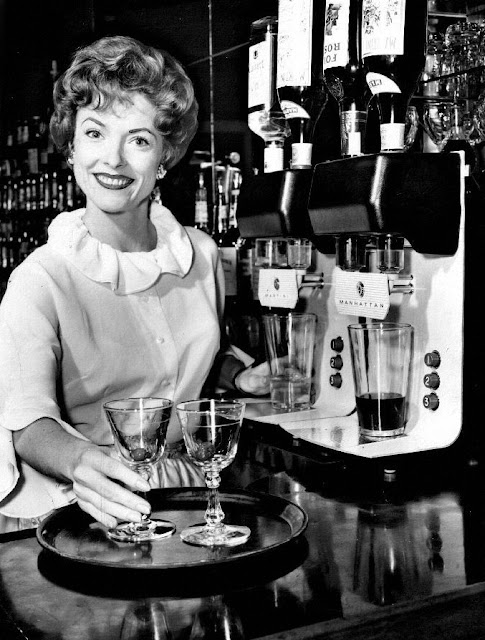
It’s a not a terrible idea and it’s certainly not a new one, and here of course it's fictional, but in the real world there have been all kinds of cocktail making machines and robotic bartenders, to serve different purposes, the Drinkomatic was obviously for small scale domestic use, 


while the “Cocktailmatic” introduced by Auto-Bar Systems in the early sixties was for large-scale commercial ventures, “where dispensing of drinks in a hurry is a problem” 


And so we come to George Jean Nathan – 1882 -1958 - drama critic and editor of The Smart Set and The American Mercury, the man who apparently said, ‘ I drink to make other people interesting.’ 


There is a story, apocryphal I imagine, that Nathan had a system or device or some Rube Goldberg-style contraption in his home that sprang to life when he put his key in the front door of his apartment building, so that by the time he got into his own apartment a martini had been mechanically and magically prepared.  If this is true I haven’t been able to find any visual evidence of such a machine.


But leaving aside whether the story’s true, I can’t help thinking that the real problem is that although making a martini certainly involves mechanical processes it also somehow requires some human intervention and intervention to make it live (though this obviously does not apply to, for instance, the Pina Colada).


It would obviously be ideal to have a loved one waiting at the door with a martini when you got home, possible a butler, 


or just conceivably Vincent Price.


Wednesday, October 23, 2019

IT MIGHT HAVE BEEN IN COUNTY DOWN, BUT IT WASN'T


I’ve been reading Around the World in 80 Days – I had my reasons.  Somebody I know is supposedly organizing an exhibition of vintage photographs of all the places the fictional Phileas Fogg travelled through.


Now, it’s well known that Verne translations are a messy business, and that early English translators took terrible liberties with his novels.  The version I read was the current Collinsclassics paperback edition, which doesn’t even name a translator.  So some of the oddities may not be Verne’s, even so it’s a rum old novel.


The stuff about food is especially strange.  Early in the novel Fogg employs Passepartout to be his servant.  Fogg of course is very English, Passepartout is very French and may not be familiar with every aspect of English society in the late 19thcentury.  Even so when he goes to his room and finds a timetable of how Fogg spends his days, I’ll bet he was surprised to learn that his boss leaves his home in Saville Row at 11.30 in order to have his breakfast at the Reform Club.  


It gets odder, ‘His breakfast consisted of a side-dish, a boiled fish with Reading sauce of first quality, a scarlet slice of roast beef garnished with mushrooms, a rhubarb and gooseberry tart, and a bit of Chester cheese, the whole washed down with a few cups of that excellent tea, specially gathered for the stores of the Reform Club.’


Now there is, or was, a Reading sauce, and maybe Verne and his translator knew that.  But I can’t imagine that any English translator was so wayward as to think this was a reasonable breakfast, or that there’s any such thing as Chester cheese.  I stand to be corrected.

Things get livelier when Fogg arrives in India and has dinner in the Bombay Railway station where the landlord serves him ‘giblet of “native rabbit.”’

‘Sir,’ he (Fogg) said, looking at him steadily, ‘is that rabbit?’
‘Yes my lord,’ replied the rogue boldly, ‘the rabbit of the jungles.’
‘And that rabbit did not mew when it was killed?’
‘Mew! oh my lord! a rabbit! I swear to you - ’
‘Landlord,’ replied Fogg coolly, ‘don’t swear, and recollect this: in former times, in India, cats were considered sacred animals.  That was a good time.’
‘For the cats, my lord?’
‘And perhaps also for the travellers.’

Things pick up only slightly when they arrive in America at the International Hotel in Sacramento where there’s a kind of buffet.  ‘Dried beef, oyster soup, biscuit, (Singular?) and cheese were dealt out without the customer paying.  He paid only for his drink – ale, porter or sherry, if he fancied refreshment.’  Sounds a reasonable deal, though didn’t Brecht say something about cheap hunger and expensive thirst?


The 1956 David Niven film did bear some relation to the novel, the 2004 Jackie Chan film (which I think of as the Steve Coogan film) of the same name, bore none whatsoever.  


Interesting fact: there is no ballooning in the novel, at least not in the version I read.