Wednesday, September 28, 2011

ROLL WITH IT


The biggest problem with eating in New York is that there are so many restaurants, both high and low, and so little time.  And certainly when you hit on a bad one you feel doubly resentful; not only are you eating terrible food, but there are thousands of restaurants serving better.


Knowing that I didn’t have world enough or time, and since a great many restaurants have a little stash of takeout menus hanging outside, I found myself starting a collection.  I realize that in some ways this is an absurd thing to do, like the two soldiers in Jean Luc Godard’s Les Carabiniers who go off to war expecting to bring back a fortune in looted treasures, but in fact return with a collection of postcards.  Still, absurd or not, I picked up dozens of these menus and they are now part of the Nicholson Gustatory Archive.

Some of the menus are rough and ready, done cheaply and inelegantly, but some take a real pride in their design and, I think, compete with each other both for form and content.  I guess the idea is that if a restaurant puts a lot of effort into its printed menu then it’ll put a lot of effort into its food, though admittedly there may be a flaw in this logic.


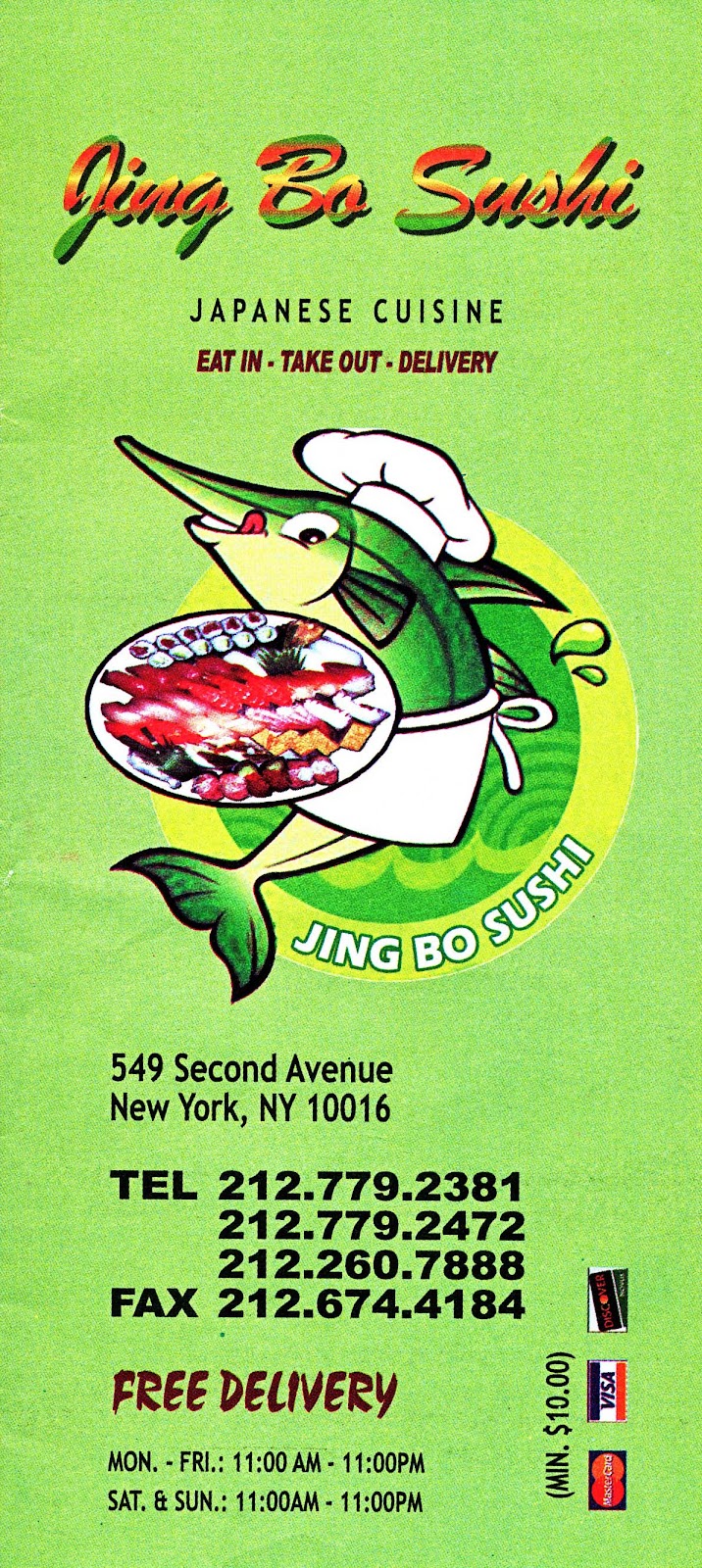
Here is very small sample of restaurants offering sushi on 2nd and 3rd Avenues.  My favorite, design wise, is definitely Jing Bo Sushi (above).  Nothing says good Japanese food like a fish wearing a toque. And I rather like the bubbles on Aquamarine (below).


But in fact it’s the contents that really draw me.  What all these restaurants have in common is a section on their menus offering special sushi rolls.  This is where invention can run wild. The Jing Bo is probably the most modest, but even they feature the Dynamite Roll and the White Christmas Roll. 


Iron Sushi (above) ups the ante a little with the Mexican Roll and the Beat Box (Hako Sushi).  Aquamarine starts to get a little wild with the Galapagos  Roll (no, it doesn’t contain turtle), the Sea Dragon Roll (ditto, no dragon), and the Fantasy Roll.  But for sheer inventiveness it’s hard to beat Aji Sushi.


The Aji serves rolls named the Kiss of Fire, the Mango Submarine, the Better Future Roll, the Greenly Green Roll, and It’s a Shocker Roll.  Whether any of these rolls are actually as exciting as the names, is hard to tell, though now that I’m home I’m kicking myself that I didn’t go into Aji and order the Sex on the Beach Roll: “shrimp tempura, spicy tuna inside top of white tune, avocado and caviar.”

Ah well, there’s always next time.  The chances are I’ll probably be in New York sometime in the next twelve months, although as we know, a year can be a very long time in the life of a restaurant.

Tuesday, September 27, 2011

WATER DISPERSION


So we went to New York and, among other things, we ate at WD-50, home of Wylie  Dufresne’s brand of molecular gastronomy, though he prefers not to call it that. The restaurant is in a part of the Lower East Side where not so long ago no sane person would dare set foot.  Now it’s a desirable area and there were a bunch of bars and restaurants near to WD-50 that looked very inviting.


WD-50 itself was austere but very welcoming, especially the staff, and our waiter was very keen to know if we were allergic to anything: the first time I’ve ever been asked that in a restaurant.  It was tempting to say, “Only to deconstruction,” but I resisted.

It seemed that everyone around us was having the tasting menu.  Call me a fool, but I never enjoy tasting menus.  They seem to contain the components of a meal without being an actual meal, as if you went to see a band play and instead of performing actual whole songs, they just played tiny, one minute snatches of their greatest hits. Ok, no doubt some bands do precisely that.

So the Loved One and I each had a starter and a main course (not being huge fans of dessert) and we were glad we did, because looking around at the other tables, it seemed as though the menu-tasters were being served small smears of something or other on tiny plates.


For starters we had aerated foie with plum jam and sliver of pickled beet, and  peekytoe crab in a hotdog bun.  Then there was duck breast with black sesame dumplings, and Iberico pork with spaetzle.  In each case there were plenty of other ingredients too.  I didn’t take pictures of the food because I didn’t want to appear like a rube, or worse still like a blogger, but the Internet shows that others have had no such inhibition. 


It was absolutely great.  I don’t know if this is a measure of whether we chose badly or well, but our meal lacked most of the knee-jerk molecular bells and whistles, and was decidedly light on the liquid nitrogen and the spherification.  But the one thing that absolutely stood out - and it was a small thing in its way - the peekytoe crab came with “salt and vinegar chips,” miniature potato chips the size of a cornflake and so rich and subtle in flavor and texture that you wanted to eat a pound of them.  I couldn’t help thinking that there are chefs in the world who could base entire careers on those things.


Actually, one of the most impressive things abut WD-50 was that you could peer into the open kitchen and there, quite visible was Wylie Dufresne, working steadily and unobtrusively.  It’s always good to know that the big name chef is actually in the kitchen, and not off doing some reality TV show.  And best of all, he didn’t come out and work the room for applause, the way certain celebrity chefs insist on doing.  


But if you want evidence of just how far and wide this whole molecular business has gone, on our last night, wandering happily and without great expectations around the Flatiron District, we happened to find an appealing looking restaurant called Gravy.  We knew nothing about it but I now know that it describes itself as the “first New Southern restaurant in New York City.”  And here, as well as the grits and the gumbo there were some decidedly molecular touches.  The crab bisque came with a fennel foam, the Long Island duck came with an egg cooked sous vide.  


Both foam and egg (and indeed the bisque and the duck) were perfectly good but you couldn’t help thinking they were the modernist equivalents of the carved raddish and the tomato rose: fancy little touches that didn’t have much to do with the real business of the food.  None of this, I hastily add, applies to the cooking of Wylie Dufresne.  When he cooks, he seems to really mean it.

Tuesday, September 13, 2011

THE SOLANUM AND I

It seems that I’ve been eating experimental potatoes.  I was at the Hollywood Farmer’s Market last week (the market was in Hollywood, the farms were not) and bought some interesting-looking spuds, patterned with purple and gold swirls. They looked like this:


I was told they were called Lakers’ Bakers, i.e. the colors resembled the uniform of the Lakers basketball team, so that’s probably a name that’s unlikely to fly in the rest of the country. 


They’re grown by Weiser’s Family Farms, and apparently they’re the invention of an (as yet) unnamed potato breeder, “an experimental numbered selection.”  It seems Weiser’s are a little uneasy about the legal implications of using the Lakers name.  They were once calleded Zebra potatoes, which sounds confusing to me: wouldn’t you expect them to be black and white?  And sometimes they’re now referred to as Pinto potatoes – which still seems to beg a lot of questions.  What’s being invoked now?   The bean, the horse, the car?


I understand there are about 5000 varieties of potato in the world, of which I can probably name 10, and my local supermarket sells about 3. Did someone say
“dwindling biodiversity”?  Even the Yukon gold, which sounds like an ancient enough name, has only been around for about 30 years.


Having got home with my Lakers’ Bakers (or whatever the heck they’re called) I didn’t feel much in the mood for baked potatoes so I decided to roast them.  The beauty, as you see above, is only skin deep.


And the yellow and purple effect disappears completely as they cook, but then a rather wonderful thing happened to the skin during roasting, it became crisp and brittle, like a very well cooked piece of chicken skin.  It probably did no harm that I was cooking them in goose fat.


We did make a slightly half-hearted attempt this year to grow some Cranberry Red spuds. Having a garden that deer regularly amble through means that planting anything edible in the ground is pretty much doomed, so we grew them in a tub on the deck.  Things seemed to go pretty well – the seed potatoes sprouted, they grew, nice flowers appeared, (Marie Antoinette used to wear them in her hair), then they shriveled, which I understand is OK, but then we were left with a few tiny, tasteless spuds, about the size of Brussels sprouts.  Not exactly nature’s bounty.  Probably best to leave it to the experimenters.


Monday, September 12, 2011

MENU MADNESS


Last week I went to the launch party for Jim Heiman’s book “Menu Design In America, 1850-1985,” a title that speaks for itself.    It was held in the Taschen bookstore in Beverly Hills.


 The party coincided with Jim’s wedding anniversary, 38 years married to the divine Roleen, and the mood was suitably celebratory.  Some of the food was provided by the Beverly Hills Cheese Store, and knowing how much they charge for their cheese it seemed there must have been a grand’s worth of the stuff. 


Pizza was provided by Wolfgang Puck, and the man himself put in an appearance, somehow looking even more like himself in person that in photographs, if that makes sense.  (These photographs here are from the Taschen website).  Not for the first time, I wondered how Mr. Puck have got on in his career if he’d been called Fritz or Johan.   Nobody forgets a Wolfgang.


A while back, I interviewed Jim about the book for Gourmet Live – and that interview will be appearing in due course, though I think not any time soon.


One of the things that didn’t make it into that piece was a discussion about nudity on menus.  Jim said that when he started collecting menus he was amazed by just how raunchy certain designs were.  


His explanation was that in the late 19th and early 20th twentieth centuries restaurants were largely male preserves.  Women, at least decent women, weren’t to be found in restaurants so menus could be as explicit as they liked.  There were “ladies” to be “offended.”

Even so it comes as a surprise to find the menu below showing a semi-naked woman, a giantess I suppose, with multicolored liquid (some kind of cocktail?) pouring from her breasts and a group of tiny men below catching it in glasses. 


I don’t know exactly what went on in the French Casino in Chicago, but something tells me it can’t have been nearly as much fun as the menu suggests.  

Thursday, September 1, 2011

MINNESOTA FATS (AND SPUDS)

I’m sure we did it all wrong in Minneapolis.  We should have gone across the river to Saint Paul, to the International Marketplace, a “Hmong barbecue paradise” according to Dara Moskowitz Grumdahl, writing in the Minnesota Monthly.  There we might have had chicken wings stuffed with noodles, papaya salad with fish sauce, larb, black rice, mustard flowers, lemongrass sausages, and so on.  But we didn’t.


And we might certainly have gone to some well-thought-of, high-end places like Lucia's, Piccolo, Heartland, or La Belle Vie.  Heartland features bison ribeye, and Piccolo offers scrambled brown eggs with pickled pig’s feet.  We were sorry to miss them, but we did, because of a combination of sloth and distraction.


We did at least manage to eat walleye, which is the celebrated local freshwater fish, and when breaded and fried in butter it was very good indeed, but then, when fried in butter, what isn’t?  


And we did have some excellent tapas at a Spanish restaurant named Solera: a mass of small plates that included their own dry cured duck breast, “beluga” lentils, rabbit with red beans and chorizo, grilled octopus with poached fingerling potatoes.  We were certainly sorry we’d be gone by the time of Solara’s “wine and swine” night a few days later.  The waiter, who obviously appreciated our appreciation, offered us a 25% discount, and that was a great offer, but it really was a long way to go back from Los Angeles.


However, our foodie adventures took a very specific turn because we were in town at the same time as the Minnesota State Fair.  I’ve been to American county fairs, but this was my first State Fair with all the higher status and expectations that implies. If you want to see many, many pigs, geese, rabbits, chickens, cows, all raised by local kids: this is the place.  If you want all the milk you can drink for just a dollar: ditto.  If you want to see “the miracle of life” – that’s pigs, cows and sheep giving birth in a hot sweaty barn while people sit on bleachers, gawking and cheering them on – then it’s the place for that too.  I really didn’t want to see this at all, but many others obviously did.


In the food line there was a lot of the usual deep fried this and deep fried that, various things on a stick – cheese, hotdogs, pork chops – but we were looking for more local fare.  Given the large local Scandinavian population we were delighted to have the Swedish potato sausage – there’s pork in there too - seen below though rather obscured by mustard and sauerkraut.


And we were very glad to be able to try the lefse which is a Scandinavian pancake made from potatoes and flour.  We had it plain with butter, wanting to get the taste of the thing itself, but I can’t help thinking it would have been better with blueberries, which was another option.


Potatoes were in abundance, and we were certainly tempted by the tornado potatoes on sale, but we decided you could have too much of a good thing, and we saved ourselves for the (OK, deeply inauthentic, non-local) Australian battered potatoes.  I am something of an Australia-phile but I’d never thought they could come up with something like this:  huge flat slices of potatoes, maybe an eight of an inch thick, battered, deep friend and then doused with liquid cheese and ranch dressing.  You could feel the sin, you could feel the arteries hardening, and you know I thought, hell, it’s worth it.


We were certainly keen to try one particular local delicacy: Minnesota cheese curds, often the basis for poutine, but here battered and deep fried.  They’re supposed to squeak against your teeth as you eat them, and these certainly did, but I’m not sure that tooth-squeaking really added to the experience.  They tasted great though.


And finally we went into the arts and craft building.  There were many finely knitted sweaters and portraits done in seeds (one featuring the host and hostess of What Not To Wear) but it was the food that really caught the eye: jams, preserves, cupcakes, cookies, breads.


Now it so happened that the previous day I had been to the Mill City Museum in Minneapolis (it's about the history of the flour industry - yes, yes, I lead a very exciting life), and I’d seen a wonderful display of fake food including bread (that’s it above) and now behind glass at the fair was the real thing. It was hard to say which looked more authentic.  But it all looked pretty appetizing.


I can’t absolutely swear that there was no walleye to be had at the fair but I certainly didn’t see any.  I did however see lots of people wearing hats, or actually more like a headband, in the shape of a walleye. I really did want one, but I suspected that the locals could already tell just by looking at me that I wasn’t one of their own, and wearing a walleye would have been a kind of blasphemy.  I would never wish to blaspheme in Minnesota.


Tuesday, August 30, 2011

THE FULL STOMACH

Before we entirely leave the subject of edible stomachs, here's a display that I saw at the Minnesota State Fair last week.  More about that later.  There in the diary building was a fascinating model of a cow's stomach, with explanatory notes, and a small boy who might or might not have been trying to guess the breed.  (It's clickable if you want to see more detail).  I know that some early haggis recipes did indeed feature cow stomach rather than sheep. Given the size, you could have had yourself quite a feast.


Wednesday, August 17, 2011

ALMOST CERTAINLY NOT THE LAST WORD ON HAGGIS


An anonymous commenter asked which of the sheep’s 4 stomachs is used for haggis.  He thought it was the omasum.  I had no idea.  Research is amazingly tricky here.   My knowledge of sheep stomachs is growing exponentially but not all of it tells me what I want to know.  The general word (including Alan Davidson) is that it’s “the big stomach” that's used, though you can obviously find online dissenters.  There's a commercially available "Lamb's Traditional Haggis" which claims to use "the smaller stomach," whatever that might mean.  Here’s an anatomical diagram.


That image comes from this website:

There you will also find this handy chart:

        Capacities of digestive tract of mature sheep
.       Compartment
.      Capacity
     Reticulum
         Rumen
         Omasum
         Abomasum
        1.2 to 2.0 quarts
        5.0 to 10.0 gallons
        0.5 to 1.0 quarts
        2.0 to 3.0 gallons
  Small intestines
        2.0 to 2.5 gallons (80 ft)
         Large intestines
     1.5 to 2.0 quarts


The site tells us that the reticulum is honeycombed, so I think we can definitely rule that one out.

So it appears the rumen is the most likely. It’s certainly the biggest stomach, though a ten gallon haggis would be a fearsome object and I certainly don't think I've ever seen one that big, though I'd definitely like to.


NICHOLSONS & COBBLERS


I’ve been reading Nicholson Baker’s filthy new novel House of Holes.  Above are respectively the UK and US covers by which you might judge it.  It certainly contains lots of sex and madness, but not much food, and mouths are generally involved with things other than eating.  Still the book reminds us – if you need reminding - that a sherry cobbler was served to Charles Dickens when he made his speaking tour of America in 1842.  Baker, or rather his characters, also tell us it was the first drink made with crushed ice, that Dickens loved it and had his character Martin Chuzzlewit drink one, and that in 1850 Dickens bought five pounds’ worth of Wenham Lake ice, the transatlantic ice trade then being big business.


The passage from Martin Chuzzlewit runs as follows.  It seems the term ice cube had yet to be invented.

He produced a very large tumbler, piled up to the brim with little blocks of clear transparent ice, through which one or two thin slices of lemon, and a golden liquid of delicious appearance, appealed from the still depths below, to the loving eye of the spectator.
 ‘What do you call this?’ said Martin.
But Mr. Tapley made no answer; merely plunging a reed into the mixture — which caused a pleasant commotion among the pieces of ice — and signifying by an expressive gesture that it was to be pumped up through that agency by the enraptured drinker.
Martin took the glass with an astonished look; applied his lips to the reed; and cast up his eyes once in ecstasy. He paused no more until the goblet was drained to the last drop.
“There sir,” said Mark, taking it from him with a triumphant face, “If you should ever happen to be dead beat again, when I ain’t in the way, all you’ve got to do is, to ask the nearest man to go fetch a cobbler.”
         “Go and fetch a cobbler!” said Martin.


A character in House of Holes also says, “You know the English talk a good game, but they’re such hypocrites.  All that business about how vulgar it is to have ice in drinks.” This, as the English would say, is bollocks.  They English are not hypocritical about vulgarity: they’re proud of it.  It’s true that the English use less ice than Americans, and the Scots very definitely don’t want ice in their whisky, but it’s got nothing to do with any imagined vulgarity, it’s because they don’t want their booze diluted.  It’s the same reason that Americans don’t want ice in their martinis.  But hey, the English don’t need me to defend them.

It seems the sherry cobbler did indeed enjoy a vogue in the late nineteenth century.  Recipes, of course, vary, but a typical one involves 3 oz sherry, 1/3 oz triple sec, 2 oz soda water, 1/4 oz sugar syrup.   I can’t say it really gets my juices flowing, but an awful lot is going to depend on what kind of sherry you use.


What Dickens actually wrote in American Notes was this:

“The planter’s house was an airy, rustic dwelling, that brought Defoe’s description of such places strongly to my recollection. The day was very warm, but the blinds being all closed, and the windows and doors set wide open, a shady coolness rustled through the rooms, which was exquisitely refreshing after the glare and heat without. Before the windows was an open piazza, where, in what they call the hot weather — whatever that may be — they sling hammocks, and drink and doze luxuriously. I do not know how their cool rejections may taste within the hammocks, but, having experience, I can report that, out of them, the mounds of ices and the bowls of mint-julep and sherry-cobbler they make in these latitudes, are refreshments never to be thought of afterwards, in summer, by those who would preserve contented minds.”


I don’t know what he means.  Is his mind discontent because he can’t recreate the drink?  Surely he could.  Or does he think the drinks are so vile that the mere thought of them sets his mind in a whirl?  Perhaps there’s a deliberate ambiguity.

And yes, that “planter’s house” is a giveaway - Dickens was on a slave plantation, though he says of the owner,  “I believe that this gentleman is a considerate and excellent master, who inherited his fifty slaves, and is neither a buyer nor a seller of human stock; and I am sure, from my own observation and conviction, that he is a kind-hearted, worthy man.”


Incidentally when Dickens made his second visit to the United States, in 1867, Charles Ranhofer of Delmonico’s in New York, created a number of dishes bearing his name, including “veal pie a la Dickens” and “beetroot fritters a la Dickens.”  There was also a dinner at Delmonico’s in his honor where “timbales a la Dickens” was served, though not the veal pie or the beetroot.  The menu, which appears in Ranhofer’s book, The Epicure, makes no mention of sherry cobbler.


Monday, August 15, 2011

THE HAGGIS AND I


I have discovered that the haggis is an endangered species.  I should probably have known this already.  Of course, in America the haggis has scarcely ever lived.  A true haggis contains sheep lung (part of the “pluck” – along with liver and heart) which is illegal here, dismissed as unfit for human consumption.  There were some reports in 2010 that the ban was to be lifted but it came to nothing, and frankly I never expected it to.  Most Americans seem to be untroubled by this situation.


But even in Scotland there are problems, apparently, and they are, wouldn’t you know, caused by global warming.  Because the Scottish climate is now less icy and windblown than it used to be, the lungworm parasite that affects sheep is suddenly thriving.  The rest of the sheep remains good, but the lungs become inedible.  Consequently Scottish butchers are importing lungs from Ireland; though I must say I’m slightly baffled by that.  Has global warming not affected Ireland?  Is Ireland now colder than Scotland? Or are their sheep simply more resistant to lungworm?


I didn’t know about these development when I recently bought a haggis in one of those American shops that specializes in all things English, from Branston Pickle to models of double-decker buses.  These places always make me uneasy – but where else are you going to buy a haggis?

You could certainly argue that the thing I bought wasn’t a “real” haggis.  As you see, it came in a can for one thing, and it was “skinless”  i.e. it was just the filling, without the stomach, though how else would you be able to can it? And despite calling itself “Scottish Haggis” it was actually “prepared in the USA” for Stahly Quality Foods, of Fife.  Still, beggars can’t be choosers.   I bought it, took it home, and only then did I start wondering how, and if, they’d got around the problem of the illegal lung.


Well, a quick look at the list of ingredients told me they’d managed to avoid the issue completely.  There was lamb heart and lamb liver in there, but no lung.  That, of course, made me wonder how authentic it was going to taste.  I mean with any haggis it’s not as though you sit there eating it, savoring the heady taste of lung: the contents are ground up and largely unidentifiable, but I wondered if the lung might be a vital component of the overall flavor, or indeed “flavor profile.”

         Other ingredients included pork, pork fat, oats and “natural flavors.”  Authenticity seemed to be flying out the window here, and yet, and yet. Maybe it wasn’t the best ever, and of course I couldn’t enjoy the Burns Night ritual of piercing the stomach with a dirk, but all in all it was very good, meaty, oaty and peppery in all the right ways.  And with neeps and tatties it made a meal for which you didn’t need teeth.


         Actually, when I was in Scotland a few years back, well before the lungworm scare, I had a surprisingly hard time finding haggis.  I ended up going to a fancy restaurant that served “ostrich haggis” which was very good, but Rabbie Burns would surely have had a fit.


          Having eaten my canned “Scottish Haggis” I read a couple of the “serving suggestions” on the label.  The most improbable was “Haggis Jacobean” – a couple of ounces of haggis in an individual serving dish with a teaspoon of whisky added, heated up, then served with fresh cream. 

         As far as I can tell, this dish is an invention by the food technicians at Stahly Quality Foods.  A browse through my books on the history of British cooking didn’t bring up anything remotely similar.  I did however discover the wonderfully named “Haggis Royale” (sic).


         Fans of Pulp Fiction will naturally think this involves the addition of cheese.  But no.  I found the recipe in Antony and Araminta Hippisley Coxe’s Book of Sausages, and they claim it comes from The Cook and Housewife’s Manual by Meg Dods, which it does, though she calls it “royal” not royale (Antony and Araminta were getting a bit fancy there).  


Dods claims she got the recipe from “the Minutes of Sederunt of the St Ronan’s Club.”  In any case it bears almost no relation to a traditional Scottish haggis.  You mince three pounds of mutton, add the crumbs of an oatmeal penny loaf, suet, marrow, egg yolks, anchovies, red wine, cayenne pepper, wrap the whole thing in a veal caul and roast it.  There are no lungs whatoesever.  You could legally eat it in America.