Friday, August 19, 2016

FROM GIN PALACE TO RUM HOVEL


For a number of reasons – including an upcoming trip to Baltimore next month - I’ve been re-reading some Edgar Allan Poe short stories. Last night’s bedtime tale was “The Man of the Crowd” – which is either the greatest ever fictional depiction of night walking, urban exploration and psychogeographic drifting; or not. 


The plot is simple enough: our convalescent hero, looking at the crowds in the street through his hotel window, spots an evil-looking old man and for no very good reason (but then who needs one?) follows him all over London for the next twenty-four hours.

I thought I was reasonably familiar with the story but I’d forgotten these lines: “Once more he strode onward with elastic tread. Suddenly a corner was turned, a blaze of light burst upon our sight, and we stood before one of the huge suburban temples of Intemperance one of the palaces of the fiend, Gin.”


As so often with Poe, you kind of wish he’d tone it down a bit, but then if he toned it down a bit he wouldn’t be Poe.  But just the term Gin Palace – it sounds so wonderful, so mythical.  It’s a palace!  And it’s full of gin!  The term of course was ironic, although some so-called gin places looked more much appealing than others.


     The old man dashes inside and the narrator follows him, but neither takes a drink, and both remain sober throughout the adventure. 


Then there’s Poe’s story “The Black Cat” in which the narrator, when violently drunk, gouges out the eye of his pet cat: something that today strikes me as far more disturbing than some of Poe's more lurid fantasies.   
“My original soul seemed, at once, to take its flight from my body; and a more than fiendish malevolence, gin-nurtured, thrilled every fibre of my frame.”  “Gin-nurtured” – well, aren’t we all at one time or another?  And then he finds a replacement cat. “One night, as I sat half-stupefied in a den of more than infamy, my attention was suddenly drawn to some black object, reposing upon the head of one of the immense hogsheads of gin or of rum, which constituted the chief furniture of the apartment. I had been looking steadily at the top of this hogshead for some minutes, and what now caused me surprise was the fact that I had not sooner perceived the object thereupon. I approached it, and touched it with my hand. It was a black cat—a very large one—fully as large as Pluto.”   
He takes the cat home with him and, as you can guess even if you don’t know, it doesn’t end well.

There’s also a column in the form of a letter, one of a series written for the Columbia Spy under the title “Doings of Gotham,” in which Poe refers to the closing down of the “Rum Hovels” of Philadelphia, which he thinks may be a good thing, though he considers it unconstitutional.

So yes, Poe was familiar with gin and rum, at least as literary tropes, and you could say the same for casks of Amontillado: “I broke and reached him a flagon of De Grave. He emptied it at a breath. His eyes flashed with a fierce light. He laughed and threw the bottle upwards with a gesticulation I did not understand.”


       It’s easy enough to find something absurd and overwrought about Poe’s descriptions of alcohol and its effects. but Poe’s own battles with the demon drink were real enough, destructive to himself and others, and sometimes downright fiendish.  He belonged to the “one drink’s too many and a thousand’s not enough” school of drinking.  One of his more tolerant supporters, Thomas A. Clarke wrote, “if he took but one glass of weak wine or beer or cider the Rubicon of the cup was passed with him, and it almost always ended in excess and sickness.”

A certain amount of walking and drifting, and no doubt staggering, seems often to have been involved, sometimes ending in Poe having to be carried home by more or less sympathetic friends and acquaintances.

But what did Poe actually drink?  I think the essential answer is: anything he could get his hands on.  When he went to West Point military academy in 1830 he was known as having a taste for brandy. His roommate Thomas W. Gibson, recalled in Harper’s Magazine that he was “seldom without a bottle of Benny Haven’s best brandy.  I don’t think he was ever intoxicated while at the Academy, but he had already acquired the more dangerous habit of constant drinking.”  Benny Havens (Harper’s or Gibson got the spelling wrong) ran a tavern that was strictly off-limits to cadets but that only made them want to go there, obviously.  Getting there was either a trudge through the woods or a float down the river but Poe (and many other’s too) thought it was worth the risk.

Benny Havens - not a man to tangle with.

Poe also claimed that other people forced him to drink, the poet William Ross Wallace, for instance, “who would insist upon the juleps, and I knew not what I was either doing or saying.”  This was in a letter to his publisher J and HG Langley, explaining why he’d arrived at their New York office in a drunken state.

There’s also an extant Poe family recipe for eggnog but however indiscriminate Poe’s tastes, I can’t imagine that eggnog ever be the number one choice for a serious drinker.  Maybe this would have been better:

Tuesday, August 16, 2016

PARACELSUS HAS A LOT TO ANSWER FOR

The most fun you can have with a dry martini and a garden gnome.


That titled explained: the gnome first appears in the alchemical works of  

Philippus Aureolus Theophrastus Bombastus von Hohenheim (1493-1541), aka 

Paracelsus.  He's also often credited with the line "the dose makes the poison" - 

good advice to martini drinkers.

Friday, August 12, 2016

THE GIN AND I

Some mornings you wake up wishing you were this guy.


And then in the evening, you wish you were one of these guys.


Monday, August 8, 2016

PLAYING WITH YOUR FOOD


A few days back I had a wander and then lunch in Sawtelle, a bit of Los Angeles that used informally to be called Little Osaka and has now been officially designated  “Sawtelle – Japantown” which I don’t think is nearly as good.

-->
I ended up in Ohana Burger (2030, Sawtelle Boulevard) – a place that describes itself as an Asian Fusion Burger Joint, which is just what it is.  And I ordered a specialty sandwich, The Alaskan, though really it was a fishburger; “furikake pan seared Alaskan cod – tartar sauce - lettuce - tomato - onion - bubu arare.”   


I know what furikake is – I have some in the kitchen cabinet. I think of it as rice seasoning: sesame seeds, sugar, seaweed, though I know there are variations.


But I’d never heard of bubu arare – and wasn’t much wiser till I got home and looked it up.  It’s crispy puffed rice pellets, the white things you see here:


It was good – but I wished the bun had been smaller, and I do hope that somebody somewhere is doing serious research on culinary bun-to-filling ratios.

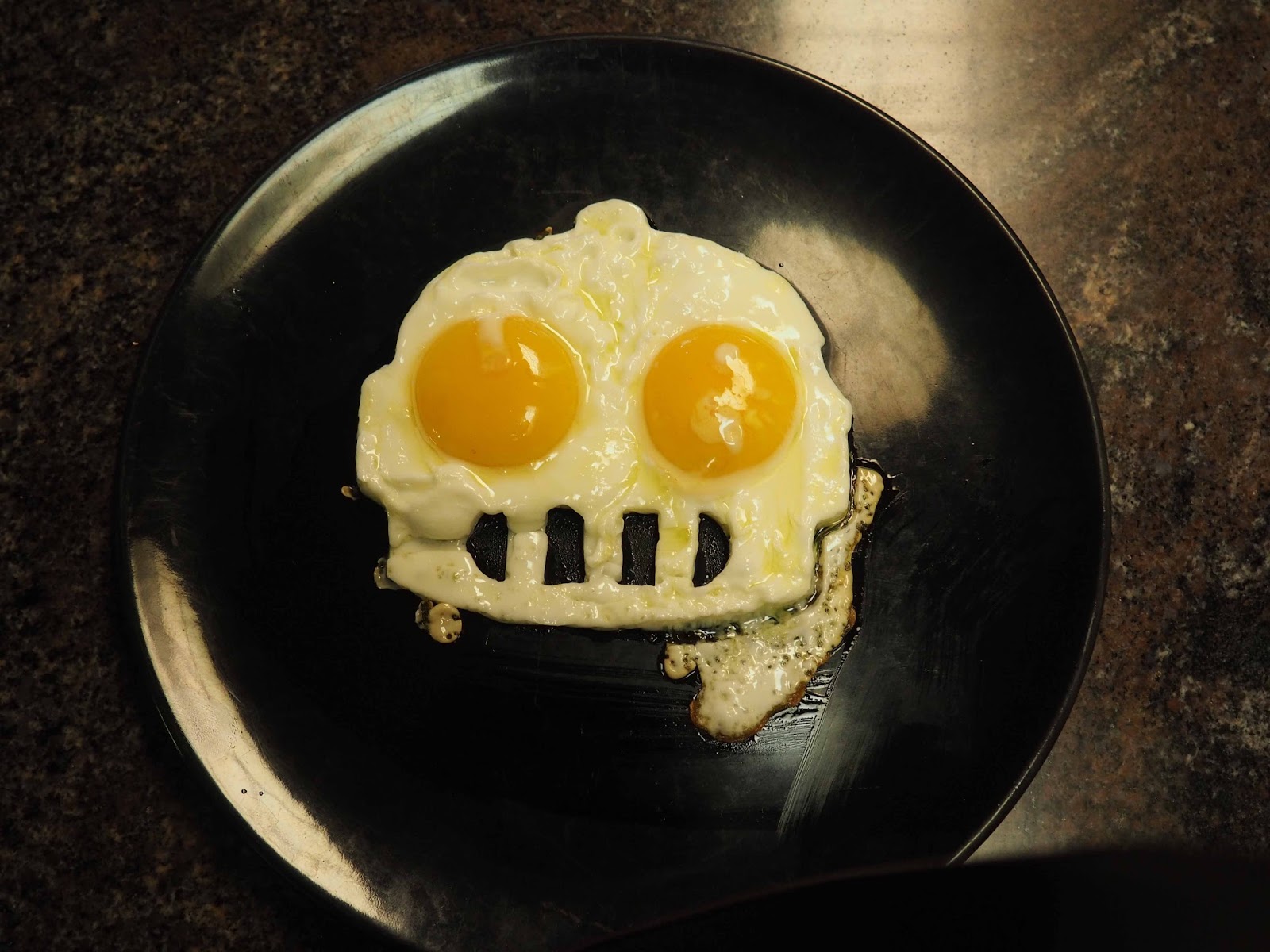
But what really made my day in Sawtelle was going to the Giant Robot store – which sells all manner of Japanese pop tat - and buying this thing, a Funny Side Up egg mold, not actually Japanese but it was obviously in the store because it looked like a robot.


I’m not one of nature’s great egg-fryers but this spurred me on.   Stick it in the pan, drop eggs into the eye sockets and there you are a few minutes later with a robot head; more or less.


I know that egg molds come in all shapes, when I was in Melbourne I saw some in the shape of Australia, and I’ve cursed myself ever since for not buying several of them, and I discover there are also some “rude” ones:


But I think that doesn’t really work.  There’s enough food in the world that’s actually phallic without having to manipulate egg white.  Call me a prude.  Or an aesthete.

Wednesday, August 3, 2016

FUSING IN VENTURA

Well, a weekend in Ventura, 60 miles or so up the coast from Los Angeles.


A so-so martini was had at the Aloha Steakhouse – “Ventura’s only beach front restaurant.”  It was good and cold, decent olives, but awful watery:


A much more serviceable martini was had at the Sportsman Restaurant and Cocktail Lounge, which I suppose is to be expected at a place that calls itself a cocktail lounge:


But hey – you know I’ve been obsessing a little about curry – and I’ve often thought that Indian food is to the British what Mexican food is to Americans, big hot flavors, much of the food fairly mushy, involving the homogenization of massive regional variations, and yet even in LA there isn’t an Indian-Mexican fusion restaurant on street corner, though admittedly there is a restaurant named Cowboys and Turbans, and indeed a food truck called India Jones.


However, in Ventura, on Main Street, there’s the Taj Café – a thoroughly, authentically Indian establishment, 


but there on the menus is something called the Lamb Frankie, which is fusion to the max:


It’s described as “Homemade egg-washed Bombay style burritos, stuffed with lamb, cooked in a special sauce, with vegetable pickle.”  I couldn’t tell you with absolute certainty whether that’s a chapati or a tortilla on the outside (I assume the former), but the inside was just great, the hot spices bringing out the lamb flavor rather than masking it.

It worked really, amazingly well, but when you think about it, why wouldn’t it?  In my mind it will perhaps always be thought of as the Bombay Burrito, and I’m keeping my eye open for the Tijuana Tandoori.

Thursday, July 28, 2016

THE MOBY DICK OF SANDWICHES


Regular readers will know about my ambitions to write the 1000 plus page, magnum opus about the sandwich in all its forms, with all its many historical meanings and manifestations.


With this in mind I have a folder on my computer desktop that gets filled up with all kinds of miscellaneous sandwich stuff.  Herewith, just a few of them.


It would be a mighty book, IMHO.  

Tuesday, July 19, 2016

INTERNATIONAL HOUSE OF CURRY

I think my dad was traumatized by a curry he ate in Sri Lanka, or Ceylon as it was called when he was there.  In fact I suspect he was traumatized by a single mouthful.  He was in the navy and they’d gone there for R and R, and he and the other sailors expressed some interest in the local food – which is a good thing, right? - and so the locals offered them some curry.  And one mouthful was enough, more than enough.  The taste was so terrible, so shocking, to my dad that he never touched curry again for the rest of his life.  That’s him in the picture below, second from the left.


Of course in retrospect you have to wonder whether the locals hated the presence of the Royal Navy and deliberately presented them with something vile and inedible.  We’ll never know, although my dad never spoke ill of the Ceylonese people, only of curry, all curries.

Obviously therefore, as a family, we never ate curry as I was growing up, but like most Englishman of my generation, as soon as I was old enough to eat out under my own steam (i.e. as cheaply as possible) I went to what we always called Indian restaurants, though we now know that they were run by people from all over the subcontinent.  We’re talking 1970s, when the balti was still ahead of us.


Thinking about it now, the truly surprising thing is how consistent all English curry houses were back then.  Chicken biryanis in London or Sheffield or Manchester or Birmingham all tasted amazingly similar.  I don’t for a moment think they were authentic, but I suppose word must have gone out on some immigrant, culinary grapevine about how the English liked their curries, and the vast majority of restaurants cooked to exactly that standard, seldom lower, seldom much higher.


I do remember the first Indian meal I ever had in America – in a restaurant in Berkeley.  The place was certainly run by Indians but the food didn’t taste at all like Indian food I’d had in England.  It may have been more authentic, or it may just have been remodeled to local American tastes.

Here in Los Angeles today there’s by no means an absence of Indian restaurants but I don’t really seek them out, and when I do go to one, of course it doesn’t much resemble the curry houses of my youth, which is probably a good thing.


I probably go The Electric Lotus, in Los Feliz about once a year: “We at Electric Lotus are committed to preserving a culture, tradition and standard in culinary tastes that a Nawab would appreciate.” 


I think that’s the lamb jelfrazi above, though it’s a little while since I took the pic, and in fact all the dishes came looking pretty much the same – I’m still not convinced that raw red onion is the very greatest garnish, but the lamb was good.


And of course in this town there’s plenty of curry that isn’t Indian.  I’m still basking in my Japanophilia and for a while I’d been eyeing the Little Tokyo Curry House, in the Weller Court Shopping Center, downtown.  It’s part of a chain, very bright and rather austere but quite Tokyo-looking.  Mostly I wanted to go there for the pork katsu, but since it came with curry why not?


That’s my plate above at the front. I thought I was being authentic by having rice (it’s hiding under the pork) but the plate you see in the background is my companion’s which came with spaghetti and had melted cheese on top.  I was struck with a bit of food envy – the cheese really worked, even if it felt a little like we were eating the food on some international space station.  Here incidentally is a staggeringly complex graphic showing how curry got to Japan:


And just the other night I ate at Pimai – Sawaddee, Yindee Tornrup , (Hello and welcome !) on Franklin Avenue.   It’s a Thai restaurant as you see (I do like a bit of corrugated metal):


I had the duck curry, which looked better it tasted (eat with your eyes) – kind of heavy on the duck skin, kind of light on the duck.   


It wasn’t great but it wasn’t traumatizingly bad.  And the Pimai has an incredible advantage that no other restaurant in L.A. has. It’s just half a mile from where I live.  If only a few more restaurants could try to work on that.


Wednesday, July 6, 2016

EATING WITH YOUR EYES


Here’s a review I just did of The Photographer’s Cookbook, which appears on the current Los Angeles Review of Books website.  This post has some extra photos that aren’t in LARB.
*

Apertures and Aperitifs: On “The Photographer’s Cookbook”


The Photographer’s Cookbook

Aperture/George Eastman Museum,
160 Pages

IF YOU MANAGE to get a reservation at Sukiyabashi Jiro, the three Michelin star sushi restaurant in Tokyo — the best in the world by many accounts — you’re expected to obey quite a list of rules, including: “Please refrain from taking photos of the sushi. The only sure way of enjoying Jiro’s sushi is to concentrate on dining. When you leave, we would be pleased to take a commemorative photograph for you at the doorway if you wish.”
Jiro Ono and Barack Obama


This sounds reasonable in a good restaurant, doesn’t it? The chef wants you to focus on what you’re eating. On the other hand, the Japanese have the expression me de taberu (we eat with our eyes). Admittedly this isn’t exactly the same as posting pictures of your dinner on Instagram, but both impulses acknowledge how important the visual element is to food and eating.
When I was, briefly, the relief chef at a fairly dismal steak restaurant in Cambridge, England, my boss — an unhappy man who hated his job and his customers even more than he hated me — dispensed a piece of what he thought was profound wisdom: “If it looks good and they’ve got a full plate, you can get away with murder.”
Let’s leave aside the question of why you’d want to “get away with murder” when it comes to serving food, but let’s also acknowledge that he wasn’t completely wrong. We want our food to look good, even if our notions of what constitutes “good-looking” may change over time. These days a full plate is more likely to seem unsophisticated, and you could argue that photographing your food is pretty unsophisticated too, but the ship seems to have sailed on that one. Even Anthony Bourdain now thinks it’s okay.
As far as I know, nobody ever took a picture of anything I cooked in that Cambridge restaurant, but I wouldn’t have minded. And for what it’s worth, a quick look at Yelp suggests that a lot of people don’t obey the no-photography rule at Sukiyabashi Jiro.

But why take photographs of food anyway? As a souvenir, no doubt — photography is in the business of fixing transient moments, and meals are always just passing through. No doubt it’s also sometimes a way of showing off to friends about all the cool places you’ve been to eat. Of course many “amateur” photographs of food are downright banal, but sometimes amateurishness can be interesting in itself. I have various Facebook friends around the world, most of whom, naturally, I scarcely know at all, and I’m always intrigued to see the pictures they put online, showing what they eat at home or in restaurants or at family gatherings. It tells me a lot about the kind of lives they lead.
There is the Brillat-Savarin model of eating: “tell me (for our purposes here, ‘show me’) what you eat and I’ll tell you who you are.” For serious photographers a similar model applies: show me what you think is worth photographing and that’ll tell me just as much. And if you show me that food is an important part of your worldview and your aesthetic, then we’re deep inside your psyche.
Once upon a time, very few photographers got through art college without shooting pictures of red cabbages or green peppers as a way of demonstrating their skills with lighting, exposure, and printing. There are even some extant Robert Mapplethorpe images, taken well post-college (he dropped out of the Pratt Institute in 1969), of a pineapple and an aubergine, and one of a watermelon with a knife stuck in it.

Mapplethorpe

The Photographer’s Cookbook — a project originally conceived by Deborah Barsel and now completed by Lisa Hostetler — contains no Mapplethorpes, which may be considered a shame, or it may not. If you believe Patricia Morrisroe’s biography, Mapplethorpe was in with the “coprophagia is the final sacrament” crowd at the time this volume was first conceived.
The book was a very long time in the making. Back in 1977, Deborah Barsel was working as an assistant registrar at George Eastman House (now the George Eastman Museum), which was not the world’s most exciting job apparently. To make her life more interesting she decided to compile a book of photographers’ recipes and food-related photographs, and she placed an ad in the museum’s magazine Image asking for contributions.
Somewhat to her surprise, within two years she’d received 120 replies, but then Barsel left her job, and the majority of the submissions sat in the archives in a box labeled “Photocookbook.” There they stayed for the better part of 40 years until Lisa Hostetler, the current curator of photography at the Eastman, opened up the box and edited the contents into the book we now have: 150 pages of photographs and recipes by high-art photographers, some of them still very famous names, others who are less familiar now than they were in 1977. There’s also been a little slippage over the years — some of the material was returned to the photographers — and some new pieces have been added, but even so we have a kind of time capsule here.
This is not the place to chart all the many changes that have taken place in the worlds of both food and photography in the four intervening decades; suffice it to say that the two processes had a lot more in common before photography went digital, when photographers mixed chemicals to their own or extant “recipes,” when it was all about temperatures, timing, gelatins, and emulsions, when photographs could be “dodged” and “burned.”
Some of the images here do look as though they come from a completely different age. For instance, Ansel Adams’s perfectly composed and beautifully lit Still Life, San Francisco, California, ca. 1932 — two eggs, an egg slicer, a bottle of milk, another bottle of Marie Brizard liqueur — looks like a historical artifact, the kind of picture nobody takes anymore, and not very many people want to look at.
Adams

Hans Namuth’s American Housewife, ca. 1952, certainly looks like a period piece, set up to look as though it’s taken from inside a fridge, peering out through shelves of cake and macaroni salad at a wholesomely attractive woman, who may or may not be a professional model, an image that now contains ironies that wouldn’t have been so apparent in the early ’50s.
Other works seem amazingly current. Neil Slavin’s Nylen’s Frankfurters in Full Dress shows a grid of 12 hotdogs, garnished with various fruits, vegetables, pickles, and what not. The image’s colors are lurid, and the overall effect is engagingly satirical, as the photographer applies a conceptualist rigor to what is, after all, just a bunch of wieners.
Slavin

One photograph by Arthur Taussig, from 1979, is downright “meta.” It shows a table strewn with books and magazines, all of them opened at pages that show reproductions of Edward Weston’s famous photographs of peppers.
When it comes to the recipes, some of the photographers have taken the task far more seriously than others. Burt Glinn’s recipe for borscht, actually his grandmother’s, is meticulously detailed and runs to three pages. But it’s there side by side with Imogen Cunningham’s borscht recipe, which is a very different thing altogether. First she denounces salt, and then she denounces Alice B. Toklas’s kitchen skills — “likely her cooking contributed to the death of Gertrude and herself” — and then she gives her recipe: “I make it half mine and half Manischewitz (commercial bottle of borscht).” Julia Child might be horrified, although there’s a wonderful, very “straight,” portrait of her here by Arnold Newman, in which she looks so benign and happy that you imagine she’d forgive even the worst culinary sins and shortcuts.
Some seem to be trying a bit too hard: Minor White’s recipe for steamed and sautéed vegetable with its talk of “heightened awareness” seems a lot of trouble for a plate of carrots and celery. Barbara Morgan gives a recipe for “Global Bread Cake,” “hoping that we will all someday become ‘World Citizens.’” You will not be surprised to learn that brown rice and buckwheat are involved. Others seem not to be trying very hard at all. Do we really need Horst P. Horst to tell us how to marinate a cucumber?
Just occasionally the photographers seem to be simultaneously overreaching and undercooking. Les Krims’s recipe for “Formalist Stew” “has 185 ingredients and takes 31 days to prepare. The only problem is, you die of hunger and boredom before it’s ever finished.” It’s accompanied by a 1974 Polaroid of his mother, topless, pouring milk out of a dead chicken — I guess the world worried less about salmonella back then.
Here, as in most cases, the images don’t directly illustrate the recipes, though at their best image and text interact and inform each other. A Robert Heinecken collage, actually from 1991, which uses magazine ads for Bombay Sapphire and tooth whitener, accompanies a recipe for Heinecken’s “Serious Martini” — gin kept in the freezer, no vermouth, no ice, not stirred or shaken, but poured into a glass that’s been in the freezer, along with the juice of one eighth of a California lemon — “This drink is not recommended before 11 a.m.” Ed Ruscha’s “Cactus Omelette” — a more or less serviceable recipe — “have a friend bring a jar (of napolitos) on a plane if necessary” — is accompanied by one of the cactus photographs from his 1972 series Colored People.

Ruscha

Two of the more successfully enduring presences in the book — young Turks in 1977, grand old men today — are William Eggleston and Stephen Shore (born 1939 and 1947, respectively), two men who from the beginning created pictures that could all too easily be accused of banality, or of looking like “snapshots,” whatever the hell that means. Now their aesthetic is widely regarded as the gold standard of both high and low photographic art.
Eggleston


William Eggleston’s photograph from the 1976 series Election Eve shows the interior of a diner where the walls, table tops, and some of the upholstery are all the same alarming yellow hue. It’s a great photograph, it’s pure William Eggleston, and it captures the bleak emptiness of a certain kind of eating experience: the fact that there’s no food in sight only adds to the misery. Eggleston provides a recipe for “Cheese Grits Casserole” — heavy on the Velveeta.
Stephen Shore’s own photographic contribution shows a restaurant table, post-meal, after the food and dishes have been cleared away from the stained tablecloth, a cup of coffee and a cigar remain, and an American Express Card sits waiting to be picked up by the server. You could find something similar on Instagram, of course, but it wouldn’t be a Stephen Shore.
Shore
In fact Shore has embraced the online world in a way that few photographers of his generation have. Between 2003 and 2008 he made 83 volumes of his work available in print-on-demand book form, the contents of each book shot on a single day. That project’s over now, but he continues to be active on Instagram, where the audience is inevitably a mixed bunch: some in the know, some not, though all free to comment. Occasionally someone will declare that the work is banal and in one case complains, “This does not feel like Shore.” Where to start with that one? But if you want to see the arugula and rugelach salad, or the mutton chop with escarole that Shore ate and thought worth photographing, well, look no further. Thanks to Instagram you could even ask him for the recipe.

Shore/Instagram
The Photographer’s Cookbook is a fascinating curiosity, and although it’s essentially a small, fun project, it’s rather more serious and subversive than it first appears. It raises all kinds of questions about consumption, desire, pleasure, and domesticity, and it whets the appetite for a very much larger work about food and photography, one that might include advertising photography and fashion — why is food so often used as a prop in fashion shoots while the models look like they’ve never had a good meal in their lives? It might address the politics of hunger with Salgado and Dorothea Lange, the nature of mortality with Nobuyoshi Araki’s The Banquet and the heartbreaking record of what his wife ate during her terminal illness, Martin Parr’s pictures of food, particularly British food, dealing with class, status, and in the broadest sense, taste. The possibilities are vast. As you see, I’ve been left hungry for more.
¤
The link to LARB is here: