Wednesday, July 28, 2010

WORLD’S SADDEST SANDWICHES


In "The Uncommercial Traveller" Charles Dickens describes his melancholy arrival in London, as a boy. (Incidentally, my spell check offers “infomercial” for “uncommercial.”) He left home in Kent and traveled by stagecoach to the big smoke. “Through all the years that have since passed, have I ever lost the smell of the damp straw in which I was packed – like game – and forwarded, carriage paid, to the Cross Keys, Wood-street, Cheapside, London? There were no other inside passengers, and I consumed my sandwiches in solitude and dreariness, and it rained hard all the way, and I thought life sloppier than I had expected to find it.”

It’s hard not to make a connection and think that the sandwiches were sloppy too, or perhaps soggy because of the rain. You could probably argue that Dickens never really got over it, and that his depictions of London always have elements of solitude and dreariness, though he didn’t have to spend the rest of his life in Cheapside.

In 1908 Royal Doulton, the company that makes tableware and collectables, devised something called Dickens Ware, a line that existed for over 40 years. Plates, jugs, teapots, trays and so on were decorated with characters and scenes from Dickens’ novels. The one depicted below is the “York Sandwich plate” and the character on it is Alfred Jingle from The Pickwick Papers.


Jingle makes his first appearance, accompanying members of the Pickwick Club on a coach journey. He warns them about the dangers of decapitation from low archways and bridges. Thus:
"Heads, heads - take care of your heads", cried the loquacious stranger as they came out under the low archway which in those days formed the entrance to the coachyard. "Terrible place - dangerous work - other day - five children - mother - tall lady, eating sandwiches - forgot the arch - crash - knock - children look round - mother's head off - sandwich in her hand - no mouth to put it in.”

Saturday, July 24, 2010

SANDWICHES IN SPACE


I’ve been reading Mary Roach’s new book Packing For Mars, which she describes as being

about “the small comedies and everyday victories” of space travel. So it’s not concerned 

with the great adventure of space, more with poop and pee and the dangers of vomiting 

into your space helmet (actually not as risky as you might imagine). But the two chapters 

that really rock are called “Discomfort Food” and “Eating Your Pants,” which are about 

eating in space.


You might think astronauts on a mission might have more to think about than food, but it 

seems to be a subject they get very excited and worked up about. My guess is that being 

an astronaut, although sometimes thrilling and sometimes terrifying, is more often actually 

pretty boring, and so they spend a lot of time looking forward to the next meal, like when 

you’re in hospital or on a plane. When the next meal arrives and turns out to be apple puree 

in a tube you can see where problems might arise.


Most space food, it seems, is pretty bad, and of course the astronauts know this better than 

anybody, which is why in 1965 John Young smuggled a Wolfie’s corned beef sandwich 

onto Gemini III to surprise his crewmate Gus Grissom. It was only a 5 hour flight so it must 

have been done for laughs rather than to whet a jaded appetite, and after two hours Young 

duly produced his sandwich. That's John Young, below. We even have the dialogue.


GRISSOM: Where did that come from?
YOUNG: I brought it with me. Let’s see how it tastes. Smells, doesn’t it?
GRISSOM: Yes, it’s breaking up. I’m going to stick it in my pocket.
YOUNG: It was a thought, anyway.
GRISSOM: Yep.
YOUNG: Not a very good one.

Not very dramatic, and not really very many laughs, though apparently there was hell to pay 

when they got down to earth. It showed that astronauts weren’t necessarily sober rule 

followers. But it could surely have been much worse. What if he’d smuggled nachos and 

dip and a couple of Coors on board? Mary Roach tells us that beer in space is a disaster: it 

simply turns to foam.


Roach also refers to something called The Astronaut’s Cookbook. I acquired a copy. It’s by 

Charles T. Bourland, who spent 30 years working on food for spaceflight, and Gregory L. 

Vogt, a science writer. It’s a very singular book.


Partly it’s about science and history, describing the kinds of food that do and don’t work ins 

space. “Irradiated meat ... cooked, packaged in flexible foil-laminated retort pouches, and 

sterilized by zapping it with ionizing radiation” works just fine, apparently.


There are some fun pictures in the Astronaut’s Cookbook of people eating in space. 

Sometimes we see that the meal tray has to be strapped to the astronaut’s leg to stop it 

floating away, and there’s a photograph of Japanese astronaut Mamoru Mohri with a 

floating Japanese apple, which the book tells us is “banned in the US, so NASA had to get 

special permission from the USDA to import them and follow a strict protocol to insure all 

seeds were destroyed.” You just know that “strict protocol” probably involved doing 

something weird with the guy’s poop.


There are some fairly ordinary recipes for pea soup, meatloaf and apricot cobbler, which 

have to be thermo-processed before going into space. And then there are some celebrity 

recipes: Emeril’s Mardi Gras Jambalaya and Rachel Ray’s 5 vegetable fried rice with 5-

spice pork: these have to be freeze dried.


And then, incredibly it seemed to me, there’s a recipe for a Frozen Space Sandwich: “place 

meat and cheese on bread … slice diagonally … place in bag and freeze.” It’s not exactly 

rocket science.


However, one of the most fascinating parts of the book shows a sample menu for the food 

eaten on the International Space Station Expedition Five, from 2005. The crew was partly 

Russian, and partly American and so the food alternated on a daily basis; Russian food one 

day, American food the next. On the Russian days it would be borsch, sturgeon and jellied 

pike. On the American days it would be tuna noodle casserole, tortillas and shrimp 

cocktails.


Above is a shot taken on Expedition Five. The official caption reads, “View of Astronaut 

Peggy Whitson, flight engineer (left) and Cosmonaut Valery Korzun, commander (right), 

eating a meal in the Service Module (SM)/Zvezda. Tomato and hamburger are floating.” It 

was evidently taken on one of the American days.


Whether this helped foster international understanding I don’t know; it seems unlikely. I 

can’t quite imagine those all-American astronauts smacking their lips at jellied pike, but 

then again maybe it wasn’t very good jellied pike and the Russians didn’t enjoy it either. 

Perhaps there was a shared agony. There’s nothing quite like really bad food for bringing 

people together.

Friday, July 16, 2010

PROOF


Photo credit: Thrillist Los Angeles

A newish Hollywood restauran, called District, is causing a bit of a stir with one of its starters, actually what’s referred to on the menu as one of its “breads.” They’re serving “duck fat Yorkshire pudding w/ thyme (allow 15 minutes).” Obviously this had to be checked out. There were other menu items to be checked out as well: fried head cheese, venison stuffed relleno, corn agnolotti. But obviously it was the Yorkshire pudding that was most in need of scrutiny.

We went, we ate, and they were terrific; served sizzling hot in black cloth a basket, oily but not too oily, and soft and dense but not too dense. The Loved One said she’d have preferred more crunch but that didn’t bother me. I’ve probably eaten too many dried out, English institutional Yorkshire puddings in my life.


If you think it seems a little strange to be eating Yorkshire puddings in Los Angeles, I’d tend to agree with you, but the fact is they’re less of a rarity here than you might think. You can certainly get them at Lawry’s on La Cienaga (cited, in an earlier incarnation, in “The Long Goodbye” and discussed elsewhere in this blog), which is a sort of copy of the London restaurant, Simpson’s in the Strand, and it’s one of those copies that’s an improvement on the original. That's their dinner cart above.


You can also get them at the Tam O’Shanter in Los Feliz, also owned by Lawry’s, and not a copy of anything as far as I can tell. It’s vaguely Scottish themed and the serving staff wear a kind of all-purpose traditional dress, and they do serve haggis around Burns night, but its thoroughly Californian, and pretty much a self-invention. I’ve heard that the Grill on the Alley also does Yorkshire pudding, but it's a bit further into Beverly Hills than I like to go.

I think a true Yorkshireman would have complained that the Yorkshire puddings at District were a bit small – about the size of a meatball - but that’s what true Yorkshiremen are like. I am a Yorkshireman, though I suspect not a very true any more. You can see why a restaurant might want you not to fill up too much on cheap starters: they want you to have plenty of room for the expensive main courses. But Yorkshire pudding was invented to do precisely the opposite. In working class Yorkshire homes the pudding was served before the main Sunday roast, so you’d want less roast beef.


And at some point in the 1980s when I was living in Yorkshire, many of the local pubs came up with the idea of serving “filled” Yorkshire puddings. They made plate-size puddings, crusty round the edges with a deep well in the center, cooked beforehand and reheated to order I’m pretty sure, and these were then filled with something or other: beef stew or fish stew or in some cases, I swear, curried chicken. As fusion cooking goes, it’s hard to get much more fused than that.


Filled Yorkshire puddings can now be found at manay an English supermarket, often frozen, and of course they’re terrible. Yorkshire puddings have to be fresh, as the ones at District prove..

Incidentally, as I’ve just discovered, calling your restaurant District makes it all but impossible to find on Google. Typing in variations of the words District, Restaurant, Hollywood and Yorkshire Pudding gets you nowhere at all, and brings up restaurants in theatre districts or business development districts all over the place. Arguably I did once live in the Yorkshire pudding district, and to an extent I still do, but these days it’s a territory of the mind rather than of geography.

Oh yeah, and by the way, there is no need whatsoever for anybody ever to buy Yorkshire pudding mix.

Monday, July 12, 2010

BIG BEER


And talking (re Dennis Hopper) of alcohol as a source of calories, I used to be at college with a man called Dave Lamb, and when he went out at night to get drunk he’d say he was going out for a “feed of drink.” which sounds somehow Irish, though he was a Somerset man. I certainly don’t recall him eating much, but perhaps he didn’t need to.

Dave wasn’t a large man – neither was Hopper - but they drank “above their weight,” as it were. But when it comes to truly heroic, self-destructive drinking, size is always going to be an advantage.


André the Giant (1946-1993) weighed in at between 450 and 500 pounds, and carried his bulk on a 7 foot 4 inch frame. It’s reckoned that he took in about 7000 calories a day, simply from alcohol, though he ate plenty too, sometimes going into a restaurant and ordering every item on the menu. I have to say I'd like to do that some day before I die.

He was also a person that myths grew up around. On the Internet and elsewhere you’ll find plenty of people who say he holds the “record” for alcohol intake, 119 beers, 12 ounces each, in a six hour session, (some accounts say 118, or 113, but they’re all well over 100.) Equally you’ll find plenty of people who say this is literally impossible, that death would occur from that amount of fluid intake, even if the fluid were only water. When you add alcohol to the equation, they reckon there’s no way he could have done it and survived. Maybe he just looked like a guy who could drink 119 beers in six hours.


A more nuanced account of André’s drinking comes from Terry Todd who wrote about him in a Sports Illustrated article in 1971. They spent some time together while Todd was writing the article and he reported that André drank “like a Frenchman,” steadily and constantly without ever getting obviously drunk.


Todd writes, “During the week or so I was with him, his average daily consumption was a case or so of beer; a total of two bottles of wine, generally French, with his meals; six or eight shots of brandy, usually Courvoisier or Napoleon, though sometimes Calvados; half a dozen standard mixed drinks, such as Bloody Marys or Screwdrivers; and the odd glass of Pernod.” And when, like Dennis Hopper, he simply wanted to get drunk he’d move on to straight hard liquor: a few fifths of vodka in André’s case.


All of which set me thinking about the Jivaro Indians from the headwaters of the Amazon: that's one of them above. In “Consuming Passions: the anthropology of eating” by Peter Farb and George Armelagos, it’s reported that the Jivaros consider beer a far greater necessity than food. The book was published in 1980 and things may well have changed since then, thanks to the benefits of civilization, but at the time of the the book, adult Jivaro males drank 3 to 4 gallons of beer a day, adult females 1 to 2 gallons, and a 9 year old child (sex not specified) would drink about half a gallon. And there's evidence (below) that they started younger than that.


Almost all the protein in their diet had to be obtained by hunting, nevertheless the Jivaro hunters would often abandon the pursuit of prey and go home when it looked like they might run out of beer.

The Jivaro’s beer is made from manioc root, also known as cassava, and the mystery ingredient, the one that causes fermentation, is ptyalin – from human saliva: young women of the tribe chew the root to break it down as part of the brewing process. Michael Uzendoski in his book “The Napo Runa of Amazonian Ecuador” writes, “Manioc brew has a nice balance of fruity sweetness, acidity, alcohol and texture … I have never witnessed or heard of a bad batch.”

Thursday, July 8, 2010

THE MORE THE MERRIER


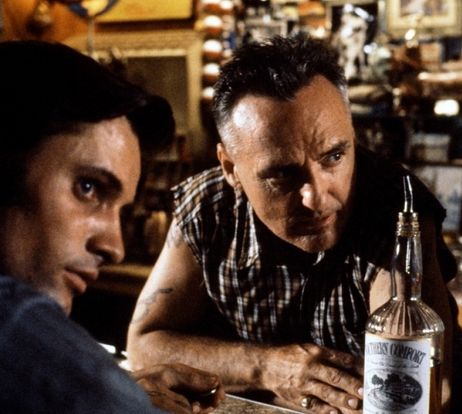
In interviews, the late, much lamented Dennis Hopper used to tell how when he was at his nadir in Taos, New Mexico, in the 1970s, his daily intake of alcohol consisted of half a gallon of rum, plus a fifth of rum on the side in case he ran out, plus 28 beers. With this and 3 grams of cocaine a day he could stay more or less “sober,” and if he wanted to get drunk he’d do shots of tequila.

I don’t doubt that this is true, but it seems a very specific sort of drunk who keeps track of exactly how much he drinks. A very specific one too, who drinks exactly the same amount every day. Was it always 28 beers? Never 27? Never 29? Didn’t he ever feel the urge to drink vodka rather than rum?

I don’t know what, if anything, Hopper ate during this period but I guess his calorific intake was high enough to keep him fed, if not exactly well-nourished. Those 28 beers alone must have contained a good 4000 calories.

I was reminded of Hopper, while reading Barbara Holland’s book The Joy Of Drinking. She says that in 1787, two days before they drew up the American Constitution, the 55 delegates at the Constitutional Convention took a break and went to the tavern next door, where they drank “54 bottles of Madeira, 60 bottles of claret, 8 of whiskey, 22 of port, 8 of hard cider and 7 bowls of punch so large that, it was said, ducks could swim around in them. Then they went back to work and finished founding the new Republic.” This is Barbara Holland, below.


I’m not sure if any of the delegates kept track of what they drank, but we know this chapter and verse because the bill has been preserved. I can’t help wondering if there were a few hangers on who drank at the delegates’ expense, or if the tavern padded the bill a little, but even if so the guys must certainly have put it away. We know for sure that several of the signatories of the Constitution were gout sufferers – John Hancock, Benjamin Franklin, Alexander Hamilton among them - and I imagine quite a few others too.


The Guinness Book of World Records long ago stopped keeping records on the quantity of alcohol people drink, but a recently published first edition facsimile lists two champion drinkers: Auguste Maffrey of France - 24 pints of beer in 52 minutes, and Dionsio Sanchez “a Spaniard” – 40 pints of wine in 59 minutes. This is Auguste, below.


I’ve been wondering if these people count as “binge drinkers” a term that comes with various definitions. By some standards 5 drinks “in a row” for men, 4 drinks in a row for women, counts as a binge. By other definitions binge drinking requires drinking a lot of alcohol rapidly with the deliberate intention of getting drunk. Clearly Hopper, the founding fathers, Auguste and Dionsio must have had far more than five drinks in a row, but none of them seems to have done it with the deliberate, and certainly not the sole, intention of getting drunk. They were just drinking what they always drank.

Incidentally my friend Hugh reckoned it was time to cut back on drinking not when he had too much to drink and woke up in the gutter in a pool of sweat and remorse, but on the occasion that he had fifteen pints of beer, then quietly got on the bus and went home and got up in time for a lecture the next morning.


Now, nobody in their right mind is going to suggest that binge drinking is a “good idea” but according to some new research done at Brown University, the next day effects of binge drinking aren’t nearly as bad as you might think. Science Daily reports, “The study found that intoxication in the evening did not affect students' next day scores on academic tests requiring long-term memory, or on tests of recently learned material. Binge drinking did, however, slow participants' attention/reaction times and worsen mood states.”

In other words, the constitutional delegates would still have been perfectly able to draw up a constitution, they just might have been a bit grumpy while doing it. Dennis Hopper, of course, would probably have reached for his gun.

Sunday, July 4, 2010

REGIONAL VARIATIONS


When I first went to San Francisco in the 1970s I went along to Fisherman’s Wharf and looked at all the seafood and felt baffled and overwhelmed by it all.

I was especially confused by the hollowed out loaf of sourdough bread filled with clam chowder. I’d never encountered a clam or a chowder and the concept of sour dough was completely unknown to me. I was drawn to it, but it seemed too strange and exotic. I wouldn’t have known how to order it or how to eat it or how it was supposed to taste Sour bread sounded strange though somehow attractive, and eating the “vessel” you’d eaten from seemed so decadent. I bought some bread and cheese and felt on much safer ground.

These days I eat soudough pretty much every day – it’s the basic bread we buy at the supermarket, and I certainly know what clam chowder is, though it’s not something I ever crave.


Even so it seems impossible to visit San Francisco without going to Fisherman’s Wharf and having clam chowder in a hollowed out sour dough loaf, usually at the Boudin Bakery. I was there a couple of weeks back and that’s exactly what I did. These days it not only seems unexotic it seems downright dull, and I was left wondering how this dish has become such an attraction to me and everyone else. Maybe it’s like eating fish and chips at the English seaside or eating Nathan’s hotdogs at Coney, you’re not sure you’re really enjoying them but you think you should.

My San Francisco visit wasn’t especially food-related but, to my surprise, I did find a kind of potato I’d never eaten before. It was in a French restaurant on Grant Avenue called Café de La Presse, I ordered the the Confit de Canard Maison and it came with “potatoes salardaise.” I didn’t take a picture, because the restaurant seemed too classy and I didn't want to seem like a rube. It looked like this:


I wasn’t completely sure how they were cooked, though garlic and duck fat were certainly involved, and when I got home I couldn’t find a recipe in any of my cookbooks, least of all Julia Childs. I figure it must be in Larousse Gastronomique but my copy has (not so mysteriously) disappeared. Online recipes are of course wildly various, not least in the spelling of the word itself, which sometimes appears as “sarladaise.” They seem to be a speciality of the Dordogne.

But the basics are simple enough, essentially you fry slices of potato in duck (or goose) fat along with garlic, onion and parsley. It’s the cooking time that gets really interesting. Some recipes suggest twenty minutes, some suggest two hours, by which time you’re pretty much making a confit of the potatoes themselves, which is OK by me. And the fact is, it’s hard to go wrong with those ingredients, as my own humble efforts (below) prove.

Saturday, June 26, 2010

THAT BOURDAIN REVIEW

My review of Medium Raw, as it appeared in the San Francisco Chronicle.


In the interests of full disclosure I should say that, about a decade ago, Anthony Bourdain gave one of my novels a snippy review. He described it as “always clever, seldom fun.” The wound has healed, but as you see, I still remember the line, because let’s face it, it’s a damn good one. Today I can also console myself with that knowledge that by Bourdain’s standards, I got off very lightly.

His new book Medium Raw, is subtitled “a bloody valentine to the world of food and the people who cook,” and much of it reads more like a poison pen letter than a love note. Sandra Lee is the “hellspawn of Betty Crocker and Charles Manson.” The movie No Reservations makes him want to “vomit blood.” Rocco DiSpirito’s TV series is a “reality-show driven abomination.” (p106) Alan Richman starts out as a douchebag, but then Bourdain upgrades him to the c-word. Even the saintly Alice Waters is dissed for her “crude and obvious blend of self-aggrandizement and genuine good intentions.”


Elsewhere, Gael Greene, Alain Ducasse, Wolfgang Puck, and many more, come in for varying degrees of evisceration. This, of course, is all great fun, even if some of it’s the shooting fish in a barrel variety. But just in case you’re wondering whether Bourdain can take it as well as he can dish it out, he turns his verbal knife skills on himself. “A loud, egotistical, one-note asshole who’s been cruising on the reputation of one obnoxious, over-testosteroned book for way too long,” “the angry, cynical, snarky guy who says mean things on Top Chef”, “the very picture of the jaded, overpriviledged ‘foodie’.” Well, he makes some good points.

He also approves of many people too: Thomas Keller, Ferran Adria, Jamie Oliver and Jonathan Gold among them; but it’s probably inevitable that the compliments tend to be rather less memorable than the blazing though finely-honed putdowns.


But actually, Bourdain’s at his best when he isn’t playing the part of gastronomic insult comic. He writes, “I like making things. And I like telling stories,” and this shouldn’t come as news. His breakthrough book Kitchen Confidential wasn’t a success only because of its revelations about bad behavior on the countertops. It was an engaging and skillful narrative that beckoned and seduced you into the world of the professional chef.

Medium Raw is being marketed as a “follow-up” to that first book, though to me it reads more like a collection of magazine articles and opinion pieces. So we have lip-smacking descriptions of eating pastrami at a deli on Houston Street in New York, waiting for the first batch of pain raisin at a bakery in Paris, consuming freshly made blood sausage in a village outside Prague. These are fine as far as they go, but the book is better when Bourdain goes further.

The prologue describing an illegal ortolan feast involving some of America’s greatest chefs could be the first chapter in a suspense novel. Who are these people (Bourdain doesn’t name names), why exactly do they wear “shrouds” while eating, and what kind of man enjoys the taste of “figs, Armagnac, dark flesh slightly infused with the salty taste of my own blood”?

A memoir about being on St Barts with a crazy, cokehead girlfriend is comic, vicious about the girlfriend, the island and its food, but ultimately it’s strangely compassionate and moving: at least about the girlfriend, not so much about the food on St Bart.


But for my money the stand out chapter in the book is “My Aim is True” which describes the work and life of Justo Thomas, who cuts and portions at least seven hundred pounds of fish every day at Le Bernardin, the New York seafood restaurant. The man is a brilliant craftsman and a force of nature, and when he goes on vacation, three people have to be employed to do his work. Bourdain observes and describes Thomas in wonderfully fine detail. We “see” the way he employs different methods for different fish, how he uses his knives, the way he removes skin and bones, how he’s able to cut absolutely identically sized pieces. Then we learn about his background in the Dominican Republic, and the role he still plays in his family there. And finally, in a masterful flourish, Bourdain takes Thomas to eat at Le Bernardin. It’s generally unthinkable for kitchen staff to eat in their own restaurant, but for Justo people make exceptions. By the end of the piece I felt I knew Justo Thomas better than I know most of my own friends. You have to hand it to Bourdain; this is really good writing, not just really good food writing.

Bourdain says he spent twenty-eight years as a professional cook and chef. By my reckoning he’s spent fifteen years as a professional writer. Will it surprise you that he doesn’t think much of writers? He says, “hanging out with more than one of them at a time is about as much fun as being thrown in a cage full of hungry but toothless civet cats.” (p48) Just once in a while, even Mr. B overcooks his similes.

Monday, June 14, 2010

HUBBA BUBBA


An old friend from England was in town; author, anthropologist and all round style tribe guru Ted Polhemus. He was here to lecture on the semiotics of denim (don’t ask).

When I say “in town,” he was actually in Santa Monica, a place I don’t know all that well, and so when we set off to find somewhere for lunch, for one reason or another we ended up on Santa Monica pier at theme restaurant called Bubba Gump’s. It’s a chain, and maybe you’ve heard of it, but I hadn’t. It was evidently inspired by the movie Forrest Gump, and although I’ve seen the movie, it was a long time ago, and I’d more or less forgotten about the shrimp boat part.

Of course the food snob in me hesitated at the prospect of a heaving, theme restaurant, a tourist place, full of large family groups with howling children and a lot of dropped shrimp on the floor. But you know, food snobbery is unattractive in anybody, and especially in a food blogger. So I decided to go with it.


And you know, really, the food wasn’t bad. Ted (see above) had the Shrimper's Net Catch “Our best Peel'n'Eat Shrimp steamed in Beer - You and your crew will be begging for more!" I had the Dixie Fishwich “Forrest and Lt. Dan had one everyday!”

And the ambiance? Well yes, it was loud and hectic, but if you got the right table, which we did, i.e. one by the window, you can see all the way north along the coast of Santa Monica Bay, with the mountains in the background, so you get a million dollar view to go with your ten dollar fish sandwich. That’s really not such a bad deal.

The waiting staff was efficient and efficient, and seemed supernaturally happy, which can’t be easy. But the best feature of all was a thing on the table that looked like a car’s license plate. When you sit down it’s in this position,


That means you don’t need anything from the waiting staff and they can run right by you. But then other times you can flip the plate up and reveal this one underneath.


This means that any waiter who happens to be passing – not just yours – will stop and ask what you need. “Another Hefenweizen, please.”

I think this is the most wonderful dining innovation: no more trying to catch the eye of some distracted waiter. The sign, the signifier if you will, is right there on the table. Of course, given some of the restaurants I’ve been in, a license plate might be too subtle. How about a light, like on the roof of a taxi, and maybe it should be flashing, or the could be flag you could raise, or a small distress flair you could launch, that could return to earth by parachute, with the message, “Actually, make that two Hefenweizens.”

Monday, June 7, 2010

BENT


I’ve been reading Anthony Bourdain’s new book “Medium Raw” to review it for the San Francisco Chronicle. It’s a lot of fun, and especially if you have negative feelings about Alain Ducasse, Rocco DiSpirito and Wolfgang Puck, among many others. They all get a lashing from Mr B.

Among the many provocative statements in the book is this one: “The care and feeding of the Fourth Estate – and their bastard offspring, food bloggers – has become an important skill set for any chef looking to hit the Big Time ... ‘turning’ a journo is usually a pretty simple matter. Just feed them for free. You’ll never have to remind them about it later. Believe me. They’ll remember. It’s like giving a bent cop a Christmas turkey.”

Now, I'm an odd kind of journalist, an especially odd kind of food journalist, though I think my bastardly blogging credentials are real enough. Even so, nobody has ever tried to ‘turn’ me. The nearest I came was having a chat (rather than an interview) with Fergus Henderson, when I was writing about his restaurant St John for Bon Appetit magazine. (The piece got spiked, but I got paid – a triumph). Fergus insisted that he never gave free meals to journalists, and I certainly wasn’t asking for one, but he did give me a glass of Poire William liqueur to go with my espresso.


For what it’s worth, St John is my favorite restaurant in the world, and I think I can look into my heart and safely say that it wasn’t a single glass of Poire William that made me feel that way. It takes more than a single shot of liqueur to corrupt me. How much more, I don’t know. Perhaps somebody would like to try a few experiments.

Friday, May 28, 2010

Friday, May 21, 2010

THEY SPEAK WELL OF ME SOMEWHERE

Here's my interview with Squid Ink


LA food blogs
Meet Your Food Blogger: Geoff Nicholson of Psycho Gourmet

By Erica Zora Wrightson, Monday, May. 17 2010 @ 9:30AM
Categories: Food writing


When asked about Volkswagens -- the subject of a trilogy of his novels -- writer Geoff Nicholson says "Well, I just kind of like 'em is all." Nicholson mainly writes novels, but he's got a blog about walking, an addendum to his book about it called "The Lost Art of Walking." He also keeps a food blog, Psycho Gourmet. It is updated rather infrequently, which is a shame because it's a rare specimen of superb writing in blog form -- really almost too beautiful to be labeled blog posts, more akin to vignettes. Luckily, Nicholson says he just finished a few projects and "it's definitely time to get back on the horse and do some more psycho-gourmet-ing." On his blog, you'll find the author's "ruminations on food, and its relationship with sex, decadence, obsession and the madness of the mouth."


Squid Ink: When and why did you decide to start blogging about food?
Geoff Nicholson: Well, like most writers I feel I should "get my name out there more." My publisher of course feels this even more than I do. It's not so much because I want to be "famous" per se, but because the better known you are the more likely people are to pay attention, read your work, buy your book etc.
And I looked at a few of these "random jottings from a tortured mind" kind of blogs (please tell me there isn't really a blog with that title) and they seemed just hopeless. There had to be a thematic connection between the posts, and I do have a number of more or less interesting obsessions -- and food is certainly one of the main ones. So why not a food blog? I started about 18 months ago.
And of course we all have the Julie and Julia fantasy, some insightful editor/publisher/filmmaker will see how great it is and I shall conquer all.

SI: How does writing fiction differ from writing blog posts? Is it hard to transition from one to the other?
GN: Well, for better or worse (I think better) I'm one of those writers who does have a recognizable voice; skeptical, subversive, quite warm, quite witty, but occasionally quite dark. And it's really the only one I've got, so that's the voice I use whether I'm writing a novel, or an essay for the New York Times or a blog entry. So the transition isn't so hard in itself. But of course a 3,000 word chapter is easy to read in a novel -- pretty hard work online. So in the blog I tend to writer shorter, more broken up paragraphs -- I haven't decided if this is good or bad.


SI: On Psycho Gourmet, You write a lot about food-related memories, or the disappointing lack thereof. As you mention in your post about the party at Taschen's house, all of this documentation of the meals we eat means we have less responsibility to remember. Do you think food photography makes us lazy? What is lost when we have photos of every aspect of a meal, instead of only a menu and our memory?
GN: Gastronomica just published a piece of mine, about my mother's weird eating habits (she only really liked white food). And I dug through all the family photos hoping to find some picture of the Nicholson family eating. Nothing there apart from my parents cutting their wedding cake, and one of me eating white ice cream. Now, of course since everybody photographs everything all the time it seems nobody can eat a sandwich without memorializing it somehow.
On the other hand, I do have a very clear memory of the best sandwich I ever ate -- at the Sidewalk Café in Sheffield -- grated cheese with pickled onion, eaten with my first ever girlfriend the morning after we'd spent our first ever night together -- actually perfectly chastely -- in her parent's house, and obviously the memory is about a great deal more than just the sandwich -- but I do wish I had a picture of it.


SI: You have a revolving-restaurant fetish, although few have lived up to your expectations. If you were going to open a revolving restaurant, where would it be and what would it serve?
GN: Well "fetish" is a tricky word -- I just like 'em is all. In the realms of complete fantasy I'd open one high atop a tower in the middle of Death Valley -- endless desert to the horizon on all sides.
The food places in Death Valley serve the most awful slop -- a decent hamburger joint would be a fantastic improvement; but if it was the all-Geoff-Nicholson-all-the-time-menu, half a dozen oysters, braised pheasant with roast potatoes, a good cheese board. I can always live without dessert.

SI: What was you favorite thing to eat as a child?


GN: It was cheese -- and probably still is. Never found one I really didn't like -- but the cheese of my childhood was crumbly white English Cheshire -- partly my mother's "white food" influence -- but I've shaken off most of the rest of my her influences when it comes to food.

SI: In your post about "Picnic at Mougins," you discuss the notion of a meal in which the company is the focus, over the food. Do you often eat out with friends? Do you ever eat out alone?
GN: I certainly don't eat out as much as I used to when I lived in New York and London -- and really it's the drinking and driving problem. Going out in London, at least in my set, meant drinking at least a bottle of wine per person with dinner. In New York it wasn't a night out unless you started with a couple of martinis.
In L.A. I, and everybody I know, is scared to death of driving drunk, or at least of being caught. So dining out tends to be a rather well-behaved business, which means it's less fun, so I do it less often. Is this a terrible confession?
I can eat lunch out alone, but not dinner.

SI: Do you read other food blogs? Who are some of your favorite bloggers? Food writers?
GN: Among bloggers I loved the guy who tried to eat in an L.A. restaurant of a different ethnic group every day -- I've just searched for it and can't find it. (SI: That's Noah Galuten's year-long eating project, Man Bites World)
But I see someone's doing the same in Washington D.C. I like a blog with something quirky, obsessive and "conceptual" about it like The Great Taco Hunt.


Among food writers I loved the late Alan Davidson and waited eagerly for his Companion to Food -- but then was a bit disappointed -- he was a genuine obsessive and scholar and I felt it should have run to 20 volumes -- I still re-read his collection A Kipper With My Tea from time to time.


I used to love an English food writer called Jonathan Meades -- but he's gone on to bigger things. I guess the burn out rate is high for food writers. And I'm sure it goes without saying -- but I'd better say it -- Jonathan Gold.

SI: Oh, and about the Volkswagens...
GN: I confess to having written three novels about them. As may be obvious from the blog if nowhere else I'm obsessed with obsession I'm not really a true obsessive myself but I'm fascinated by people who really are and many have been obsessed with VW Beetle -- basically from Hitler to -- well you name it, but certainly Charles Manson and Ted Bundy. And, of course, this makes a great structure for a novel.