Saturday, November 20, 2010

MANGETOUT


It’s hard not to have some seriously mixed feelings about the case of Dr Arturo Carvajal who, if the Internet is to be believed, is suing a Miami restaurant, Houston’s, because they didn’t tell him how to eat an artichoke.

The story goes that he ordered grilled artichoke and ate the whole thing, spiky leaves and all.  Evidently it went down OK, but then he woke up in the middle of the night with gut pains, went to hospital, where an “exploratory laparotomy” (that’s a big cut into the abdomen) revealed that there were artichoke leaves stuck in his bowel, which suggests he didn’t even chew them much.
        

The Internet world (and certainly the restaurant) seem to think he was nothing but a damn fool.  It did cross my mind for a moment that this might all be a publicity stunt for the restaurant, but it's a very odd kind of publicity.  It raises the question of whether a restaurant has a legal obligation to ask every customer if they know how to eat the food they’ve ordered?  Should a server make sure the customer knows not to eat the chicken bones and the lobster shell?  I’d say no, and so it appears would just about everyone else except Arturo and his lawyer.  What’s more, if I’d found myself in Arturo’s position I think I’d have kept very quiet about it so as not to humiliate myself still further.  Even so, I do have some slight sympathy for the guy.  Surely we’ve all been in situations where we’ve been presented with food that we didn’t know how to eat, and were too embarrassed to ask.

One of the ordeals in my first year at university was having lunch with the college chaplain.  There were maybe a dozen undergraduates and him, so the ordeal was surely much worse for him than for us.  The first course was melon, which I knew all about, but there was some unidentifed powdered stuff in a bowl that people were passing around and sprinkling on their melon.  I had no idea what the powder was, but everybody else seemed to and I didn’t want to appear unsophisticated by asking, so I did the same as everybody else, and perhaps I took an overgenerous helping, but what did I know?


The powder, I now know, was ginger and as I took a mouthful of melon heavily coated in the stuff, it was as if a hot grenade had exploded in my sinuses.  I choked and sneezed and it left my taste buds in pretty bad shape for the rest of the meal, of which I now have no memory.  Everyone at the table was far too polite to say anything about my humiliation; just as they’d been far too polite to suggest that perhaps I’d helped myself to way too much ginger in the first place.  Would they have stopped me eating a whole artichoke?  Probably not.  I have to say that was the last time I ever put ginger on melon, though I didn’t think of suing anybody.

The fact is, humiliation is always lying in wait for the unknowing diner.  My friend Laura tells the story of when she worked as a waitress in a country club in the American South.  An apparently sophisticated woman ordered the filet mignon and when it arrived she said it  wasn’t what she’d ordered.  Laura checked and confirmed the order was correct.  Still the woman insisted, “But a filet is kind of fish.”  Another friend of mine tells the story against herself, about her first time in a Paris when she went to a restaurant, ordered the steak tartar and asked for it medium rare.


There’s a great story by Chekhov called “Oysters” in which a little boy, begging outside a restaurant, is taken inside by a couple of swells and fed on oysters.  The boy’s game to eat them but he doesn’t know what they actually are, so when they arrive he tries to eat the shells as well.  The swells of course think this is a huge joke but how was the boy to know otherwise? 

Chekhov’s little boy aside, I guess there’s the reasonable assumption, that if you order something in a restaurant you know what it is.  And if you don’t know what or how to eat it then you’ll ask.  Arturo Carvajal was apparently afraid to admit his ignorance.  It’s not an uncommon thing.  And as a matter of fact, the first time I was told how to eat an artichoke, in fact by the steak tartar friend who’d become a true Francophile by then, I couldn’t help thinking she was pulling my leg.  It seemed pretty darn improbable.  And how did people ever work out how to eat a pomegranate?  Or a persimmon?


Talk of oysters got me thinking about Hodge, Samuel Johnson’s cat.  The good doctor fed him on oysters, which he went out and bought himself, feeling that the servants would resent buying oysters for a cat.  There’s a statue of Hodge outside Johnson’s house in Gough Square in London, and sculpted onto the plinth is an opened oyster with its shell.  Hodge, as Johnson told us, was a very fine cat indeed, even so, I don’t suppose he knew how to shuck an oyster.  But I'm sure he knew better than to eat the shell.

Friday, November 19, 2010

BOMPAS AND PARR AND ME

Here's the Bompas and Parr article, as it appears on the Gourmet Live blog - they're giving it away, so I'm giving it away too.   If you get the free app you get to see a ton more pictures.


GOURMET LIVE BLOG

APP EXCLUSIVE: A NICE CLEAN CHEW

The below feature appears in the current issue of Gourmet Live and was written by Geoff Nicholson. Download the free Gourmet Live app to get this story and more.
Photo by Nathan Pask
I can remember exactly when I “discovered” Bompas and Parr. It was April 2009 and they were doing an event—part culinary jape, part performance art, part science fair experiment—that went by the name of “Alcoholic Architecture.” They took over a space in London’s Soho, and as visitors arrived they were decked out in protective suits, then ushered into an area filled with an all-enveloping, aromatic cloud. The cloud consisted of vaporized gin and tonic.
A real gin and tonic, in liquid form, is regarded as a perfect delivery system for getting alcohol into the blood stream, with the bubbles in the tonic accelerating the absorption of the gin. But it’s not nearly as efficient as walking into a cloud of the stuff. This way the gin not only enters the body via the mouth, but also the nose, and even, according to Bompas and Parr, through the eyeballs. Half an hour in that room was enough to get most people thoroughly buzzed, and it certainly made those Las Vegas bars where you stand around in an ice vault sipping vodka seem positively tame.
“Alcoholic Architecture” was a lark, but a huge amount of thought and work had gone into it. Vaporizing gin and tonic isn’t something you can just do on a whim. Equally, word was that serious medical opinion had been sought to get the concentrations in the vapor just right so that the end result wasn’t a room full of paralytic drunks, or worse. Sam Bompas and Harry Parr presided benignly over proceedings—a pair of clever, dandyish, enthusiastic, very English young men.
Having “discovered” them, I soon realized they didn’t need any discovering. A small but highly significant part of the world already knew all about them, a world that included celebrity chefs, corporate sponsors, art galleries and English country houses. This world knew them best as “jellymongers” and jelly was their first love as well as their first medium.
Some cultural clarification may be necessary here. Jelly is the British generic term for the America product Jell-O, a linguistic difference largely necessitated by international patent law. The folks who manufacture gelatin desserts in Britain have done just fine without paying to use the methods patented by the inventors of Jell-O. Whereas Jello-O is a powder, British jelly usually comes in concentrated rubbery cubes, though Bompas and Parr actually use leaf gelatin.
The Bompas and Parr story began in 2007 at London’s Borough Market where they tried to set up a stall selling jellies to the public. The management told them to get lost but they succeeded in getting a few commissions to make jellies for private parties. The timing was right. Britain was thoroughly food-obsessed, and jelly fitted in with a nostalgia both for Britain’s heritage (both Henry VIII and Queen Victoria were great jelly enthusiasts, apparently) and also for childhood. However sophisticated the British palate had become, there was still an atavistic longing for food that was sweet, wobbly and fun.
The business took off, but Bompas and Parr were far too smart and quirky to settle for simple nursery school shapes and flavors. Harry Parr was trained as an architect and when it came to making jelly moulds he had access to the computer technology used to create architectural models. Before long he was making jellies in the shapes of buildings designed by cutting edge architects such as Norman Foster and Richard Rogers. It tickled something both in the public’s imagination and in the media.
A terrific, glossy book by Bompas and Parr, published this year, simply titled Jelly, demonstrates the range of possibilities: funeral jellies using black cherry, Prosecco and gold leaf; a Christmas pudding jelly containing Hippocras (a spiced wine punch supposedly devised by Hippocrates); flambé ed jellies arranged into a diorama of the Great Fire of London; and fluorescent jellies that glow in ultraviolet light, a version of which was seen at San Francisco MOMA.
The sensibility that made jelly weird, wonderful and playfully grown-up could also be applied to other aspects of food. Bompas and Parr’s non-jelly projects have included a twelve course Victorian breakfast served at Warwick Castle (a meal that had to be cooked in three separate kitchens), an all black banquet for the London Design Festival, and an occasion on which they flooded an 18th century house in London with over four tons of Courvoisier punch, creating an “architectural punchbowl” big enough to row across: structural engineers had to be called in to ensure that the building didn’t collapse.
Bompas and Parr also organized Britain’s first “flavor tripping party” where they fed their guests with freeze-dried miracle fruit (the legendary West African berries that make bitter and sour foods taste sweet, so that vinegar tastes like sherry, hot sauce tastes like a sugar syrup), then invited them to tuck into a buffet.
There’s always an element of stunt in these events, but they actually do address—in a determinedly unsolemn manner—the whole issue of how we experience food and flavor, how setting and atmosphere affect our perceptions and the extent to which we eat with our eyes and brains.
I recently met up with Sam Bompas and Harry Parr in London, at Whiteleys, an upscale shopping mall (and originally London’s first department store) where they’d set up a temporary “artisanal chewing gum factory” in a couple of empty shops. The artisans were the customers themselves: this was do-it-yourself chewing gum making. Visitors first entered a dramatically lit space, much like an art gallery, where two hundred jars of flavored liquids were on display. You were free to open the jars and sniff the contents to your heart’s content, then had to choose just two to add to your gum. Flavors included fruits, flowers, alcohol, herbs, some far more outrĂ© than others. And of course the totally off-the-wall ones really got people excited: white and black truffle, tobacco, bacon, curry. I gamely entered into the spirit of the thing.
The boys were nothing if not encouraging. I chose gin as my first flavor, which was perhaps a little obvious, and then I wondered aloud if they had any ambergris. “Absolutely!” Sam said enthusiastically. This wasn’t quite as unlikely as it might seem: I’d read that they’d used ambergris-flavored cream in one of their earlier projects.
Sam disappeared behind a curtain and in due course returned with a tiny vial containing the essence of gin and ambergris. I then moved on to a second, much more businesslike room, a workshop-cum-kitchen where the chewing gum actually was made. It started with gum base that had been melted in a microwave, and frankly looked like gum that already been chewed, but then I added my flavors, along with powdered sugar and acetic acid, and then some coloring—blue seemed most appropriate—and after much stirring, kneading and rolling, I ended up with six balls of strangely attractive aquamarine gum.
Harry assured me along the way that I was doing a great job, though I felt decidedly ham-fisted. And afterwards Sam suggested that I wait a day or two to let the gum “mature” before eating it, though I couldn’t help wondering if this was so he’d be a long way away should I experience nausea and gagging. But in fact my gum tasted pretty good. I tried it out on a few more or less willing friends and it got some decent reviews. The words “a nice clean chew” were used, though I think most of my guinea pigs didn’t really know what ambergris was, and might have felt differently if they had.
From my point of view, Bompas and Parr had achieved a small miracle. I have always loathed chewing gum, almost to the point of phobia: it took much stiffening of the sinews even to visit the artisanal factory. But I realize now it isn’t the gum that I hate, it’s that hideous, synthetic mint flavor that accompanies it. My mind, and my way of thinking about flavor, has been interestingly tweaked.
*
Bompas and Parr make a good double act. Harry is the boffin, Sam is the showman and charmer, or as he put it, “Harry’s technical and very process-oriented while I do a heap more work with people. That said, we both pitch in on everything.”
I suggested that Bompas and Parr events must be fiendishly difficult to pull off. They have a light, celebratory air about them, but organizing them must be a logistical nightmare. Weren’t there times, dealing with health and safety issues or building regulations when it was hard to keep the lightness?
“On the contrary,” said Sam, “there’s huge fun to be had with health and safety. How often do you get to ask a stranger if they suffer from ear discharge? The trick is to make sure each experience is onion-layered. So if people want to just pop along and have fun that’s cool. But if they want to understand and learn something there’s a weight of thought, deep research and some expert opinions behind the spectacle.”
“A fine example is the Architectural Punchbowl. At face value it was a room flooded with booze that you could float across before drinking. This was fun to do. But if you wanted to know more, you could explore the historical context where British Admiral Edward Russell did a similar thing in 1694, look at the engineering problems or take part in a piece of research put together by psychologists and architects at University College London on dining and perception.”
Clearly Sam wasn’t a man who would admit to difficulty, but even so I thought it must be hard to keep coming up with fresh and interesting ideas that were identifiable as Bompas and Parr territory.
“No way,” said Sam, “we’ve got a sack of ideas we want to crank through and it keeps getting bigger. At the moment it runs to five close-typed pages and we have a pipeline of stuff coming up through into 2012. Harry and I just bother following through on those harebrained ideas everyone has with friends in the pub.”
I don’t think he was being disingenuous. His attitude of “Problem? What problem?” seemed genuine, very refreshing, and dare I say rather un-British. And of course this attitude guarantees an absence of pretension. For all of the science, research and technology that go into a Bompas and Parr project, the guys realize the importance of not being too earnest.
There’s something elemental about what they do. Water, fire and air are usually involved, and on occasion even earth: they made “occult jam” containing sand from the Great Pyramid, and a different jam recipe supposedly contained a fragment of Princess Diana’s hair. There is something louche and decadent about these projects, but also something innocent and good-natured.
As for the future, Sam says, “The big show in December is Taste-O-Rama at the Harley Gallery, in Nottinghamshire, England. We’ll be screening an eat-a-long version of Indiana Jones and the Temple of Doomso people can have a movie in their mouths. I’m hyped as we’ve just been sent CAD files of actual monkey brain scans for the chilled monkey brain scene.”
“The thing that’s really special for the screening is the venue. We’ve been allowed into Welbeck Abbey for the first time in history. The place is unbelievable. It has what was once the largest underground room in Europe, a ballroom so large that it would have a separate orchestra at either end when they were having parties in the 1890s. It’s like a forgotten treasure and the event is going to rock.”
You know, I’m absolutely sure it will.

Wednesday, November 17, 2010

BUSTERED


Apparently there’s something in the air about Marilyn Monroe right now; or maybe there always is.  I just got sent a copy of a novel by Andrew O’Hagan, called The Life and Opinions of Maf the Dog, And of His Friend Marilyn Monroe. The book is, as it were, a fictionalized “memoir” by Marilyn’s dog, Maf, (short for Mafia Honey), a mutt given to her by Frank Sinatra.

         Marilyn doesn’t do a whole lot of eating in the book – mostly she drinks champagne – but she does do some.  There’s a meal eaten in her car in the parking lot of a “Jack-in-the-Box chicken joint,” and there’s a terrific scene at Musso and Frank where she’s with Sinatra, Natalie Wood and a “hoodlum chum” of Sinatra’s called Frank DeSimone.  Sinatra keeps telling Marilyn to have the Shrimp Louie, the zucchini, the spaghetti with meat sauce, but all she wants is rice pudding.  Incidentally all these items are on the current menu at Musso and Frank.  I assume O’Hagan is a smart enough novelist to have checked that they were also there in the early 60s; and given the restaurant’s resistance to change, it seems entirely likely that they were.


Maf meanwhile, being a dog, eats whatever he can get: cakes, “small casseroles,” Twinkies, pretzels, nachos, sausages, Friskies and a “plate of morsels” at the Plaza Hotel in New York.  I don’t know if a dog would consider this good food or not, though Maf certainly doesn’t complain.


         Canine eating habits have been on my mind somewhat lately since I’ve been pursuing my intermittent Buster Keaton obsession.  Keaton was one of the few actors who seemed to enjoy performing on screen with animals, and in his real life he had all kinds of pets including a number of St. Bernard dogs, all of them called Elmer, which was the name of a character he played in some of his movies. 

         Keaton said, “Elmer did his own shopping.  HE would look a butcher in the face until the guy couldn’t stand it and would throw him a steak, the best in the house, and then charge it to Keaton.  Elmer ate three lunches at MGM – the original expense account dog.  He lunched at my bungalow at noon, with Marion Davies at one, and with the executives at two.”


         Few dogs, even in America, eat as well as Elmer did.  For that matter few people eat so well either.  And of course we know that even the average American mutt eats better than a great many people in the world.  I’m always simultaneously amused and outraged by those “premium” dog foods, all natural this and organic that. 

         At the same time, of course, there are cultures that are happy to eat dog. And I started to wonder what these dog eaters feed to the dogs that they’re going to eat.  A lot more research is required on that one, but I did find an intriguing reference in Calvin W. Schwabe’s Unmentionable Cuisine.

         He writes that when early British and American explorers arrived in Hawaii, the locals couldn’t understand the westerners’ attitude toward dogs and pigs, why one was to be a faithful companion and one was to be food.  The Hawaiians kept both as pets, and they also ate both of them.  What did they feed the dogs on?   Well, I don’t have a complete answer, but according to Schwabe, the Hawaiian women suckled both piglets and puppies, which I’d have thought was taking even the pet thing a bit far.


         Safe to say that Buster Keaton didn’t eat his dogs, but he was a great lover of gadgets and machines, and at his ranch in the Woodland Hills, he had a model  railroad.  According to Eleanor Keaton, “The toy train came out of the kitchen on a track that ran the length of the pool alongside the fence, and curved over a trestle to a round table.  We used to deliver soft drinks and hot dogs to guests.”


         There are a thousand and one reasons to love Buster Keaton, but this isn’t the least of them.  

Saturday, November 13, 2010

CHAMPAGNE WISHES, HOTDOG DREAMS


The Internet has been alive the last couple of days with the “discovery” of Marilyn Monroe’s recipe for stuffing – from the new book Fragments.  That’s it above, written on a stray piece of stationery, though why she’d have a blank sheet of paper with an insurance company letterhead remains a mystery.

Cookbook authors Matt and Ted Lee, who recreated the recipe for the New York Times, said it bore the "unmistakable balance of fussiness and flexibility that is the hallmark of an experienced and confident cook."  Oh come on.  It’s nice that the boys speak well of Marilyn, but clearly it isn’t “Marilyn’s recipe,” it’s something she copied down from somewhere; a book, a magazine, a TV show? 


It seems to me that writing down a fussy recipe doesn’t make you an experienced and confident cook any more than posing with a copy of Ulysses makes you an experienced and confident reader of literary fiction. Marilyn Monroe was one of those people who was always on the cusp of becoming something or someone else; a method actor, an intellectual, a great cook.  I’m sure she was sincere, but sincerity isn’t everything.


A quick zip around the Internet trying to discover Marilyn’s favorite food reveals two answer: hotdogs and caviar.  I tend to believe the latter, and I’ll tell you why.  There’s a wonderful and often hilarious book titled The Prince, the Showgirl and Me by Colin Clark (son of Kenneth, brother of Alan), which is essentially the diary he kept as a young man while working on the movie The Prince and the Showgirl, with Marilyn Monroe and Laurence Olivier. 


Monroe and Olivier were (predictably) a match made in hell, not least because Olivier soon realized that for all her flakiness, her inability to remember lines or even show up with any regularity, she was still acting him off the screen.  That’s gotta hurt.

Clark recounts the shooting of a scene one morning in which Marilyn is seen eating a late supper with Olivier.  She was allowed to chose her own food for the scene, and went with caviar and chicken salad.  It needed a lot of takes to get the scene right, and since the food wilted horribly under the hot movie lights, fresh caviar and chicken were provided for each take.


Clark writes, “However there is a limit to the number of times that even the greatest actress can tuck into caviar and chicken salad at 11 in the morning.  I thought she did jolly well.  SLO (that’s Olivier) kept telling her not to eat, 'just mime,' but MM is now a 'method actress'.”

She drinks vodka and champagne in the scene, the vodka was water, the champagne was apple juice, but Marilyn protested and real champagne was produced, which of course got warm very quickly, though that didn’t stop her drinking it and getting drunk, which nobody seems to have minded in itself, they were just worried about continuity. 


I’m sure they were right to worry but the scene is fantastic.  Marilyn eats brilliantly, expressively, says almost nothing, just listens to Olivier making a phone call, and does indeed act him off the screen.  She also seems to get through an absolute ton of caviar.


Wednesday, November 10, 2010

THE ROAST KEEF OF OLD ENGLAND


Like much of the rest of the world, I’ve been reading the Keith Richards quasi-autobiography “Life.”   I say “quasi” because he has a great ghost/co writer in James Fox, and because parts of it are oral biography where he simply quotes other people talking about him.
You wouldn’t expect Keith to be much of a foodie, and he’s certainly got no time for fancy-shmancy cooking, but he does CARE about his food.  Not many rock stars, I think are still brooding about school food but Keith’s memories of the Gypsy Tart served up at his infant school in the late 1940s are still fresh and painful.  “It was pie with some muck burned into it, marmalade or caramel ... It wasn’t my idea of a dessert,” he writes, and having refused to eat it he was given lines and had to write out “I will not refuse food” three hundred times.  That’ll set a lad straight. 


Gyspy tart (that's one above) turns out to be a local recipe from Kent, Keith’s native county, made with evaporated milk and brown sugar, and let’s face it, very 1940s post-rationing Britain.  Maybe it wasn’t just the tart he was rejecting.


By 1967, Cecil Beaton (that's him above) was writing in his diary about the Rolling Stones that, “No group makes more mess at the table.  The aftermath of their breakfast with eggs, jam, honey everywhere is quite exceptional.”  Keith quotes this apparently with approval.

Elsewhere there’s Keith recipe for bangers and mash: a pretty ordinary recipe as far as it goes but enlivened by Keith’s real or confected prose style, that includes the direction (re the sausages) “now let the fuckers rock gently.”  And perhaps roll too.

Then there’s some famous nonsense about the back stage shepherd’s pie at a Rolling Stones gig in Toronto on the Steel Wheels.  A shepherd’s pie was delivered to the lounge and some of the security guys ate some it, and when Keith arrived he was furious demanding to know who.  There was still some left, but Keith had to have first pick.  Nobody fessed up and Keith refused to go in stage until a new one had been produced.  The gig was delayed, to Mick Jagger’s annoyance, and I assume everyone else’s, and when the pie arrived Keith just stuck his knife in it (he’s very keen on knives) and then went on stage. 


This story is told in the first person by someone called Tony King who refers to the “pie’s crust,” saying Keith “just wanted to cut the crust,” and Keith agrees with this, “Don’t bust my crust baby,” he says.  But you and I know that a shepherd’s pie doesn’t have crust, it has mashed potatoes, so either this is some unique usage of the word “crust” or the pie was some odd Canadian variation; that’s probably one for future scholars.


And finally Kate Moss is summoned up to tell us that Keith really does do his own cooking.  She says, “Food of the kind he likes is one of the few comforts he has, whereas everything else is all over the shop.”  She tells a rather charmless story of an occasion at Redlands when Keith was making bangers and mash and he chased one of Marlon’s friends with a saber because he’d stolen the spring onions.    “Patti was really worried,” says Kate.  She makes Keith sound like a deranged lunatic, which I suppose was her, and his, intention, and fairly wearisome.  But really, Keith’s very good indeed when he actually talks about music. 


As you’ll have gathered, it’s not easy to find a picture of Keith Richards eating.  Drinking and smoking, sure.  Even on the cover of Beggar’s Banquet (above - you can click on it to enlarge it and see it better) all he’s doing is shoving an apple - or maybe a potato - into Mick’s mouth (go and pick the symbolism out of that one).  But here he is, apparently eating a picture of the queen.  A tasty world!

Tuesday, November 9, 2010

JELLYMONGERING


Not all gelatin or gelatine (those are the US and the UK spelling variants) is made from pigs: there’s kosher gelatin and halal gelatin, but much of it is. There’s no such thing as vegetarian or vegan gelatin, but there are non-animal thickening agents which get the job done; agar and carrageen among them.  Bompas and Parr, the Jellymongers, are resolutely carnivorous in their jelly making, there’s a famous interview in the Guardian in which they’re asked “Vegetarians: genius or madness?” Bompas replies, “Madness! Totally rubbish! Why would you deny yourself something so delicious?” Parr adds. “AND they can't eat our jelly.”


Sam Bompas and Harry Parr, since we’re on first name terms, get called various things, from architectural foodsmiths to the future of British gastronomy.  I assume somebody somewhere has called them charlatans, but I’ve ever actually seen a bad review for them. They operate on the borders of art and food, between food as event and as chemical experiment, somewhere between Damien Hirst and the Galloping Gourmet. They’re deeply involved with the history, science and technology of food and taste, but they make it a lot more fun than that sounds.


To date they’ve been responsible for various projects including a “History of Food” banquet, which began by analyzing the guests’ “humors.”  They did a scratch and sniff showing of Peter Greenaway’s The Cook the Thief his Wife and her Lover (bad meat, old books etc), an exhibition of glow in the dark jellies at MOMA in San Francisco, a model of Richard Rogers “gherkin” building made of gingerbread, and they’ve attempted to reproduce, or perhaps reinvent, the shield of Minerva (sans lampreys alas).

I’ve just written about them for Gourmet Live, and that should be coming out soon, so I’ll try not to repeat myself.  But I was keen to meet up with them, since the Venn diagrams of their interests and those of Psycho-gourmet seem to have a certain amount of overlap.


I met them at their “artisanal chewing gum factory,” a pop-up operation they’d set up in Whiteleys in London.  It was a sell out event, in which you paid your money then got to make your own gum, and flavor it with 2 from a choice of 200 flavors.  I went for Hendricks’s gin and ambergris, but much wilder options were possible: wormwood and wasabi, myrrh and hotdog, sea urchin and beer.  Mine looked like this; yes, of course it's strange and misshapen, that's what we mean by "artisanal."


A couple of days later I watched them doing an in-store demonstration at Fortnum and Mason’s food emporium.  They handled the event with great aplomb, but I think I wasn’t really seeing them at their best.  And the fact is, the process of making jelly isn’t much of a spectator sport, since there’s usually a gap of a couple of hours wait while the jelly sets.  The phrase “here’s one we made earlier” comes in handy.


What interested me was that although Bompas and Parr are very concerned with the mystery and mythology of food, they’re also in the business of demystification.   Everything is possible: nothing is too difficult.  So they insisted to the in-store punters that there was no great trick to making jelly, you just pick your liquid, add your gelatin, wait a while and that’s pretty much it.  Of course it helps if you have strange and interesting flavors and it’s even better if you’ve got a few quirky jelly molds such as the one of St Paul's Cathedral that Sam Bompas is holding in the picture above, but in the end it’s food, not rocket, science.  Below are some typical jelly lovers at the event.


So, back in California, over the weekend, in honor of Bompas and Parr, and with a few tips from their rather wonderful book called simply Jelly, I made myself a couple of jellied vodka and tonics.  The lads use leaf gelatin but I used the powdered stuff I got at the local supermarket.  As I understand it, leaf gelatin has to be chopped up and melted in a double boiler, but I just mixed mine in to a cup or so of quickly boiled tonic, made sure it had dissolved, added the vodka, then topped it up with cold tonic, dropped in a slice of lemon, put it in the freezer and in about 90 minutes I had it, though I didn’t have it very long.


I suppose this really isn’t a million miles away from being a Jell-O shot, which isn’t exactly sophisticated, but I liked that it still looked very much like a glass of vodka and tonic, and it tasted not entirely unlike one too, and in some ways it tasted better.  The jelly retained and intensified some of the effervescence of the tonic, so that as the jelly touched the very front of the tongue there was a strange fizzing sensation, quite different from the fizz of an actual mouthful of tonic water, and in many ways far more mysterious and exciting.  I’m not sure if this was what the Jellymongers had in mind, but for a psychogourmet it was just perfect.


Monday, November 8, 2010

SNAX AVAILABLE

Being in England, the home of the curiously flavored potato chip/crisp, I of course ate my way through a few curiosities.  McCoy’s Oriental Ribs and Thai Sweet Chicken (that’s two different flavors) were pretty dreadful despite their “flavour ridges” and didn’t taste either of ribs or chicken.  But the Red Sky West Country Bacon and Cream Cheese (100% natural) which didn’t sound especially promising, turned out to be really very good.


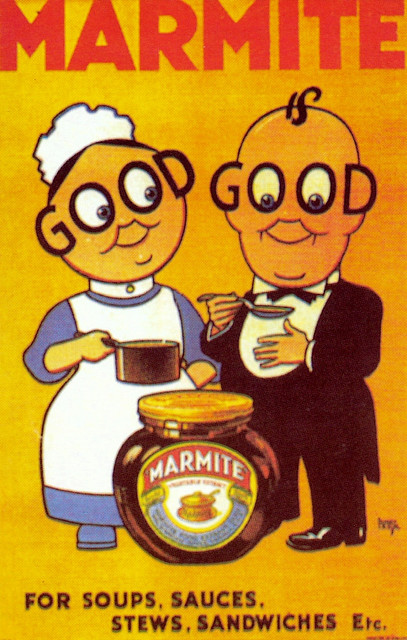
Marmite flavor crisps were also sampled, but they were as nothing compared to Marmite oven baked cashew nuts.  The pack said they were “just for Marmite nutters,” which seemed needlessly apologetic, and isn’t “oven baked” a tautology?   What else can you bake in?


Frankly, it sounded like something you might eat for a bet.  It seemed likely that the Marmite would ruin the taste of the cashews, but you know what, it didn’t.  The Marmite flavor was, well you could hardly say subtle, but more restrained that you might imagine, and cleverly balanced so that it was somehow equal and opposite to the taste of the nuts, so that both flavors came through.  The end result was, of course, very savory and salty, and bad for you in several ways I’m sure, but who doesn’t love that?  I was surprised and pleased by Marmite oven baked cashew nuts: a triumph for the jaded British palate.


I wasn’t in England long, and had other things to do besides explore the wilder shores of British snackery (and let’s be honest, a little goes a long way) but since I was on a pork safari, it only made sense to sample some pork scratchings, or as the packaging has it, pork rinds, or perhaps even pork crackles. 


The manufacturers of Mr Porky obviously feel the need for euphemism: anything to avoid using that indelicate word “skin.” There are at least four versions of Mr Porky but we only tried two: “best ever” and “prime cut.”  The prime cut tasted better and porkier, and maybe that was because they had the extra big pieces, or maybe they just used extra salt. The best thing about them was the warning on the packet: “only recommended for people with strong healthy teeth.”


They were OK, but frankly no pre-packaged pork scratching can compare with the “pork scraps” of my childhood (I’ll try not to get too Proustian here), sold in the pork shops of Sheffield and bought hot and in bulk, and yes, perfectly likely to crack your teeth.  They were also cheap as chips.  My fellow Mr. Porky eaters and I did wonder why these modern versions were so damn expensive: about 70 pence for 35 grammes in the case of the “best ever.”  There are a great, great many pigs slaughtered in the world every day, with a considerable quantity of skin on each pig, so why is skin such an expensive commodity?  And given also that so much of the pork you buy in supermarkets these days comes with the skin taken off so it can be sold as “lower fat,” here ought to be an Everest of pig skin just lying idle waiting for the scratching enthusiast to himself.  But there isn’t.  So where does all that skin go?

One answer is into gelatine, which of late has been much on my mind, chiefly because while I was in London I met up with Bompas and Parr, England’s finest and possibly only “Jellymongers.”  More of that in the next post.