Tuesday, June 14, 2011

OF WALKING N EATING


As some of you may know, I have another writing life in which I’m an enthusiastic, and occasionally obsessive, walker.  It seems to me that eating and walking go together pretty well.  Either you walk while you eat, or you walk to somewhere and eat when you get there.  In England, fish and chips work pretty well either way, though of course you have to be walking somewhere that has a fish and chip shop.  You can’t just stick some cod, chips and mushy peas in your back pack and dig them out when you get to a suitable peak.

The Germans and Austrians seem to do this rather better.  They have something called a “walking sausage,” more properly a landjaeger.  I first saw these on sale in the Pike Place market in Seattle and for some foolish reason didn’t buy one.


As it happens I’ve been reading some remarks about walking and food written by Grimod de la Reyniere, he of the Almanch Des Gourmands.  He has a couple of interesting things to say.  One, “It is a proven fact that all centenarians have been prodigious walkers,” about which I don’t feel qualified to comment.  And two, “A morning constitutional of four or five leagues is one of the best ways of seasoning the dinner that greets you on your arrival.  A similar walk back has a singular faculty of aiding the digestion.” Now this is very slightly confusing because a league has been different distances at different times in French history, but it was never less than 2 miles, and at the time Grimod was writing I believe a league was 2.66 miles.  So essentially he’s suggesting a 24 mile walk with dinner in the middle, which certainly makes a hole in the day. 

Grimod also says “a true gourmand never ventures abroad without an emetic about his person” which would surely make walking with him quite a performance.


I decided to consult Colin Fletcher’s The Complete Walker.  That's him above, and I imagine walking with him was quite a performance too.  The edition I have of The Complete Walker contains a 130 page chapter titled Kitchen, and within that about 40 pages are devoted to food; lots of stuff about freeze dried food, empty calories and something he calls “new wave eaters.”  Frankly not all of this is relevant to the kind of walking I do, which tends not to involve a night spend out in the wilds, and if you ask me he’s talking about camping rather than walking.  Still, I found it interesting that Fletcher says “I carry three small bags of herbs on each trip, ringing the changes on ground cumin seeds, oregano, thyme, sage and Italian herb mix.  Other bags may hold garlic powder, dried onion flakes and imitation bacon chips.”  Well, why not?

And then I went to and see the movie The Trip with Steve Coogan and Rob Brydon.  That’s the poster above: for some reason they don’t have any wine in their glasses, and I assume there must be strange marketing reasons for that.  It’s a movie about two British men of a certain age who go on a slightly half-hearted gastronomic tour of parts of northern England.  They squabble a little, do competing impressions of Michael Caine and Sean Connery (among many others), and often they seem to be on the brink of discussing the meaning of life, but always manage to avoid it.

It’s a terrific film, and one indicator of its strength is that I’d been out of the theater for a couple of hours before I said to myself, “Wait a minute.  Isn’t this a bit like that movie Sideways?” 


Coogan and Brydon do a certain amount of walking over hills and dales, especially in the Lake District, but since they’re eating in fancy restaurants every night they don’t take three small bags of herbs with them, though one small joint does make an appearance.  And certainly there are no imitation bacon chips.

The actors play fictional versions of themselves, and the movie frequently makes you wonder what’s “real’ and what’s not.  So when they arrive at an improbable restaurant called L’enclume, in the middle of the English countryside, I was quite prepared to accept that this was some satirical invention by the filmmakers.  The guys are served by a waiter with a thick, creamy French accent who delivers martini glasses containing what he describes as a ”nice little appetizer.  You’ve got liquor made out of mallow leaves topped with a fizz made out of ginger beer, whisky as well as chili.” Steve Coogan says, though not to the waiter, “The consistency is a bit like … is a bit like snot, but it tastes great.”

                  
                   Anyway a little light Googling reveals that L’enclume really exists, though I find it hard to believe that anybody who works there can keep a straight face.  Today between their three tasting menus you can have, “Carrot sacks with brawn and juniper, fried cake and cress,” “Salt and vinegar crispy rice, cod 'yolk', cream of egg and garlic,” “Vintage potatoes in onion ashes, whey sauce flavoured with lovage and wood sorrel” and “Hake with chicken skin.”


Sometimes life is very hard for the satirist.  The world, and especially the food world, just keeps getting ever more beyond parody.  On the other hand, I do discover that L'enclume is also the French name for a sexual position that allows maximum penetration, so maybe the guys at the restaurant have even more reason to smirk.


Wednesday, June 8, 2011

PALTROW'S PROGRESS


Not like I’m obsessing about Gwyneth Paltrow or anything but a few weeks back there was a short piece in the New Yorker describing a launch party for her cookbook. Many a guest attested to Paltrow’s kitchen prowess, and then along came that famous bon viveur Michael Stipe, quoted as saying. “Once, a duck she was cooking caught fire, and she threw it in the pool.”  How we laughed. 

I, of course, wondered which poor minion got the job of removing the duck from the pool.  Somehow I imagine it wasn’t the divine Ms P. But hold on.  It appears that Gwyneth’s been telling the story herself on a British chat show, and it’s become considerably more baroque. On the Graham Norton Show it wasn’t just a duck, it was a whole “personal rotisserie.”  She described the event thus,  “I’ve been cooking for a long time now, so I’m pretty comfortable, but I actually had a horrible disaster last summer. I got this rotisserie and I wanted to rotisserie duck and it’s the perfect thing because all the fat renders off and you’re left with crispy duck … You have to put drip pans underneath the duck, but I’m such a moron that I didn’t realize one of the burners was on underneath the drip pans, so one of the pans caught fire. I don’t know if you’ve ever seen duck fat on fire, but it’s like a nuclear weapon and the whole thing exploded and we had to throw bits of it in the swimming pool. I had a fire extinguisher and I lost my eyebrows.” 

So now, it’s not the duck that’s on fire, but bits of the machine.  Even more crap.  Even more work for some poor bastard.

Anyway, of course I don’t know if any of this is actually true.  Nobody feels the need to tell the truth on chat shows or when New Yorker reporters are around.  Maybe it’s all just a joke.

But the composer Rossini (above), he of the Barber of Saville and William Tell,  and a more than adequate amateur chef, certainly wouldn’t have found it so funny.  According to unreliable history, Rossini wept only three times in his life: the first at the disaster of his first opera, the second when he heard Paganini play the violin, and finally, when he was at a picnic lunch on board a boat, and a turkey stuffed with truffles fell overboard.

Monday, June 6, 2011

ANDY WARHOL: GOURMET IRONIST

And speaking of art and food, I see that the Andy Monument has been erected in New York’s Union Square.  It’s a statue of Andy Warhol, by Rob Pruitt, and as you see, it’s life-size and silvered (actually chrome, apparently).  That’s a Bloomingdale’s shopping in his hand, and there’s a Polaroid camera round his neck.

It seems that the human instinct to make altars and shrines instantly came into play in Union Square and empty soup cans and flowers were immediately arranged around the base of the statue.  Not exactly inventive, but given some of Warhol’s other works (I’m thinking of the “oxidation” paintings) this is definitely a blessing.


Of course, it’s impossible to think of Warhol without thinking of Campbell’s soup, and the more you think about it, the more of a foodie he seems.


He made the movie Eat (above) in 1963 or 4 (scholars differ), a 45 minute movie of Robert Indiana eating mushrooms (very slowly).


In homage (for want of a better word) to this, in the 1980s Warhol appeared in a Japanese TV commercial for Burger King, which lasts just under 4 and a half minutes and shows him eating a burger, at more or less natural speed, but it’s far less compelling than Eat. Warhol seems painfully ill at ease in front of the camera.  Equally he’s not the guy making the movie.  He also looks extremely thin, which I take it owes more to speed than to burgers.


I found myself browsing through the Warhol diaries and there’s quite a bit of fun stuff related to food in there.  He goes to the Four Seasons restaurant: the place is packed: the food is terrible.


Priscilla Presley comes by the office for an interview and reveals that she never ate caviar in all the years she spent with Elvis: he’d have thrown her out of the house if he’d ever seen her eating fish.


Warhol goes to the Stage Delicatessen for “good Jewish Celebrity sandwiches” and says, “The ‘Diana Ross’ was the worst, though – liver with jelly and peanut butter.”


And best of all he meets Famous Amos, he of chocolate chip cookie fame, and asks the brilliant, idiot-savant question of why the cookies look different on the pack than they do in reality.  Amos says it would take too long to cook them so they looked that way.  Warhol raised no objection.  He understands perfectly that there need be no consistency between form and content.


I like the Andy Monument well enough but actually I think I prefer this one, in Bratislava. 
Call me naïve, but somehow it just looks more like him.


Friday, May 27, 2011

THE OTHER PINK MEAT


So the USDA in its infinite wisdom has set down new guidelines for the cooking of pork.  Now, they tell is, it’s OK to eat it cooked to an internal temperature of 145 degrees (down from 160) which will mean the end result may be slightly pink.  This in fact is the way I’ve been cooking pork for years, and a quick look around internet responses to the USDA guidelines suggests that one set of cooks were with me and had already decided a lower temperature was perfectly safe, while another set is going to continue overcooking their pork regardless.

The USDA website contains what they describe as a fact sheet, with the question “What is pork?” and they give a surprisingly interesting answer.  “Pork” they say “is the meat from hogs, or domestic swine. The domestication of "pigs" (immature hogs) for food dates back to about 7000 B.C. in the Middle East. However, evidence shows that Stone Age man ate wild boar, the hog's ancestor, and the earliest surviving pork recipe is Chinese, at least 2000 years old.” 

This may not exactly be news to culinary scholars, but it seems rather more than you’d expected from a government website.  And there’s lots more info there too, including the reasons why pork is a “red meat.”  Because, they say, “Oxygen is delivered to muscles by the red cells in the blood. One of the proteins in meat, myoglobin, holds the oxygen in the muscle. The amount of myoglobin in animal muscles determines the color of meat. Pork is classified a ‘red’ meat because it contains more myoglobin than chicken or fish. When fresh pork is cooked, it becomes lighter in color, but it is still a red meat. Pork is classed as ‘livestock’ along with veal, lamb and beef. All livestock are considered ‘red meat.’”


Well this is probably bad news to people who wanted to consider pork the “other white meat,” but who ever really believed that?


Of course I think about pigs often enough, with or without encouragement of the USDA, but I’ve always been thinking about them even more lately having acquired a copy of Giles MacDonogh’s book A Palate in Revolution, a study of Grimod de La Reyniere (that's him above), who is one of the first, arguably the first, professional food writer and restaurant critic, who published his Almanach des Gourmands in 8 volumes between 1803 and 1812. 


As a young man Grimod gave grand dinner parties in the family home during his parents’ absence.  When his father returned unexpectedly on one occasion to find a pig dressed up and presiding at the table, he disowned his son and sent him off to an abbey near to Nancy, where by Grimod’s own account he actually discovered the true joys of eating. 

Having a pig at the head of the table would have had a particular  significance for Grimod.  He was born without hands.  He had a claw at the end of his left arm, a webbed pincer on the right. His parents, wishing to assert there was no genetic taint in the family, claimed this was not a deformity but an injury sustained when the young Grimod had fallen into a pig pen.  In later life he had artificial hands fitted and encased them in white, possibly pig skin, gloves.  The image below, may be Grimod again, nobody's sure, but if so they've obviously made the hands look extremely lifelike.

One of Grimod’s favorite culinary japes was to stand with his false hands pressed against an exceptionally hot stove.  Those who saw this, and didn’t know about the artificial hands would assume the stove couldn’t be very hot, and so pressed their real flesh and blood hands against it.  With hilarious consequences.


The picture above was taken in Pioneertown in the Mojave desert, not so long ago.  It shows a fine looking pig, Vietnamese, I think, pot-bellied very possibly.  The hand belongs to the Loved One.  The glove is made of kid, not pigskin.  We are not monsters.

Saturday, May 21, 2011

UNDER THE HAT


 My life being as it is, I recently interviewed Ricky Jay, the sleight of hand artist, actor, writer, collector, and all round good man, for the San Francisco Chronicle.  We were there to talk about his new book Celebrations of Curious Characters, which I found just terrific, a wonderful mix of the personal and the historic, full both of telling local details and grand designs, some of them not entirely irrelevant to a blog titled Psycho-Gourmet.

I met Ricky Jay at his local deli and he ordered oatmeal with raisins, adding, “That sounds exotic.”  I wanted a bagel, and I wondered aloud if there might be anything exotic to be had in the bagel line.  Jay said,  “They have a variety – but if you order something like a quince bagel I’ll probably have to go to another table.”

Fortunately he didn’t have to go to another table, and he did tell me, though I knew it already from reading the book, that neither he nor his wife had ever drunk a whole cup of coffee, adding that he just didn’t like the taste and that, “It isn’t a religious thing.”


In one of the pieces in the book he writes about the time he was enrolled in the Cornell University School of Hotel and Restaurant management.  “I vaguely hoped to combine the talents of the cooking and gaming tables.”  It’s probably better for everybody that it didn’t work out.

He recounts that on the first day of class, the professor told his charges to light their ovens so they could preheat while he delivered a lecture.  At the end of the lecture the students’ apparently simple task was to cook bacon in the oven.  Keen to do what he was told, Jay reached into the oven and grabbed the top rack between his thumb and forefinger, with predictable results. He writes, “For years thereafter, the sound of the sizzle and the brand of the word AJAX on my digit were reminders of my all too literal acceptance of instruction: the stigmata of blind faith.”


In that same piece he describes the “culinary magic” of Sieur Herman Boaz who according to the 1795 playbill seen above concluded his act by asking six or eight ladies to think of a card, “and the cards so thought on will be found in and cut out of a roasted leg of mutton which will be brought upon the table hot.”


I would have liked to see that, though I did once see Jerry Sadowitz (above) - the foul-mouthed (though that wildly understates it) Anglo-Scottish magician/stand up comedian – produce cards from inside a watermelon.  At one point in his act Sadowitz started to rant lewdly against the famous, and over-priced, and not very good, Indian restaurant across the street from the venue, a prejudice I happened to absolutely share.


Ricky Jay also tells us about Charles Dickens’ occasional performances as a stage magician.  Dickens’ first biographer, John Forster, described the act which had as its finale a performance called “The Pudding” for which Dickens borrowed a man’s hat and, in just two minutes, cooked a plum pudding in it, “returning the hat at last, wholly ininjured by fire.”  Jay reckoned this was this well within the 19th century stage magician’s repertoire.  

In Dickens’ Night Walks he describes a man “known for his pudding,” though not plum in this case.  Dickens is sitting in a Bow Street coffee house one morning after his nocturnal ramblings, when a man enters, “in a high and long snuff-coloured coat, and shoes, and, to the best of my belief, nothing else but a hat, who took out of his hat a large cold meat pudding; a meat pudding so large that it was a very tight fit, and brought the lining of the hat out with it.”  The man who runs the coffee house provides the new arrival with a knife, but instead of cutting the pudding into slices the man “stabbed it, overhand, with the knife, like a mortal enemy; then took the knife out, wiped it on his sleeve, tore the pudding asunder with his fingers, and ate it all up.”

Despite having a cadaverous look about him, the man has a red face, which he explains he “inherited” from his mother, a red-faced drinking woman.  As he looked at her on her death bed he suddenly took on her complexion and it had stayed ever since.  Dickens concludes, “Somehow, the pudding seemed an unwholesome pudding after that, and I put myself in its way no more.”


At the risk of confirming every prejudice about English food, I should say that I grew up eating steak and kidney pudding.  The pastry was made with suet, and it came in a can and was steamed.  It's not a part of my childhood that I have much nostalgia for, but a little research reveals that Fray Bentos are still very much in the steak and kidney pudding business.  It never occurred to me how easily one of the puddings might fit into a hat, but suddenly I now see that all manner of Ricky Jay-style mischief would have been possible.  Another missed childhood opportunity.


Friday, May 20, 2011

REFRIED PALTROW


Look, I have nothing against Gwyneth Paltrow as an actress.  She is a pretty decent actress and she has very interesting tastes in shoes. But every time she opens her mouth to talk about food or cooking I just want to scream. Her latest foolish utterance comes in an interview with Elle magazine.
*
ELLE: Have you ever had a dinner party disaster?

GP: Yes! When I was about 19 and started cooking there was no “online,” so you couldn’t go to Epicurious.com or anything for help. I was having six people over for dinner, and I realized that I had bought all the ingredients for eggplant Parmesan, and had no recipe for it. I didn’t know you had to sweat the eggplant and then bread it and fry it first, so I just arranged raw eggplant in layers with mozzarella cheese and tomato sauce. It was so awful. I think we ended up ordering pizza.
*
But hold on GP, if you didn't have a recipe for eggplant Parmesan how could you possibly know what to go out and buy?  You couldn’t, could you?  And even if by some bizarre chance you randomly happened to buy all the ingredients for eggplant Parmesan, without a recipe how could you possibly know that’s what you’d bought?  By some magical process you knew what the ingredients were for eggplant Parmesan, by some random principle you bought them but then you didn’t know what to do with them?  This whole answer is complete gibberish, isn't it Gwyneth?  And you know it, don't you?  Stop it.  Just stop it right now.  

Nice plug for Epicurious.com however.  And here's a picture of Gwyneth kissing a chef who once said, "There are two ways of making a woman happy, and they both involve putting something into her.  Food is one of the things."


Tuesday, May 17, 2011

YOU CAN TAKE THE BOY OUT OF SHEFFIELD


I’ve been reading about George Orwell and Sheffield.  He stayed there, very briefly, March 2nd - 4th 1936 when he was researching The Road to Wigan Pier, his book that describes working class conditions in northern England during the Great Depression.  He famously wrote, "Sheffield, I suppose, could justly claim to be called the ugliest town in the Old World..."  He certainly had plenty of experience of ugly towns, including some outside the Old World, having been a policeman in Burma. The picture below, of a Sheffield steelworks, was taken by Emil Hoppe in 1925, and no doubt things had got worse by the time Orwell arrived.

Orwell also described Sheffield thus, “stone walls blackened by smoke, a shallow river yellow with chemicals, serrated flames, like circular saws, coming out from the cowls of the foundry chimneys, thump and scream of steam hammers (the iron seems to scream under the blow), smell of sulphur, yellow clay, backsides of women wagging laboriously from side to side as they shove their perambulators up the hills....”

To me this sounds both ancient and oddly familiar.  He is describing the environment in which my parents grew up.  They were born and raised in Sheffield (as was I), and they would both have been ten years old at the time Orwell was writing.


My dad (that’s him above – a victim of excessive hand-tinting rather than too much makeup) wasn’t much given to talking about the past, though on the rare occasions when he did, I don’t think he was given to exaggeration or self-pity either.  He used to tell the story that when he was a kid his evening meal often consisted of nothing more than a can of evaporated milk.  Perhaps surprisingly, he continued to like evaporated milk: you might think he'd have developed a hatred of it, but all through my childhood we had it every Sunday teatime with tinned fruit.


George Orwell was a great anthropologist in his own country and a wonderful observer of class, managing the rare feat of being both genuinely sympathetic and genuinely uncondescending. He kept a diary as he traveled, along with notes and cuttings, and the published form of the diary that covers the Sheffield visit contains the following item from the News of the World, dated March 1st – I guess he read it on the train on the way up.


LIVING on 4s. A WEEK: MAN'S DESCRIPTION OF HOW HE DOES IT.

Following the disclosures in the News of the World of parent who have to bring up big families on tiny incomes, a correspondent draws our attention to the case of a man who spends less than 4s. a week on food.

His week's supply and its cost is as follows:-

3 Wholemeal loaves 1/0
½ lb. Margarine 2½d
½ lb. Dripping 3d
1lb. Cheese 7d
1lb. Onions 1½d
1lb. Carrots 1½d
1lb Broken biscuits 4d
2lb. Dates 5d
1 Tin evaporated milk 5d
10 Oranges 5d

Total cost 3/11 ½

In fact the man in question lived in London, where things were supposedly a little easier than in the north. Still it makes for amazing reading, and you’ll notice the can of evaporated milk there on the list.

The man was spending the modern British equivalent of 25 pence: at today’s exhange rates that’s 40 cents.  I know it’s extremely hard to compare amounts of money from the past with those of the present. The website measuringworth.com offers various ways of calculating the comparison: using the retail price index 4 shillings comes out at £10.10, say $16 in today’s money.  That’s pretty hard living.

Just as an exercise, and I accept not a deeply meaningful one, I checked the items on that list against what they’d cost today, using the Safeway website as my source.  There are certainly cheaper supermarkets than Safeway, but we also know that food in poorer neighborhoods actually tends to cost more.  Prices are in dollars.

Food For Life 7 Grain Whole Wheat Bread - 24 Oz – (4.39 each) – 13.00
Imperial Spread (no dripping listed) .99
Lucerne Cheese Natural Sharp Cheddar – 1 pound - 4.19
Onions - 1 pound - 1.10
Carrots – I pound – 1.00
Bahlsen Hit Vanilla Cookies (I'm not exactly sure what these are, but they’re Safeways' cheapest (at $3 a pound, so call it half price if they were broken) 1.50
Dates (4.39 for 7 oz - 0.63 per ounce so for 2 pounds – ouch) 20.00
Safeway / Vons Evaporated Milk - 12 Fl. Oz. -  1.39
Oranges (navels 85c each) 8.50

Total 51.84

This obviously doesn’t mean a great deal – I assume 1936 wholemeal loaves were much cheaper than a modern Food For Life version, though as a proportion of the whole, the expenditure on bread is quite consistent.  But of course it’s the dates that put everything out of whack.  Would anybody ever spend two fifths of their food budget on dates?  And could dates ever really have been so cheap in England?


My father left home and Sheffield, and joined the Royal Navy as soon as he reasonably could, in 1941, aged 16.  He always said navy food wasn’t bad, but there was never enough of it, but I’m guessing that when you’re sixteen there’s never enough food, full stop.


When I was growing up in Sheffield, one of the regular Saturday morning outings was to go with my dad to the indoor food hall at what was the then newly-built Castle Market; a bit of 1960s Brutalist architecture that nobody liked at the time, but now considered a wonderful relic.  We’d go to a fish stall where I’d have a plate of tiny cockles and my dad would have a plate of large whelks.  If you think there was something vaguely pre-Oedipal about this, I think you may well have a point.

It turns out that at exactly this time, my best friend from Sheffield, Steve, was also being taken to the Castle Market by his dad.  Once in a while Steve and I compete to see who has the more authentically working class origins.  On this occasion Steve wins hands down.  While I was being taken for a plate of cockles, he and his dad were tucking into plates of tripe.  You just can’t compete with that.


I had no idea that this was standard Sheffield father-son bonding ritual until I discovered the Sheffield artist Pete McKee (born a good decade later than me) who paints stylized scenes from his own Sheffield childhood.


The one above is titled “Cockles in Castle Market” and it seems his experience was just the same as mine – whelks for dad (who looks infinitely groovier than my own dad), and cockles for the son, who in this incarnation has become faceless. I think I understand what he’s getting at.

Friday, May 13, 2011

MR. POTATO HEART


Regular readers of Psycho-Gourmet will know that I have a great affection both for art and for interestingly shaped potatoes.  But given how many potatoes there are in the world, and given how many I personally eat, it surprises me just how few quirky or interestingly shaped potatoes I ever find.  However, last week, in my bag of Yukon Golds I discovered this wonderful heart-shaped potato.


It was actually even more heart shaped than it looks in the picture – oh for a bit of 3D.  I kept it for a while but, you know, a potato only has a certain amount of life in it, so I decided I should eat it, and with some judicious cutting and frying I did manage to come up with a couple of vaguely heart-shaped potato slices.


I’m not claiming that this is great food art, or even potato art.  For that may I direct you to a Beirut-based artist named Ginou Choueiri, who makes potato-based artifacts that look like this.


The information I have says that he draws the faces on the potatoes, though I must say, looking at them I wonder whether it isn’t some kind of photographic process that puts them there.  Anyway, the coming together of the flaws in the skin of the potato and the features of the human face is somehow very alarming yet very compelling.

Which reminds me of an idea I had when I lived in New York.  As I walked down Lower Broadway I used to see these guys with little street stalls offering to write your name on a grain of rice.  I’m sure they don’t only exist in New York. There was no trick to it, the guys were just very careful and skillful, and they obviously had very steady hands.


But I thought it would be cool to set myself up in competition, and because I have an Irish heritage, I’d set up a stall that said, “Your name on a potato!”  And because the Irish are so well-loved in New York, how could it have failed?  It would have been best of all if your name was Spud.


There are a great many things I don’t understand about the restaurant business, but high on the list of mysteries is the success of the spud-u-like chain in Britain (OK I’m using the word restaurant pretty loosely here).


The business model is fairly amazing – you take a big cheap potato, fill it with something else almost as cheap – baked beans, coleslaw, egg mayonnaise - and then they can sell it at an incredible mark up, for 3 or 4 quid per spud.  Sounds like a recipe to print money, but how can customers not feel ripped off?


And I used to think that spud-u-like was the worst possible name for a restaurant but these days I think it’s kind of brilliant.  Even just typing it is a kind of silly pleasure.  It’s a bad name, a ridiculous name, a jokey name, but that’s OK because everybody’s in on the joke. 

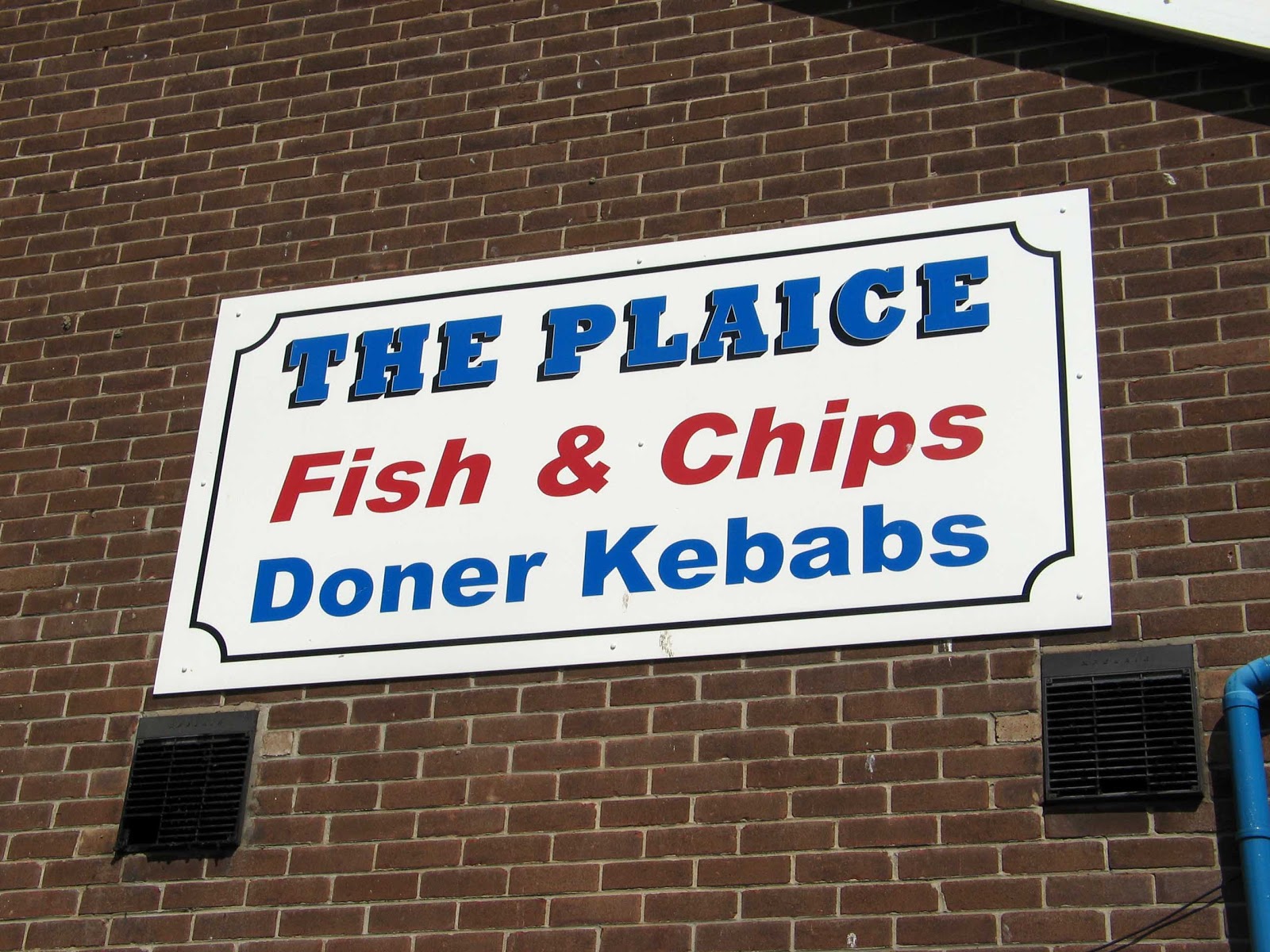
I think a little humour with your food is no bad thing.  I love this very humble sandwich bar, near to Liverpool Street station:  


You just know that all the local office workers have conversations along these lines:  One  says, “Shall we have lunch at the Ritz today?”  And the other one says, “I don’t know, I’m bored with the Ritz, let’s try the Savoy.”  How we laughed.