Showing posts with label raymond chandler. Show all posts

Thursday, March 31, 2022

HOLD THE FAUX

I’ve been rereading Raymond Chandler’s The Little Sister.


As we know, Chandler liked a drink and so did many of his characters. In The Little Sister we meet Dolores Gonzales – a faux ‘Mexican spitfire’ who at one point says to Marlowe ‘I wear black because I am beautiful and wicked – and lost’  

Reader, I’d be tempted to marry her.  Of course she also turns out to be a murderess, but in Chandler we pretty much expect that.


She was played in the poorly regarded film adaptation of the book, titled Marlowe, by Rita Moreno, who was born in Puerto Rico.


    In the novel Dolores also says, ‘We will have a drink … The goddamedest drink we will have … Scotch?  Or would you prefer a mixed drink?  I mix a perfectly loathsome martini.’

Well nobody’s perfect.


But Marlowe isn’t only about booze. He goes for something to eat

‘Down at the drug-store lunch counter I had time to inhale two cups of coffee and a melted cheese sandwich with two slivers of ersatz bacon embedded in it, like dead fish in the silt at the bottom of a drained pool.

‘I was crazy. I liked it.’


Here’s one I made earlier – ersatz-free.


Sunday, February 2, 2020

SOME LITERARY OYSTERS


Here is Herman Melville in Moby Dick: ‘Methinks that in looking at things spiritual, we are too much like oysters observing the sun through the water, and thinking that thick water the thinnest of air.’


OK, I understand the metaphor, but in what conceivable sense do oysters observe the sun?  Even in 1851 when Moby Dick was published, it must have been common knowledge that oysters don’t have eyes with which to do any observing.


But then in The Walrus and the Carpenter, 1872, Lewis Carroll gave them hands and feet, and I suppose ears.

"O Oysters, come and walk with us!"
The Walrus did beseech.
"A pleasant walk, a pleasant talk,
Along the briny beach:
We cannot do with more than four,
To give a hand to each."


And here’s Raymond Chandler writing in what I think is a faux-self-deprecating way about his first novel The Big Sleep, 1939 ‘My story is just another detective yarn that happens to be more interested in people than in plot, to try to stand on its own legs as a novel with the mystery a few drops of Tabasco on the oyster.’

 And here is the person I consider to be the greatest literary oyster eater: Isaak Dinesen, 


who accrding to legend consumed only oysters, grapes and Champagne, which I thought wouldn be the worst diet, though apparently not - at the time of her death she was suffering from malnutrition (and a few other unpleasant things as well) 

She did write however, in ‘The Deluge at Nordeney.’  

“Do you know a cure for me?"
"Why yes," he said, "I know a cure for everything. Salt water."
"Salt water?" I asked him.
"Yes," he said, "in one way or the other. Sweat, or tears, or the salt sea.”


The last of these is also the brine in oysters.


Thursday, November 29, 2018

BUTTER WOULDN'T WASH ...


I’m living in Chelsea, round the corner from a Waitrose supermarket.  The food and drink they sell are perfectly decent but they publish a free tabloid titled “Weekend” which makes me want to kill.

The current issue has Elton John on the front, and inside there’s an advertorial from Sipsmith for “Hot Gin.”  Hot water seems to be the main ingredient.  I mean, really?

Elsewhere in the paper there’s a Heston Blumenthal-inspired recipe for a gimlet but this ain't no ordinary gimlet.  It's one of these, the one on the far right I imagine:


And this is how you'd make it if you were of unsound mind:


Of course this isn't really a gimlet, and I balked at the nonsense about butter and cider, but I can think of one gimlet-fetishist who’d have reached for his roscoe at the very idea.  I mean Raymond Chandler of course.


And it so happens that Chandler lived, briefly, in Chelsea in 1958, not half a mile away from where I am, in Swan Walk.  Hold that thought.

         The best thing about my local branch of Waitrose is that they sell oysters – 79 pence each, which isn’t bad, but if you get there at the end of the day and there are just a few left, fewer than 6 I assume, then they knock down the price.  Last night I got three at 32 pence each.  They looked like this:


         Oysters appear here and there in Chandler, usually as similes or occasionally as an adjective – somebody wears an oyster-white raincoat, someone has oyster-white luggage.
I do like this from “Red Wind” which is about the implement rather than the bivalve - “She jumped as if she had been stuck with an oyster fork. Then she tried to smile. It wasn't very successful.”
       And there’s this from “Blackmailers Don’t Shoot,” Chandler’s first published detective story (1933):
“Mardonne came out from behind the desk. He moved jerkily, like a marionette. His eyes were as dead as stale oysters. Saliva drooled down his chin.”
Almost enough to put you off your oysters, but somehow not quite.


Sunday, March 25, 2018

THE GOOD LONG DRINK


The old joke, of course, is that an alcoholic is somebody who drinks more than his or her doctor, but I’m pretty sure my own doctor doesn’t drink at all.  I'm never sure where that leaves me.


I was told the story, supposedly true, that when the poet Taner Baybars (who I knew very slightly) went to live in France towards the end of his life, his drinking got out of hand.  He wasn’t in the best of health anyway, and so he went to see a French doctor who asked him how much he drank.  Taner answered truthfully that he was now up to three bottles of wine a day, and anticipating the doctor’s reaction said he was prepared to reduce his intake, but didn’t think he could get down below one bottle a day.  The doctor replied that getting down to one bottle a day was probably unnecessary but he really should try to limit it to two.

I’ve been thinking about doctors and drink because I’ve been reading Jim Thompson’s The Alcoholics, published in 1953.  I was seduced by the pulp jacket, shown at the top of this post, though actually I read it in this version:


As is usually the way with Thompson, the book’s a bit all over the place, and it contains this description of the way alcohol works:
“Everyone knew that when the the alcohol in the bloodstream reached a small fraction of one percent, the person through whom that bloodstream flowed became a corpse.  His heart stopped. He smothered.  Everyone knew that alcohol rose up the spinal canal to the brain, pressing harder and harder against the fragile cells until they exploded and their owner became an imbecile.”
         Now Thompson knew what he was talking about when it comes to drink – he spent time in clinics trying to dry out - but I really don’t know what he’s up to there.


The Alcoholics is set in a clinic run by one Dr. Murphy, and there’s a bad nurse who (if I’m reading it correctly) is also a bit of a nymphomaniac.  There are some curious similarities to One Flew Over the Cuckoo’s Nest, though Thompson’s  biographer Robert Polito says the book's “a pale rewrite” of Behind the Door of Delusion, published in 1932 under the pseudonym “Inmate Ward 8.”  The jacket here seems to have been designed by a bright 10 year old:


 There are also vague similarities to parts of The Long Goodbye, specifically Dr.
 Verringer’s clinic where the writer Roger Wade ends up.  Maybe Chandler also knew Behind the Door of Delusion.


Chandler certainly knew what he was talking about when it came to drink, and digging around on the interwebs I found this, from the Daily Independent Journal, Thursday Feb 24th 1955 (I think we can assume Chandler might have consumed a gimlet or two):


Still, what a time to have been alive, when writers made the news simply by being carted off to the funny farm.


Wednesday, March 7, 2018

THE GIMLET EYE

You know, in the past, it seems that people used to get a lot more excited about Rose's Lime Juice than they do these days.


I guess they figured it was a ladies' drink.  


Raymond Chandler (and Marlowe) would have been appalled. But they'd both have agreed (see The Long Goodbye) with the sentiment of this ad "always with Rose's." 


Sunday, June 18, 2017

THE CLEAR AND THE NOIR


I know my readers are a sophisticated bunch, so you’ve probably seen the movie of The Lady in the Lake (1947) – based on Chandler’s novel - where Marlowe is played by Robert Montgomery and also played by the camera so that everybody talks directly into the lens, hands the camera a cigarette, takes a swing at the camera, and so on, and we only see the actor when he appears in a mirror, which he does surprisingly often.  It’s kind of clever but it also kind of doesn’t work.


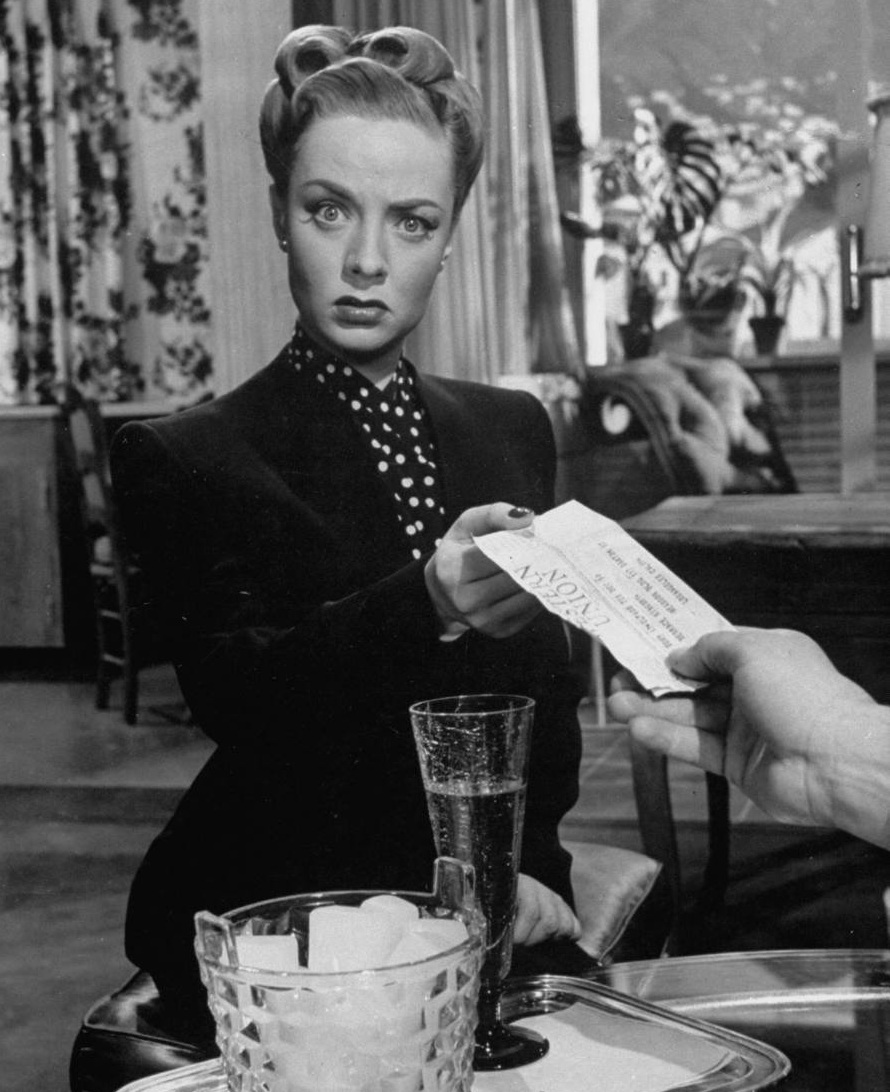
Still, the movie is much enlivened by the presence of Audrey Totter, an actress with a 40 year career, starting as a compelling yet not quite A-list movie actress, and later appearing in all kinds of TV series from Alfred Hitchcock Presents via Dr Kildare and Wagon Train right through to Murder She Wrote, which was her last appearance in 1987.  Here she is in Life magazine, in character I assume, though I haven't worked out which one:


By noir standards there really isn’t a lot of boozing in the movie of The Lady in the Lake, but there’s one scene where the Audrey Totter character (Adrienne Fromsett) takes Marlowe back to her apartment for a drink she returns from the kitchen with a bucket of ice and two tall glasses of some clear liquid (alas you can only see one of them here): 


And my question is: what’s in that glass?  Raw vodka?  Raw gin?  We know that noir women are hard-drinkers but surely even they didn’t serve tumblers of raw alcohol to their gentleman callers.  White wine?  Well that’s probably the best guess, though even in 1940s Hollywood that would surely have seemed a bit gauche.  Or perhaps there are some mysteries that even Marlowe isn’t meant to solve.


Thursday, October 1, 2015

WATERY SCUM


The London Mob is a scary thing, for its sympathizers as much as its opponents.  And last week there was an “anti-gentrification demonstration” in Shoreditch protesting about the increasing hipsterism and expense of the neighborhood.  Pigs’ heads and flaming torches were carried, apparently. 


A great deal of publicity has come the way of one of the targets, an establishment called the Cereal Killer Café, where hipsters (or idiots), can pay a few quid for a bowl of cereal served up by a couple of annoying blokes with beards.


Painted was thrown at the shop and the word “Scum” was written, backwards it appears, on the window.  In the history of rioting this is rather tame stuff, but no less stupid and misdirected for that.  These Cereal Killer boys should be mocked certainly, they should be treated with pity and contempt, but I’m not sure they really count as scum or as a meaningful target for class warfare.


Say what you like about scum of the Bellingdon Club, they don’t go down the East End and wreck eel and pie shops.  Hold on to that thought.


Now, every week I go into my local supermarket and look at the fancy beers.  There seem to be ever more of them, a sign of burgeoning hipsterism for sure. And of course the fanciness is often largely in the label, like this one:


As a man who loves a good labyrinth, I’m obviously tempted to buy a bottle or two, but then I look at the price, which is currently about $14, and think better of it..  When a bottle of beer costs more than an acceptable bottle of wine then something is a bit Koyannisqatis (“life out of balance”), as the Hopi would say.  So I settled for this, bottle of Payback Porter.


It was, as we say, “affordable” and to be honest I actually misread the name.  I thought it said Playback, and was therefore a reference to the Raymond Chandler novel of that title.  The beer of course is “noir” and many a noir book jacket would make a perfectly good beer label, if you ask me.


And then a few days later I went to the rather fancy Ray’s and Stark Bar, at the Los Angeles County Museum of Art, and ordered a bottle of Old Rasputin Russian Imperial Stout (that’s “Russian” as in brewed in Oregon) – again extremely noir, though in a different way.


The Old Rasputin cost $8 which I suppose is what you’d expect to pay in a fancy bar, and they did deliver some free potato chips (that's crisps for my English readers) which were pretty good.

And there on the counter of Ray’s and Stark Bar was the notorious 45 page “water menu” – it's the blue thing on the right of the picture above, a text for our times to be sure, like a wine list but for water – giving details of origins, mineral contents and what not – and also of course the prices. Let me quote, not quite at random, “Berg Water is a glacial water from western Greenland. As massive icebergs break off 15,000 year old glaciers, they are harvested and melted under strict purity guidelines to preserve the water’s natural qualities. The result is a water virtually untouched by man and with little to no trace of minerals.” 


I’m not sure about the environmental correctness of “harvesting” glaciers, but it’s not a moral dilemma that’s likely to affect me, since a three quarters of a liter bottle of Berg costs $20. If you accept my premise that a bottle of beer shouldn’t cost more than a bottle of wine, how you gonna feel when a bottle of water costs more than a bottle of vodka?
         This water menu has been much mocked, and rightly so, and is of course madly annoying as is its begetter, “water sommelier” Martin Riese. 


And I admit that a part of me did feel like rioting about it, and maybe daubing the word “Scum” somewhere about the premises, but I didn’t, I am a civilized man.  I also think the LACMA has some very serious and enthusiastic security men who’d just love to step in and beat up somebody like me.  They probably think I’m hipster scum.