Monday, May 9, 2011

GUILT FREE ADOLESCENCE


Sunday’s New York Post did a “Proustian Questionnaire” (their words) with five New York chefs who are in the running for a James Beard Award, the “Oscars of The Food World.”  And oh, what a mixed bag of answers it produced and oh how the chefs dispensed a staggering mélange of commonsense and the worst kind of disingenuous posing.


It’s good to know for instance that Michael White, of Marea et al, (above) thinks food trucks are the most overrated food trend, and that Michael Anthony of Gramercy Tavern (below) feels the same way about veganism.  I mean it’s good in the sense that I share their prejudices.


But there were a couple of questions that really undid the chefs.  The first was, if they could only eat one thing for the rest of their life what would it be? Michael Anthony came up with soft-shelled crabs: right, how could that ever get old?  And April Bloomfield (below) of The Spotted Pig said (wait for it) vegetables, which strikes me as about as smart as saying “groceries.”  “Vegetables” is really not one food, is it now?


But the part of the questionnaire that produced the most absurdity was, “My guiltiest food pleasure is ...”  Michael Anthony feels guilty about ice cream, Bloomfield guilty about Twix.  Oh gimme a break.  And White said (I’m not making this up) roast goose.  Oh hell yes, Michael, we’ve all been down that slippery road of self-reproach.


At least Wylie Dufresne (above) had the good sense to be guilty about something worth being guilty about: American cheese, though since he said cheese was the one food he’d want to eat for the rest of his life this wasn’t a complete surprise.  Actually his answers were pretty good, including his opinion that ramps were the most overrated food trend “at least for this month.”


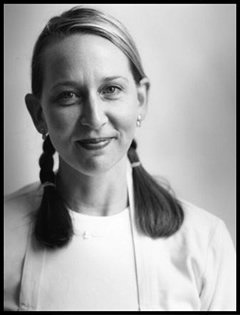
 But it was left to Gabrielle Hamilton (above) of Prune to say “Never ever associate the word ‘guilt’ with ‘food’ or ‘pleasure’.”  Good for her.  What a great attitude.  What a good woman.  I’m even tempted to go to her restaurant, though since it only seats 30 crammed diners at a time this won’t be easy.

Actually I thought somebody’s guiltiest food pleasure might be charging $98 for a vegetable tasting menu (that’s the Gramercy Tavern), or $140 for a serving of Chinese caviar (that’s at Marea), but this seems to be an entirely guilt-free area.

But I’m not bringing this up simply to mock my betters.  And these chefs are by no means the worst.  I know people who feel guilty if they eat a slice of bread, and as for smearing it with butter … But it intrigues me that guilt seems to be such an important part of the human psyche when it comes to pleasure.


A lot of people have shed their guilt about sex.  What you do with you sex organs is now widely regarded as a matter of preference rather than morality.  So the morality gets displaced.  Now food is the arena where morality gets played out.  It’s wrong to eat food that isn’t organic, wrong to eat food that isn’t locally sourced, wrong to eat anything that isn’t free range or low fat or without antibiotics.


The real problem is that food manufacturers exploit that guilt.  It’s virtually impossible to enter a supermarket and but something that isn’t announcing how natural and healthy it is.  I just went into my own kitchen to look for evidence:  it’s all too easy to come by. 
The raisins announce themselves as “a fat free food,” which is so good to know.  A pack of tortillas can’t be fat free but it declares “no lard.”  The mayonnaise tells me it “supports a heart healthy diet.” Wow – that’s so great, absolutely nothing to feel guilty about there.  Maybe I’ll have to hunt down a goose, just for the sheer illicit pleasure of it


And here, in the picture below, are Wylie and Gabrielle, looking deliciously guilt-free.  Maybe it's something they ate.


Monday, May 2, 2011

CHOCOLATE MEAT POPCORN


After the mention of Wim Delvoye in my previous post, Jen Wardle commented about Delvoye’s “meat floors” which I’d never seen before: various parquet-style floor tile patterns, with the colors and textures of sliced meat.  They look amazing, as seen in the pictures above and below.


And yet I couldn’t help being a little bit disappointed to discover that the floors weren’t made of actual meat.  They were only images, scans of meat, so that the floors were actually covered in photographs.  I can see that a gallery floor laid out with slices of meat might get a bit rank before too long, but a man like Delvoye who builds a machine to create poop, and then sells the end product, might have been expected to go all the way.


When I arrived in Los Angeles, one of the first art exhibitions I saw was Ed Ruscha's “Chocolate Room” at MOCA. It consisted of 360 sheets of paper silk-screened with real chocolate and arranged around the walls of a gallery.  The best thing about it, naturally, was the smell.


In fact the work was a recreation of something Ruscha had done at the Venice Biennale in 1970, and this was touted as “a major new MOCA acquisition.”  Which I assume means that the sheets of chocolaty paper are currently being stored in a climate controlled art vault somewhere in LA, and I can’t help wondering what kind of archival process is used to guarantee that the smell stays fresh and intense.  We all know that old chocolate can get very unappealing indeed.  I believe "bloom" is the technical term.


In fact Ruscha’s title “Chocolate Room” was a bit of a misnomer, it was really just chocolate walls, or even chocolate wallpaper.  The gallery floor and ceiling were left bare, which I think was a missed opportunity.  Why not a chocolate floor?  Or in the interests of collaboration why not chocolate walls and a meat floor?  And for that matter, why not a popcorn ceiling?


Thursday, April 28, 2011

WITH THE PIGS IN AMERICA


The Daily Mail, that bastion of English manners and morals (and a newspaper that has always reviewed my books very fairly) had its knickers in a twist recently on discovering that children can go on line, buy tattooing kits for just 30 quid, and in the Mail’s terms be “branded for life,” although branding, it seems to me, is a rather different type of body modification.

They cited the case of 16-year-old, Levi Brady, from Cardiff, who had the phrase ‘100% Welsh Lamb’ tattooed on her lower back.  Apparently this was done by a professional, though not an especially good one judging from the picture below.


Levi’s mom, Renee, was quoted as saying, “The tattooist has branded a child as a piece of meat for the rest of her life.  It is the most disgusting thing to have on a young girl and the location of the tattoo is grossly inappropriate.”

Well I certainly don’t think getting tattooed as “100% Welsh Lamb” is exactly a good idea, especially since at some point young Levi may be accused of being mutton tattooed as lamb.  But when you see some of the appalling things that people have tattooed on their bodies, she could have done much, much worse.


I don’t suppose I’ll ever get a tattoo.  I’ve thought about it on and off for at least 25 years but the big problem is that I could never decided what to get.  It never at any point crossed my mind that a food related tattoo was an option, but apparently many others feel differently.


Quite a few seem to go for the butchery option, most often a pig.  I have to say I find this oddly appealing.  Some of them really are quite well drawn.  Like this one:


Arguably such a tattoo would "brand" you as a pig (or at least a pork lover) for the rest of their lives, but I guess some people can live with that.  The pig also has the bonus of offending Jews, Muslims and vegetarians alike.  


At least there seems to be something classic about meat imagery.  Cupcake imagery I’m not so sure about, but there seem to be tons of cupcake tattoos around, and the feet are a popular place to have them.  


I suppose if you get tired of a foot tattoo you can always keep your socks on.  It’s much harder when you have a massive one tattooed across your chest.


No, no, really, how could anybody possibly live to regret a tattoo like that? This one apparently belongs to a woman called Robin who was studying baking and patisserie at the Texas Culinary Academy. I wonder if she’s considering a career change yet.


There are loads of tattoos of beer cans and soup cans, tattoos of Colonel Sanders, Aunt Jemima, Ronald McDonald et al.  And of course fast food logos have already been designed to be powerful and eye catching and symbolic, so hey, wouldn’t it be a great idea to have them tattooed all over your body?


All of which brings me to Wim Delvoye, a Belgian artist whose work I first saw in New York where he’d created an installation known as “Cloaca”, a giant poop making machine.   That's it below.  Food goes in one end, undergoes many mechanical and chemical processes and thoroughly lifelike feces are eventually excreted.


As you see, the machine was as big as a bus and it left you feeling what an amazing thing the human body is, that nature could so easily produce what art and science could only do with enormous difficulty and effort.  It also, of course, sticks it to the art world, which is always fun.


Since 1990 or so Delvoye has also been tattooing pigs.  I have to say this doesn’t seem entirely right to me, I mean it’s got to hurt the pig somewhat, the pig can’t give consent, etc, but then a lot of things are done to pigs that they would probably never consent to, and in fact the pigs in the pictures look happy enough post-tattooing, though in some cases they're taxidermied, so it's not all that easy to tell.


What I thought might be really cool would be to own a pet pig, have a pig butchery diagram tattooed on your body, then have a human butchery diagram tattooed on the pig. 


Wouldn’t that be cool? I don’t think I’m going to go that route personally but I hope somebody else does: knowing the way of the world, somebody may be at it right now.


Thursday, April 21, 2011

AUTO PARTS


And speaking of Titus Andronicus, like many of you I’ve recently become aware of the story of John “Pricey” Price (great nickname – that’s him above), an Australian man, whose “de facto” wife Katherine Knight, murdered him, and cooked him intending to feed him to his adult children.  Apparently it happened in New South Wales back in 2000, and she was convicted in 2001, but it only seems to have become a hot news item now because the woman’s appeal has been (understandably) turned down. 

 
The story goes that Knight (above) stabbed Price 37 times with a butcher's knife, then skinned him and hung the hide from a meat hook in their “lounge room.” Then she decapitated him and put his head in a pot on the stove and began stewing it, then cut some flesh from his buttocks and baked it.  Many  veggies and gravy were also on the menu.  The police arrived at the house before the children did, and dinner was never served, which all in all is a very good thing.  But even if the kids had arrived first, the human pelt hanging from the ceiling might surely have suggested that something wasn’t quite right.

My awareness of the case coincided with news of an exhibition in Paris.  It came to me as a news alert from the Taipei Times (though the story originated with Bloomberg) and it was headlined “Broiled buttocks? 
Or perhaps a pair of braised breasts?”  It was referring to the opinion of St Jerome, who in his treatise Against Jovianus describes the cannibalistic preferences of the Attacots, a wild tribe living in Roman Britain.  Evidence of the Attacots and what they got up to is extremely scarce, but if you can’t trust a saint, who can you trust?

The exhibition was “Tous Cannibales” at the Maison Rouge and as I write it’s still on display until May.  The exhibition deomnstrates the way artists have used the imagery of cannibalism in their work. I had was especially taken with this piece  below, by Yasumasa Morimura, a Japanese artist/photographer who inserts himself into famous artworks.


The work is titled Exchange of Devouring and of course he’s turned himself into Goya’s Saturn who either is or isn’t eating his own children.  In fact I believe that “child’s” body is actually his own, so to be precise it’s an act of auto-cannibalism.


However the real revelation of the exhibition Michel Journiac one of the founders of the “Art Corporel” moment, and yes I’m sure there are places where they talk of little else, but I’d never heard of him.  A video of his 1969 performance art piece Messe Pour un Corps (Mass for a Body) was in the exhibition, a parody of the Catholic mass in which he dressed up as priest and offered the audience pieces of blood sausage made with his own blood.  I don’t know how many accepted.


Above is a picture of him giving his blood, which suggests to me he was making a bit of a drama out of it.  I mean, I have blood drawn a couple of times a year and there’s really no need for the long face.  The phlebotomist and I chat away happily throughout the whole business, and I confess that I always think of asking her to draw an extra test-tube full of the stuff so I can take it home with me and do something culinary with it, make blood jelly the way the Vietnamese do with duck’s blood.  In truth however I never have the nerve: you don’t want your phlebotomist to think you’re a nut job, do you?


Anyway, I did manage to find Journiac’s recipe for “boudin au sang humain” on a website called paris-art.com and frankly it sounds a little tame.  90 cubic centimeters of human blood, 90 grams of animal fat, 90 grams of chopped onions, salt, and “un boyau salé ramolli à l'eau froide puis épongé” which I assume is a casing, but my French, and my online translators, don’t allow me to be absolutely certain.

But the real objection is the quantity of blood.  A cubic centimeter is a milliliter and a milliliter is 0.00211337642 US pints.  So 90 milliliters is 0.190203 pints  or 0.38 of a cup which is frankly bugger all.  I think he should at least have been prepared to give a pint.

And I’m also unimpressed by the 90 grams of animal fat.  What a cop out.  The last time I was having blood taken, I wondered how I might find a tame liposuctionist who would out suck a few pounds of my blubber and let me take it away with me so that I could make a real Nicholson blood sausage.  Or, since I’m a Yorkshireman, I’d probably call it black pudding.

I suppose, for all sorts of reasons, that it’ll never happen, not least because everyone would say, but Geoff, that French dude Journiac got there first. 


 I have to say this isn’t one of the greatest artist disappointments of my life, and in any case I was easily cheered up last night when I went to Boardner’s my favorite Hollywood watering, and not nearly as glam as it looks in the ad.  I often go there for a quick drink before heading off somewhere fancier and sometimes I end up just staying there instead.

There’s always been cheap happy hour food but now they’ve revamped the menu and includes morcilla (Spanish blood sausage) with quail eggs.  Oh boy!  It looked like this.


Something tells me this might be a bit fancy for the regular clientele of Boardners.  Some people from my wife’s office went there and gasped in disbelief at the notion that quails might lay eggs - but I really, really do hope not.  On the way home I wondered where the chef sourced his morcilla.

Tuesday, April 19, 2011

EATING WILL SELF AND OTHERS


And speaking of eating alone, I’ve been reading Will Self’s new novel Walking To Hollywood.  As a solitary pedestrian and psychogeographer, Self (and the narrator of the book, also named Will Self) inevitably does a lot of eating alone, whether in bed and breakfasts, pubs, greasy spoons, or as the sole customer in sad Indian restaurants lit by fluorescent tubes.


Actually I do believe some of the most excruciating moments of my life have been in English bed and breakfasts, being forced to share a breakfast table with complete strangers.   Breakfast is part of the process by which I become fully human: having to share space with others (and - god forbid - talk to them) before I’m human, can make me turn positively feral.

Here’s Self’s terrific description of a meal in the Board Inn, somewhere in Yorkshire, a place with raffia table mats, and a menu that features “Rioja,” the quotation marks suggesting that it may not be Rioja at all.  He goes for the lamb balti.


       “The girl … took my order, then a while later she came back again with a little kahari on a plate, a stack of tiny rotis beside it and a small mound of white rice.  I decanted the meaty sludge and began eating with the labored precision that is the very hallmark of solitude … I chased rice grain with tine around the stadium of my plate.”

Pretty good that, and I also liked, or rather shuddered at, his description of a pharmacy assistant with a “feijoada complexion  ... in the fatty mass of which swam morsels of acne.”  I can’t say that I eat feijoada every day, but the next time I do it will be extremely difficult to keep that image out of my mind.  Thanks a bunch, Will.


Tuesday, April 12, 2011

PARTY OF NONE

Here's my latest at Gourmet live


GOURMET LIVE BLOG

APP EXCLUSIVE: TABLE FOR ONE

The below full-length version of Table for One, by Geoff Nicholson, appears in the current issue of Gourmet Live. Download the free Gourmet Live app to get this story and more.


Photo by Getty Images
I went to Musso and Frank Grill last week, one of my favorite restaurants, and Hollywood’s oldest, dating from 1919. I ate there alone and I didn’t try to find anybody to go with me. I realized that the maximum pleasure I could get at that moment was to sit alone on a red leather banquette at one of Musso’s smaller tables, to order a martini, a steak and a glass of red wine, to be served by the serious, unfussy waiters, to take my time, to linger, to savor the food and the atmosphere, and to enjoy it in a way that wouldn’t quite have been possible if I’d had company. It was perfect.
I wouldn’t always have felt that way. I once regarded eating alone in public as humiliating torture. In fact there was a time when I longed for Warhol’s idea for the Andy-Mat chain of restaurants to conquer the world. His concept was brilliantly simple. The restaurants were to be somewhat like the old automats, with food bought from coin operated machines, but in Warhol’s version, once you’d got your food, you scurried away into a booth for one, and watched television as you ate.

This may initially have been some jokey, throwaway conceit that Warhol dreamed up while writing From A to B and Back Again, but before long he’d found financial partners, an architect to design the interiors, and Loulou de la Falaise to devise a menu. They even had a location for the first one, on Madison Avenue at 74th street, due to open in the fall of 1977. But it never happened. Reading between the lines it sounds as though everything got way too complicated (there were half-baked ideas about orders being sent to the kitchen via pneumatic tubes), or maybe everybody just sobered up. In any case it all fell through, which I used to think was a terrible shame, but now I’m not so sure.


In retrospect it seems that by far the biggest obstacle facing the enterprise was Warhol’s proposed slogan: “The Restaurant for the Lonely Person.” I just don’t think anybody wants to be defined as a lonely person, and if you are genuinely lonely, then going out to a restaurant and sitting alone in a booth, watching reruns of, say, Two And A Half Men would surely make you feel absolutely desolate.
More than that—and here’s why I edged away from the Warholian concept—why should the solitary diner have to hide away in a booth? Why can’t a singleton go into a restaurant, have a table for one, and enjoy all the pleasures that eating out has to offer? And the obvious answer, of course, is that he or she can, and I am proof of this. It took some time, training, and self-discipline, and there were certainly some hiccups along the way, but it’s a skill I’m very glad to have acquired.
The first thing to overcome is that feeling that people in the restaurant are looking at you with contempt, thinking what a loser you are. Well, as your mother might have told you, this kind of self-consciousness is really just arrogance. Chances are you’re not the main focus of other people’s attention, and if you are then they’re far more pathetic than you.
The next thing to overcome is other people’s pity, especially that of the waitstaff. You know things are bad when the waitress speaks to you in soothing, reassuring tones as though you’ve experienced some recent tragedy or trauma. If you have in fact experienced some recent tragedy or trauma this must be far, far worse.
The best way of defusing both contempt and pity is to be totally unapologetic, to behave as though eating alone is the most natural thing in the world—because it is. If you present yourself as confident and self-possessed, if you behave like someone who’s happy to eat alone, then others will accept that’s exactly what you are. In the early stages this may be just an act, but sooner or later the act becomes the thing itself.
Generally, the more serious and grown up a restaurant, the more likely it is to make the solo diner feel welcome. A table for one at Hooters probably isn’t going to be the most comfortable experience, but the staff at Sardi’s in New York or Fergus Henderson’s St. John in London are going to take it completely in their stride. The food will admittedly be rather more intriguing at the latter, roast marrow bone for instance, as opposed to Sardi’s Jumbo Lump Crabcakes. And you’d imagine that any Gordon Ramsay restaurant would be OK since, if Kitchen Nightmares is to be believed, Ramsay himself spends half his life eating alone, though I suppose we’d all feel less alone if we had a camera crew with us.
I understand the need for props—a laptop or a cell phone for instance—but playing Angry Birds as you wait for the food to come just makes you look like a twerp. As for checking tweets and Facebook messages, well that does raise the question: If you’re part of such a great social network, how come nobody will be seen eating in public with you?
You’re probably better off with a book, but you have to be careful what you choose. Reading Proust with your sushi is just pretentious. As for that wonderful scene in Scorsese’s After Hours where Griffin Dunne recognizes Rosanna Arquette as a potential soulmate because she’s in a restaurant reading Tropic of Cancer, well that’s just pure wishful fantasy. And as you may remember, that movie meeting results in a lost night in lower Manhattan from which the hero barely escapes with his life.


And as a matter of fact it was largely in Lower Manhattan that I taught myself to eat alone, in places such as Gonzalez y Gonzalez, Jerry’s, the Canteen, Marian’s, most of them now gone. One that remains, and one of my very favorites, is Noho Star on Lafayette Street. It’s been in existence for 25 years but I’ve only been going there for about half that time. One of the great attractions here for a man dipping his toe in the waters of solo dining is that each table has a spotlight above it so that a tight cone of illumination lights up the table and your plate of Bill’s Special Baked Meatloaf, while leaving the solitary diner discreetly in the shadows.
In New York I ate alone out of necessity because I hardly knew anybody when I first arrived there. Naturally that changed after a while, but circumstances can make solo diners of us all, especially when we’re tourists or on business trips. Being away from home also allows you to play the suave, international man of mystery. Admittedly this is easier in some places than others.
I remember a night when I was in Tampa doing some research, and I wound up in the Ranch House Grill right down the road from my motel. The walls were festooned with taxidermy, wagon wheels, and displays of lassoes. The place was quiet, the waitresses were warm without being intrusive and it was really terrific. But if it hadn’t been, well so what? I’d never been there before, I’d never go there again: it really didn’t matter what the staff thought of me or what I thought of them. I would have survived a disaster, but I was glad to do much more than survive.


On another occasion I found myself in Alice Springs on a Saturday night, looking for somewhere to eat. I was now playing at being Bruce Chatwin. Every restaurant in town was packed and rowdy and none looked like the place for a solitary diner, but eventually I found The Overlanders Steakhouse. They didn’t have a table for one but they seated me at the “Overlanders Table” alongside twenty or so other desert waifs and strays. The prospect horrified me—all the anxiety of eating alone, along with all the anxiety of socializing with a bunch of complete strangers. But in the end it was fine. Before long we were all friends and I was eating the best camel steak I’ve ever had. Of course, what constitutes a fun idea when you’re in the middle of the Australian outback, mightn’t be so appealing when you’re home. It looks, however, as though I may have to get used to it.
Having taught myself to eat alone, I find that communal dining is becoming a widespread and supposedly exciting trend. One of the hottest new restaurants in Los Angeles is A-Frame, lodged in a former International House of Pancakes. Early reviews described it as hyper-casual which sounded fine, but then I read that owners Roi Choi and David Reiss wanted to create a “family-style dining environment;”, which of course begs the question of which family: The Kardashians, the Borgias, the Mansons? But I finally knew this restaurant wasn’t for me when Reiss said in an interview: “We wanted people to eat with their hands and share, and we wanted it to be full-on communal everything. People are sharing with people who they’ve never talked to in their lives, and that’s really cool for us.” Whether it’s really cool for the people doing the sharing remains to be seen. I guess I won’t be going to find out.


I accept, naturally, that sharing tables isn’t exactly a novelty. We’ve all shared tables at school, college and work, often with people we’d prefer to avoid. The long, refectory table was first used by medieval monks, and mimicked a millennium or so later by the Belgo restaurant chain when it set up shop in London in the early 1990s. (There was a short-lived New York version later in the decade). With Belgo however, there was always so much else going on—the waiters in monks’ habits, quotations from Rabelais carved into the walls, the raspberry flavored beers—that you accepted the communal table as just another eccentricity. And I’m sure that fans of Le Pain Quotidian accept their communal tables as part of the “philosophy.”
You could also argue that some restaurants are so cramped and the tables so close together that you essentially end up sharing anyway. And certainly if you’re one of the lucky few who gets a reservation at David Chang’s Momofuku Ko—just 12 seats arranged around a counter—you’re bound to be brought into some kind of intimacy with your fellow diners, like it or not.


I can certainly see the attractions of very small restaurants, and I started fantasizing about a restaurant for one, with one table and one chair and a small but very attentive staff. As far as I know, no such establishment exists but I have discovered a restaurant that only accommodates two customers per night (though I confess I haven’t been there). It’s the Solo Per Due (which translates as Just for Two) in Vacona, in central Italy. It is actually part of a large estate complete with Roman ruins, but while eating you have the tiny dining room entirely to yourself, and waiters are so discreet they have to be summoned by a bell. Discretion aside, the restaurant also prides itself on providing special services, offering to lay on personalized flower arrangements and firework displays.


Solo Per Due is intended for that once in a lifetime romantic dinner for two but I can’t help wondering how they’d react if you booked the table and turned up by yourself. This would surely be taking solo dining to its furthest extreme. I also wonder just how far the special services extend. I wonder if they’d be prepared to supply a TV for you to watch while eating.


*
Gourmet Live can be found at:       http://live.gourmet.com/