Showing posts with label Pheasant. Show all posts

Sunday, December 26, 2021

XMAS FOODIES


This being the season of good cheer and good food ...


...I found myself reading a wonderfully sour article by Jonathan 

Meades, titled ‘Meat on Canvas.’  Here’s a good bit about food 

photography,

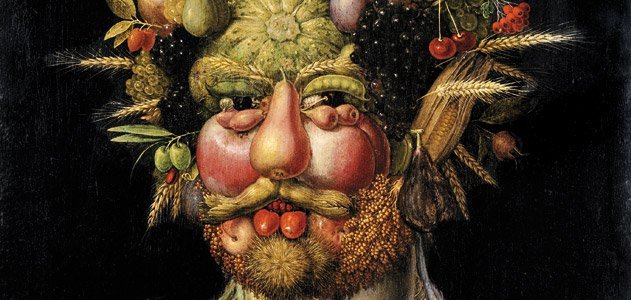
‘As a result of the food photographers who see themselves as heirs to Archibaldo and Miro … chefs have submitted to the dictates of art direction. They make food which is to be looked at … They talk about presentation, all the time, believe me they do.’


Of course he was talking about professional food photographers and professional chefs, and this was written in 1986 when ‘social media’ were a sci-fi writer’s fantasy.  But these days, half the world seem to be food photographers, and a quick riffle through the social media of people I follow has brought up all manner of pleasures, that are a long way from being Archimbaldian

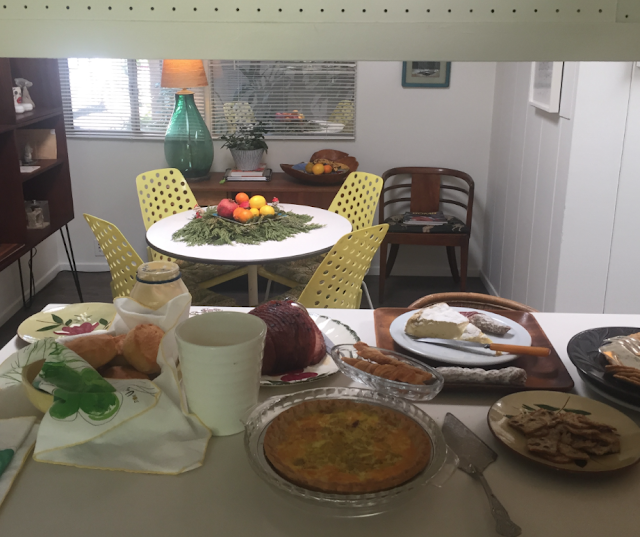
Here, for example, is William Basinski’s  ‘Xmas schorgasboard … root beer glazed ham, quiche lorraine, buttahmilk buisquits, brie and Italian salami and crackers & what-not for noshing and grazing.’


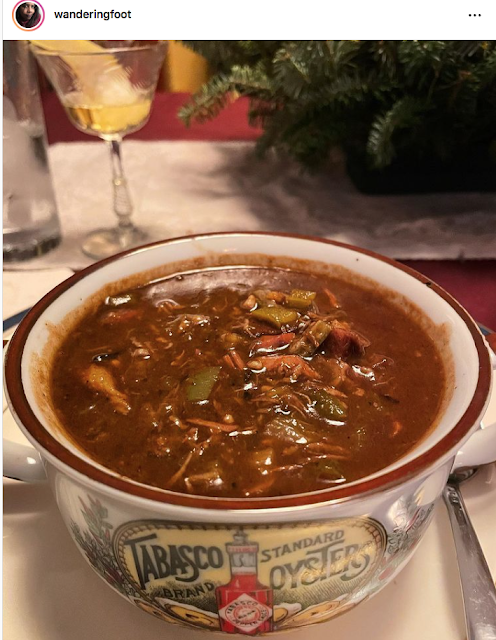
This is Christmas Gumbo as eaten by Lynell George:


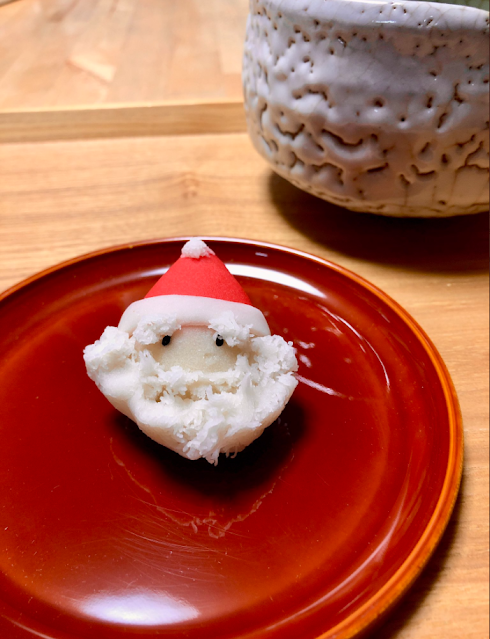
This is a mutant Santa from Food Sake Tokyo:


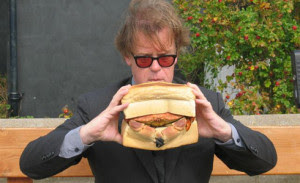
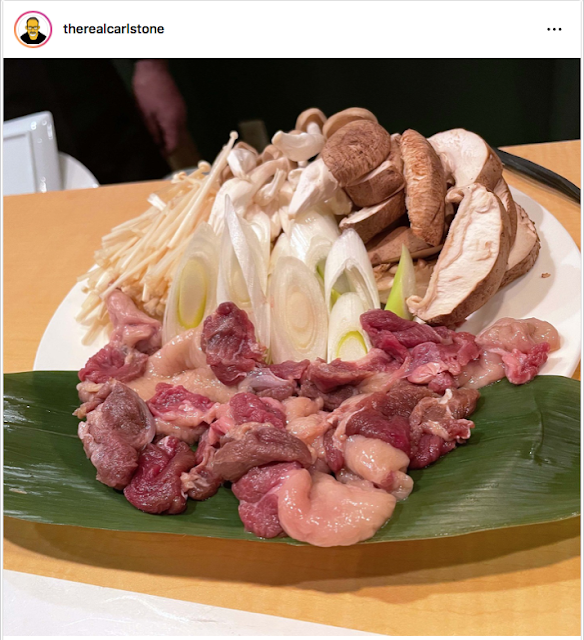
And this also Tokyo, and more or less unimprovable, is a photograph Carl Stone put on Instagram labelled 熊すき焼きwhich I gather translates translates as Bear Sukiyaki.  


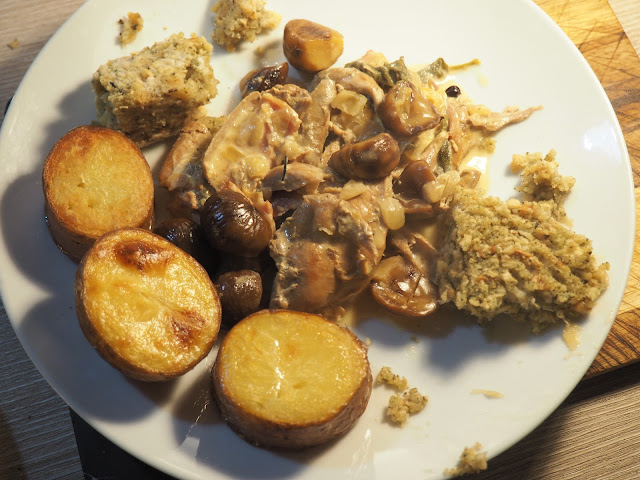
And since you ask, this was my pheasant and chestnut casserole; which could have been better, though I’m not sure what I’d have done to make it better.  I don't think snazzier presentation would have been the answer, though it could have done no harm:


Thursday, November 11, 2021

PUB DAY

To celebrate publication of my book The Suburbanist - see below, and yes it does contain a chapter about 'suburban food,' my editor took me out to a pub for lunch; the Mistley Thorn, in Mistley - witch finder territory.


My lunch included some Mersea oysters which were everything an oyster should be.

And because my editor belongs to the hunting and shooting class (not sure whether or not he fishes) he brought with him a brace of recently bagged pheasants,  My job, in a day or two, will be to debag them.


The book:


Wednesday, September 4, 2013

THE PHEASANT OUTLOOK


My old university college sometimes served pheasant stew, or I suppose casserole, for dinner.  If this suggests we undergraduates were a sophisticated and libertine crew, it’s worth saying that the number of complaints (none of them from me) was quite astronomical.  Many of them were about the presence of shot in the flesh.  This caused plenty of derision among the dons, with the suggestion that the college just wasn’t getting the caliber of students it once had.


When I lived in Suffolk, long after I’d left Cambridge, pheasants used to roam in my garden, but I didn’t shoot of them.  I bought most of my meat at a butcher in Halesworth High Street, CA Palmer and Son, been there since 1947.


They had rabbits and partridge and pigeon too, but pheasant was my go-to game. I cut my pheasant into portions, fried it in flour and cooked it with bacon, apple, onions, carrots, a bit of brandy, red wine and a lot of herbs.  It was pretty good (though it wasn’t as dark or as rich as the version from my college), and I’ve been trying hard to remember whether I ever found any shot in it. 


I just looked up the Palmers website and they say their game is “locally grown by our trusted local suppliers,” and that all their meat, poultry and game is “home killed.”  Well I suppose if some local farmer shoots a pheasant in his own field that’s pretty much the definition of home killed, but it all sounds to me as though the wording is deliberately unclear.

When I started living in America I assumed there’d be pheasant, and indeed every kind of game, available everywhere: venison, possum, bear why not?  So many Americans have guns, so many Americans hunt (certainly compared with the English) surely game meat would find its way into every local butcher.

Leaving aside the problems of finding a local butcher in the States, it seems that the Food and Drug Administration is fiercely against the buying and selling of game meat unless it’s been farmed.  This is done in the name of both public health and conservation.  Remember the buffalo. The picture below is "Taking the Hump Rib" by Alfred Jacob Miller.


On the other hand if you shoot something yourself it seems you’re free to eat it to your heart’s content, and as far as I can tell, it’s perfectly legal to give meat to friends, or even complete strangers.  When I lived in upstate New York, a neighbor once showed up on the doorstep with a bloody bag of venison freshly cut (you couldn’t exactly say “butchered”) from a deer he’d just shot.  It made half a dozen pretty good meals.  These days I live in suburban Los Angeles, and I just don’t count enough mountain men among my acquaintances.

Anyway you can imagine my delight when someone, knowing my love of game and of sandwiches, sent me this wonderful ad from a World War Two magazine, celebrating the American Red Cross Canteen, based in the railway station at Aberdeen, Milwaukee.  It turns out that more than half a million service men and women ate pheasant sandwiches as they traveled through Aberdeen.  Pheasants were "donated" by locals,  sometimes a thousand at a pop.


We even have the recipe: cooked, chopped pheasant (the chopping was very important – it was never to be ground), chopped hard boiled eggs, chopped carrots, grated
 onion, chopped celery, sweet pickle relish, salt and pepper,  mayonnaise or salad dressing. 
I have to say that the sandwich in that soldier’s hand looks as though it really doesn’t have very much filling.  But hey, there was a war on.  Holy smokes indeed.

Wednesday, November 9, 2011

AOK


I ate a lot of OK food in England: a couple of OK curries, an OK steak at Café Rouge, an OK all-you-can-eat Chinese buffet in Woodford, an OK Cornish pastie bought from a shop in Highgate.  This is not a complaint, OK food is infinitely better than not OK food, but of course we always hope for more than OK, and fortunately my trip provided some of that too. 


The best restaurant meal I had was lunch in the Rex Whistler Restaurant at the Tate Gallery.  That's it above but it's actually a lot less daunting than it looks there.  There was a “pre-lunch” section of the menu offering Colchester oysters and pork crackling with apple sauce.  The crackling was some of the most extraordinary I ever ate, and I have eaten a lot of pork crackling.  It was soft and melting on one side, tooth-breakingly hard and crisp on the other.  How exactly did they do that?


And then for the main course I had teal.  Teal!  How often do you see that on a menu?  It came with Swiss chard, parsnip crisps and bitter orange sauce and it was just wonderful, and it looked like this:


Actually it looked better than that.  But then, after we’d eaten, I looked at the menu again and there in the starter section was a pheasant and rabbit puree served with acorn puree.  Acorn puree!  How often do you see THAT on a menu?  The waitress assured us they were just ordinary acorns that had been boiled and crushed, but what a missed opportunity to eat something I’d never eaten before.

Boiling and crushing acorns sounds well within my skill set.  And it so happens that as I look out of my living room window a see an ancient oak tree, that just a few weeks ago was heavy with acorns (also heavy with cavorting squirrels).  I haven’t found an absolutely convincing recipe for acorn purée yet - I gather tannins are the big problem - and I guess the boiling leaches them out.  Anyway there’s a project for next year.


The most joyously surprising thing I ate in England was Lincolnshire smoked eel with pickled beetroot and horseraddish cream (above).  Now I know that eel is supposed to be endangered in some places these days, but even when it wasn’t endangered it was still pretty hard to find anywhere.  Some of my family were Lincolnshire farmers, but they certainly never served up smoked eel.  The fact that I ate this Lincolnshire eel in a fancy wine bar in Covent Garden called Terroirs, that also served Giuseppe Gualerzi Felino salami, ventreche “noir be Bigorre” and Cantabrian anchovies was especially pleasing.  It suggested that Lincolnshire eel can compete with the world.  (I’m assuming Cantabrian refers to the Spanish region rather than Cantab as in Cambridge, but in truth I didn’t ask).


The best meal I ate in somebody’s home was chez my pals Jeremy and Louise in Essex.  Jeremy and I had been having some back and forth about the hanging of pheasants.  As I recall, when I first started eating pheasant, there was a great deal of mystery about how long you hung them, and there were schools of thought that suggested the flesh was best when it had been hanging for ages and was alive with decay.  These days I’m not sure that store-bought pheasants are hung at all. The one Louise cooked had had been shot by Jeremy the previous weekend, so it had only hung for 5 or 6 days which he reckoned wasn’t enough, and I could see his point, though it seemed perfectly good to me.


And then the next day we went to the coast, to the Essex Coast, to a place called Point Clear.  It was the end of the day, turning cold and the sun was going down, and the beach there was scattered, positively awash with oyster.  Some of them had already been attacked and cracked open by seagulls, but in no time at all I’d rounded up a dozen live ones and we took them home with us. 


And you know, I’ve always liked the Richard Mabey, foraging, “food for free” thing, but I’ve never wholly embraced it.  There’s always the worry that you’ve misidentified a poisonous fern or mushroom, or in this case that you’ve picked up a tainted oyster (not that you can’t eat a tainted oyster in a restaurant) and in fact I couldn’t tempt Jeremy and Louise to share nature’s bounty with me.  But these oysters were great, and of course they were free. The Colchester oysters on sale in the restaurant at the Tate were selling for £2.15  each.  So I’d saved myself the best part of twenty six quid.  That’s a deal.  That’s way, way better than OK.