Showing posts with label Jonathan Meades. Show all posts

Tuesday, April 30, 2024

MUCKING UP THE BOOKS


There was a great article in the LA Times by Laurie Ochoa (that’s her above, about a million years ago, with Mark Z Danielewski), headlined, ‘If the world has gone digital, why do so many of us still want cookbooks?’ I don’t have an answer to that but I know it’s true in my own case.


Laurie quotes Kate Gibbs of the Guardian, ‘Cookbook sales in the U.S. grew 8% year-on-year between 2010 and 2020, with sales numbers boosted even further by the pandemic.’ Which is slightly, though entirely, surprising.


Laurie also writes, ‘A well-loved cookbook is a well-worn cookbook. We shouldn’t be afraid to get our cookbooks dirty.’  And that may be true but even so I try to keep my cookbooks cleanish, though of course there are exceptions.


But here’s a thing, I obtain a lot of my food (and drink) books secondhand, and honestly I don’t want the pages stuck together by somebody else’s failed attempt at onion gravy.  My own failed gravy I can live with.


However, with most of the books I buy this isn’t much of a problem. I would guess that a high percentage of the volumes you find in used bookshops, and especially in charity shops, have been given to people as presents.  Not only have these books not been read and cooked from, in many cases they haven’t even been opened.


Here are some of my more or less recent acquisitions: the priceless Ginspiration, bought at a local church sale, yep, I'll go anywhere for a used book:


Jonathan Meades’ The Plagiarist In the Kitchen – reader, it cost 25 pence.  Sorry Jonathan.


And here are some from the past, both bought at the same, now closed, local charity shop. Cocktails With Bompas and Parr


Yep, I made the tentacle martini (op cit) and managed not to spill gin on the pages.


And the Book of St John – if you need a recipe for grilled ox heart with beetroot and pickled walnuts, where else are you going to look?


And of course there is Apicius, mine is a 1958 edition and new translation.  


I’ve never made anything from it, and judging by its condition neither has anybody else.  But that’s not surprising: you have to go a long way before you find somebody who needs a recipe for stuffed dormouse.


Wednesday, June 14, 2023

TRENDS, YEAH RIGHT

 I was in London for a couple of days, not specifically to check out the latest food trends but you can’t help noticing some developments.  For example it seems that some Londoners have gone mad for salad, as seen here with these people queuing for The Salad Project; perhaps not as soaringly ambitious as the Manhattan Project but it obviously has its fans.  


The Salad Project is apparently a ‘new casual dining concept’ which hopes to become a major chain.  There are apparently ‘customizable salad options’ which I think means you make your own salad from the salad bar; not the most revolutionary concept I can think of.

Did I try it? Obviously not.  There are very few things I’ll queue for and salad definitely isn’t one of them.


Elsewhere I saw that cocktails are still popular, as proved by this window display at a Nicolas wine shop where they will actually sell you ingredients!


   And there was a temporary, I assume movable, falafel hut right there on Oxford Street.  No queuing necessary.


         But if you’re looking for a concept it’s hard to beat Redemption Roasters,‘The UK’s First Prison-based Coffee Roastery’ – yes really.  The coffee is roasted inthe prison roastery at HMP The Mount, all part of an effort to rehabilitate prisoners and reduce reoffending.  We went to the one on Gate St, close to Grays Inn.  My Americano was perfectly decent and there smoked salmon and cream cheese bagel had a very generous filling.  Again, no need to queue.


And then I started thinking about Iain Nairn, the British architectural critic (1930-1983), because I’d been browsing through Nairn’s London in mild preparation for my London visit.


Quite a bit of what I know about Nairn comes via Jonathan Meades.  The first time they had lunch together Nairn ate a packet of crisps and drank fourteen pints of beer.  The second time, says Meades, Nairn was ‘thinking about his figure’ so he didn’t eat anything at all and drank a just eleven pints.  ‘He died a few months later of cirrhosis,’ says Meades.


Meades describes Nairn’s London as ‘a sort of characterless novel of the capital by the greatest topographical writer of the past half century.’ This was written in 2007, and of course he doesn’t mean that Nairn’s book lacks character but that it has no dramatis personae.


I’d been especially drawn to Nairn’s description of the ‘Long Bar, Henekey’s, High Holborn,’ which starts with the lines, ‘Any long bar implies serious drinking, but this has a sense of dedication that is far beyond mere commerce.’  So I thought I’d better go there.


The pub is now called The Cittie of Yorke - there's a sign on the front saying there's been a pub on the site since the 14th century so either it's kept up with trends or it's immune to them - and the reality still matches Nairn’s description: gigantic barrels position high up behind the bar and linked by a dangerous looking catwalk, with cabins along one wall, which look like confessional booths, and in fact there is something ecclesiastical about the place.  Nairn concludes his piece, ‘but this place needs no stage props.  They sell spiced buns.’


I think they’ve stopped selling spiced buns, though I didn’t seek them out.  But they definitely do sell plates of nachos with cheese and salsa and guacamole and whatnot, which we ordered and they looked like this:


Probably a little better than a bag of crisps for soaking up fourteen pints of beer, but only a little.


Sunday, December 26, 2021

XMAS FOODIES


This being the season of good cheer and good food ...


...I found myself reading a wonderfully sour article by Jonathan 

Meades, titled ‘Meat on Canvas.’  Here’s a good bit about food 

photography,

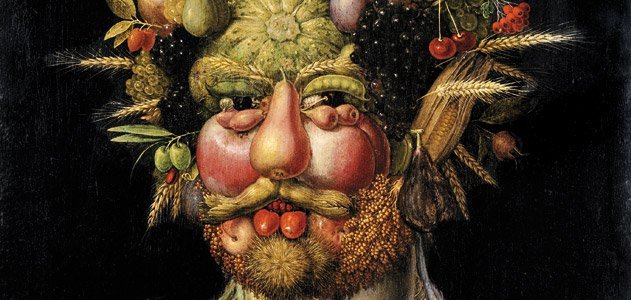
‘As a result of the food photographers who see themselves as heirs to Archibaldo and Miro … chefs have submitted to the dictates of art direction. They make food which is to be looked at … They talk about presentation, all the time, believe me they do.’


Of course he was talking about professional food photographers and professional chefs, and this was written in 1986 when ‘social media’ were a sci-fi writer’s fantasy.  But these days, half the world seem to be food photographers, and a quick riffle through the social media of people I follow has brought up all manner of pleasures, that are a long way from being Archimbaldian

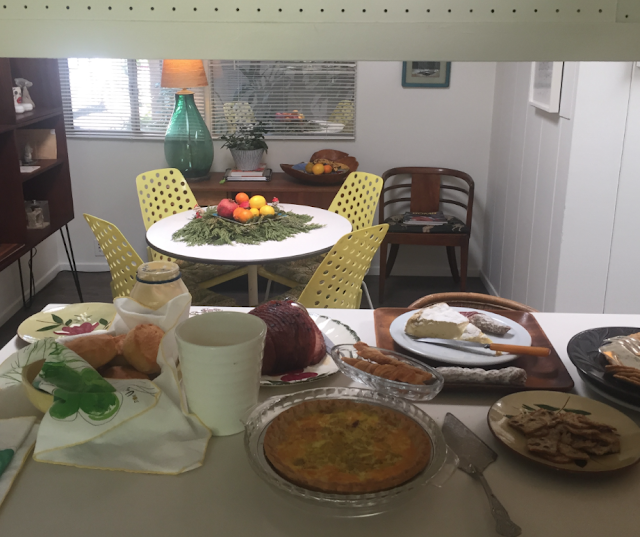
Here, for example, is William Basinski’s  ‘Xmas schorgasboard … root beer glazed ham, quiche lorraine, buttahmilk buisquits, brie and Italian salami and crackers & what-not for noshing and grazing.’


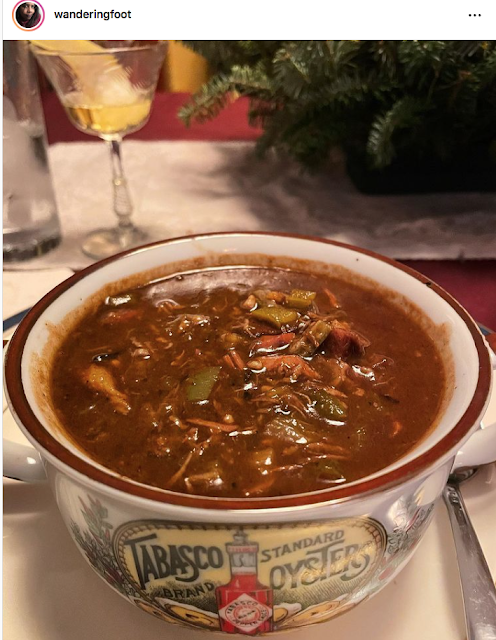
This is Christmas Gumbo as eaten by Lynell George:


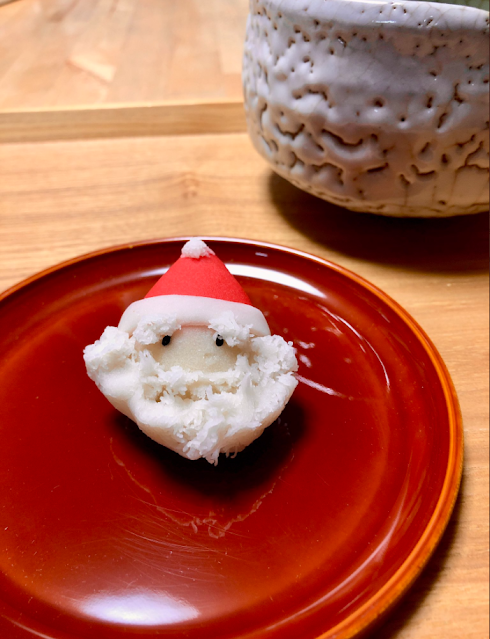
This is a mutant Santa from Food Sake Tokyo:


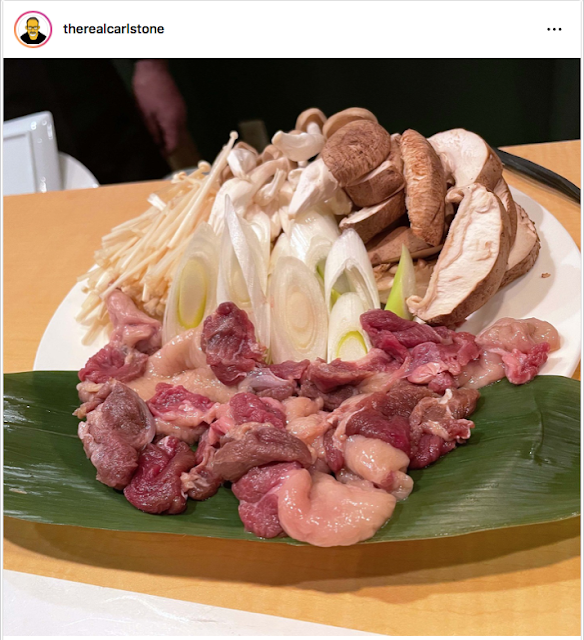
And this also Tokyo, and more or less unimprovable, is a photograph Carl Stone put on Instagram labelled 熊すき焼きwhich I gather translates translates as Bear Sukiyaki.  


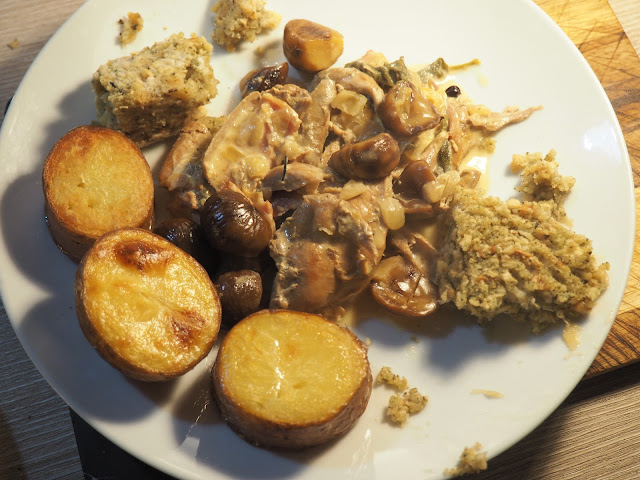
And since you ask, this was my pheasant and chestnut casserole; which could have been better, though I’m not sure what I’d have done to make it better.  I don't think snazzier presentation would have been the answer, though it could have done no harm:


Monday, July 5, 2021

THE MENISCUS MARTINI

 Being of sound mind, I would never dream or telling another human being how to make a martini.  You go into a bar, order your drink, and let the person behind the bar make it the way they want to make it.  If the drink’s no good, well the bartender has gone to hell in their own way.  And of course you're in a kind of hell because you have to drink it.


The one below, as I recall, was in a hotel bar in Baltimore, from which I expected nothing put delivered very well.


However, if pressed, and as you almost see it in the picture above, the one thing I would advise in making a martini is to give the drinker a full and generous pour. A meniscus that rises gently above the top of the glass is the mark of any great or even good martini. 


I was reminded of this (as if I needed reminding) , by something in Jonathan Meades’s book Pedro and Ricky Come Again, a piece titled ‘The old man’s comforts and how he gained them’


Meades describes an ancient female relative named Aunt Doll who was a drinker of Mackeson, Marsala, port and sherry who asked the young Meades to pour her a drink, with the admonition, ‘Oh go on. Fill it just to the brim you Jonathan my tresshure.  I like to see a hearty meniscus on moine.’


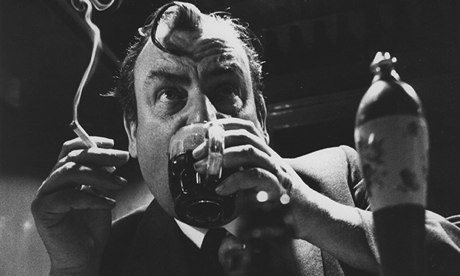
This is Jonathan Meades, though that is not his Aunt Doll. (Photo by Tim Mercer).


I’d say a meniscus is far too subtle and classic a thing to be genuinely ’hearty’ but I get the point. Here’s one I did earlier.


Photo by Luna Yearwood-Smith.

Thursday, December 8, 2016

OUTSIDE THE WHALE

-->
You know me, if I see something on a menu that I’ve never had (or even heard of) before, then I always feel duty bound to order it.  And so in the FuRaiBo restaurant on Sawtelle Boulevard, (over 100 locations in Japan, just two in the USA, according to their business card) I obviously had to order an item called “Hanpen Cheese”  The menu described it as “Fish cake w/Cheese Panko Breaded.”  When it came it looked like this:


Of course, I grew up eating fishcakes from fish and chip shops in England – they were essentially a lump of deep-fried mashed potato with a minimal quantity of fish, this kind of thing:


The Hanpen Cheese was a different kind of thing, although I suppose just about recognizably from the same extended food group.  It seemed to be a kind of sandwich: two slices of white fish (I couldn’t possibly have told you what kind of fish) with a slice of cheese in between them, (is that a line of seaweed in there too?) these slices then pankoed and deep fried. 


Did it taste good?  Well of course it did.  Deep fried fish and cheese, you can hardly go wrong, but it took a bit of research when I got home to discover exactly what I’d eaten.

Yes, hanpen is generally a kind of fishcake, though ham and tofu may be involved, as well as or instead of both the fish and the cheese.  Those mysterious slices of white fish were almost certainly made from surimi – the kind of paste they use in imitation crab sticks or fish sticks, that starts out looking like this:


So mystery solved, and really not all that mysterious as these things go.  Will I order it next time I see it on a menu?  Well I may or I may not, but I'll no longer feel duty bound.

After the FuRaiBo, and still with an urge for novelty blowing through my taste buds, I went to the Nijiya supermarket across the street and bought some of this to take home with me.


It was a curious, sweet, sticky salad of sand lances and walnuts.  The Japanese name for sand lance (which I’d never even heard of before let alone eaten, and is sometimes known as the sand eel though it’s not a true relation of the eel) is Kugini.  And I believe this salad, made by boiling the fish with soy sauce and sugar, is called Tsukudani, but don’t shoot me if I’ve got that wrong.


                               *
I have never seen whale on a menu, not even in Japan, though I did see it in supermarkets there, and (don’t hate me) I’ve eaten it, and it was an interesting rather than a great experience.  The taste really was somewhere between meat and fish, as I suppose befits a marine mammal.


Now, life being as it is, I happened to be reading Jonathan Meades’ An Encyclopedia of Myself.  I’m very fond of Jonathan Meades’ work, and was once mistaken for him.  I was once also mistaken for food writer Jonathan Gold.  Perhaps a pattern is emerging.


Anyway, Meades generally comes across as a pretty thorough-going omnivore, so imagine my surprise at discovering that there’s one food he’ll never eat and that’s whale.  It seems to me that he had it in fairly grim circumstances, on Osmington Beach, in Dorset, and baked in a pie.  (I had my whale as sashimi)  He writes:
“It was a scuddy, billowy day when I ate the whale. Not the whole whale--I was only four--but enough whale to get the idea of whale's quiddity, to get a mnemonic fix, which persists over forty years, and is ocular and palatal and olfactory and haptic.” 
(If you think he’s overcooking his prose there, I think you may have a point.)


Anyway, he hated the whale pie and tried to hide it under the pebbles on the beach.  He concludes, “Since then, I've eaten the tripe of kine and sheep, sea slug (a.k.a. beche-de-mer), ox brain, lamb brain, pig brain and trotter and ear, duodenum and other intestines, spinal cord, flying fishes' eggs, beaver, salmon entails, testicles (rognons blanc), locust, etcetera. But there is a limit to omnivorous curiosity and carnal abandon. Whale is mine. Not another cubic metre will ever pass my lips.”

Does he really mean cubic metre?  That’s a large amount of any kind of food.  Perhaps he meant cubic millimeter.  Also, interestingly, in an earlier version of this piece that appeared in the New Yorker in 1996 he included dog on his list of the exotica he'd eaten, but I suppose he now feels that’s unacceptable, and doesn’t want to be hated.  Even so, given that it’s some 60 years since he last ate whale I’d have thought it might be worth giving it another try, maybe next time he sees it on a menu.