Tuesday, July 31, 2018

A PLATEFUL OF EUPHEMISM

I understand the need for euphemism in food, of course I do.  We speak of sweetbreads rather than pancreas, we say sausages rather than “unappealing bits of innards chopped up small, seasoned and stuffed into a length of intestine.”  
         And I can see why we don’t want to think about happy little calves when we’re eating our blanquette de veau. We want to dissociate the thing on the plate from the thing gamboling through the field.  The Simpsons covered this pretty well back in the day when they covered things pretty well.


But that doesn’t explain everything.  Part of the explanation is – the French.  After the Norman Conquest of England, high-toned French terms entered the English culinary vocabulary – so that it was a lamb in the field but mutton, as in mouton, when it got to the table.  It was a cow in the field but beef (boeuf) on the plate.

This seems okay as far as it goes.  But why doesn’t it apply to, say, rabbit, which did not become lapin, and chicken only in certain limited cases becomes poulet?  As for oysters and geese – huitres and oies - I suspect there was no change because most Anglophones wouldn’t have known know how to pronounce those words.

I also wonder if it had something to do with size – why bother giving a special name to something as small as a quail?  Or a pigeon which, as I understand it, is the same in both languages.

         The pig however seems a different problem again.  We’re told that the English pig became the Frenchified pork (from porc) – but why didn’t it become cochon?


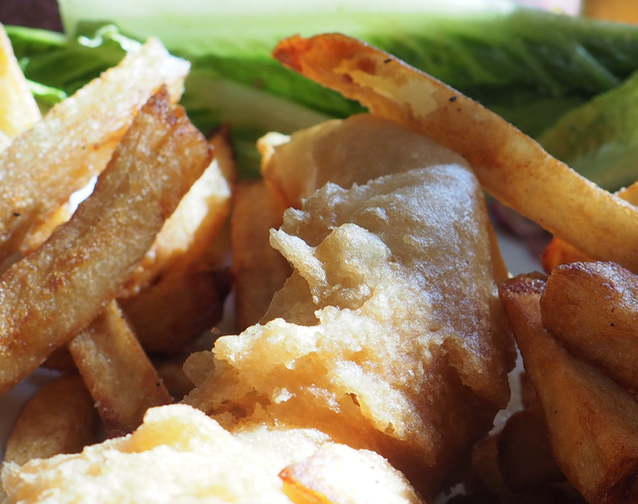
 All this was going through my mind a week or so back when I was at Franklin and Company, a modest gastro-pubbish neighborhood joint in Los Angeles, and there on the menu was “The Pig Sandwich: Braised garlic pork, gruyere, charred broccolini, balsamic mustard, toasted ciabatta.”  I ordered it: it looked like this and it was pretty tasty:


It came with French fries, which were fine, but I could have substituted them for waffle-cut duck fries (not canard fries) and it would only have been $3 extra, so now I think maybe I should have pushed the boat out just that little bit.

The restaurant is on Franklin Avenue in Hollywood, and it’s been through a few conceptual tweaks in its comparatively short history.  In the early days it had a version of this as its logo:


It’s a cartoon often, though not always, attributed to Benjamin Franklin, part of his campaign to remind the colonies that they had a better chance of standing up to the British if they were united rather than sliced into bite-sized chunks.

The restaurant doesn’t seem to use that logo anymore, and as far as I’m aware snake (or serpent as the French would say) was never on the menu, which I think is a shame.

Sunday, July 22, 2018

ALL THAT GLISTERS

The terrible news over the weekend was that the peerless food writer Jonathan Gold has died: a shocking surprise to most of us.

No doubt a lot of people who knew Jonathan much better than I did will be writing about him.  We didn’t see each other very often, but we’d eaten together, been at various events, exchanged emails from time, and I thought of him as a friend. I’m sure a great many did.


A few things to say immediately –

The best thing about his food writing - he wasn’t only interested in food – he knew and cared about music, literature, painting and much else besides, and it showed in his writing.

 He was wonderfully skilled at making you understand what a restaurant was actually like.  I’m not sure I ever read a really scorchingly bad review by him (though I know a few exist) and yet from his descriptions I absolutely knew there were some restaurants I’d never, ever want to go to.

I once asked him why he drove a big pickup truck, and he replied “Because I’m a  big man.”

Photo by the blessed Anne Fishbien
And finally, and forgive me if you’ve heard me say this before – he is the only Pulitzer Prize winner with whom I’ve ever shared a plate of pigs’ trotters.  The only one I’m ever likely to.  These are the trotters in question:

Friday, July 20, 2018

THE RIGHT STAUFFENBERG

Today, July 20th, as you may know, is the anniversary of the assassination attempt on Hitler, led by Colonel Claus von Stauffenberg, in 1944. The bomb plot failed, and Stauffenberg and several dozen military and conservative supporters were arrested, tortured and executed.

Now, you don’t need me to tell you that history can be used for any number of different purposes.  One the hand, since 1999, the swearing in of new recruits to the Bundeswehr – the united forces of Germany - takes place on July 20th to show that the military are entitled to resist immoral state actions and commands.

But Stauffenberg’s assassination attempt has also now (incredibly) been embraced by the far right, as a symbol of resistance, that Germany shouldn’t be controlled by “foreigners.”

There is also (I now know thanks to Susanna Forrest) a gin:


The advertising guff (below) suggests it invokes seeing "The Rite of Spring" for the first time in 1913, that was May 29th, though other dates and events may, of course, present themselves.


Wednesday, July 18, 2018

GIN AND I

It was, apparently, Gin Month while I was in England, and although you and I may think that every month in England is gin month, I suppose the marketing departments of liquor companies need to keep busy, and obviously they wanted June to be even more gin-sodden than the other months of the year.  I did what I could.

Not so very long ago the only place I knew in London where you could be sure of getting a good dry martini was the American Bar at the Savoy.  I’m not saying there weren’t other places, I just didn’t know them.  But the game has changed completely.  Bartenders all over the city now know what a dry martini is.  The days when they served you a glass of warm vermouth are passed.  And the Savoy endures.  Like this:


They make their house martini with Bombay Sapphire which, given the availability of a thousand and one artisanal, handmade, special edition gins, seems a little pedestrian but I had no objections to the taste.  However, should you have a 120 quid burning a hole in your waistcoat, you can turn to the “vintage cocktails” page of the drinks menu.


You’ll notice the presence of three cocktails using “vintage gin.”  Now, I don’t mean to spoil the party, but I’m not sure there’s any such thing as a vintage gin and I’ll tell you for why.
A friend of mine had an aunt and uncle who were happy and unrepentant alcoholics, and gin was their favorite drink.  As they approached retirement, and knowing they wouldn’t have much money to spend on booze once they’d stopped working, they filled the basement of their house with many, many crates of gin.  And when they retired they started to drink the first gin they’d laid down, which was now a couple of decades old, and they discovered that unlike whisky or brandy, gin did not get better with age, in fact it went off.  They ended up with a basement full of gin, most of which was undrinkable.  That’s the story anyway and it may not be 100 per cent true but the moral is clear:  drink your gin as soon as you get it.

Next stop was Dukes bar in the Dukes hotel in Mayfair.  This is where Ian Fleming drank – he lived close by – and they serve a Vesper which is a version of the martini Bond orders in Casino Royale.  He demanded Kina Lillet in his drink and Lillet can still be bought but they changed the recipe some years back.  So Dukes adjust their recipe accordingly - No. 3 London Dry Gin, Lillet Blanc, Angostura bitters, and Potocki vodka.


And this is the beauty part: the Dukes Vesper is neither stirred nor shaken but rather constructed tableside from ingredients that have come straight from the deep freeze.  If you like ritual you’re going to like this a lot.


And later a return to Mother’s Ruin in Walthamstow – a gin palace with, on the night I was there, the slowest bartender I’ve ever encountered.  He was Dutch, I think, and he said he was tired and he had to keep checking the drink recipes. It made you want to give him a good shake, although when the martini came it was perfectly fine.  Yep, that's a sage leaf.


And you know me, there are only two cocktails I really like: the martini and the gimlet and there it was on the Mother’s Run’s list – “Gimlet – Hendricks Gin, Ancho Reyes Verde chili liqueur, lime juice, gomme” - so I ordered one.  A different, far zestier bartender had swept into action.


The gimlet looked like this (yeah, I spilled some):


I think Raymond Chandler (and indeed I) would have preferred something a bit more translucent – and without a slice of cucumber - but it tasted very good.


And finally, because I was coming to the end of my time in London, I had a cocktail in Fitz’s bar at the Principal Hotel - the bar is named after Charles Fitzroy Doll who was the architect of the hotel and, among other things, designer of the dining room of the Titanic. 


Above is the Baby Babel made from “Tanqueray No. TEN Gin, Visciolata del Cardinale, LBV Port, Cream Sherry, Egg, Burr & Co. Coffee Ground Tincture.”  And of course I had no idea what “Visciolata del Cardinale” was, but research shows it to be a cherry dessert wine.  And frankly the whole thing tasted very much like dessert. But once in a while an alcoholic dessert in a glass goes down extremely well.  The bartender was absolutely wonderful.


Monday, July 16, 2018

FUN WITH MEAT - ENGLISH STYLE

What I ate on my travels.

Some barbecued venison in Essex:


Some barbecued lamb in Gloucestershire:


A might pile of miscellaneous meats at the Anatolia restaurant in Hackney:


And a pile of kebab meat from a place in West Hampstead called, I kid you not, Lezziz Express, which turns out not to be an outpost of lesbian separatism, but a halal joint.  The yoghurt sauce was hiding a multitude of sins.  And I was left thinking I should have ordered the chips and cheese: ah well, there'll be another time.


Tuesday, July 10, 2018

MASHED WITH EVERYTHING

I was in Mistley, in Essex, on the river Stour, and my companion and I went into the Mistley Thorn, a pub that’s been in existence since at least 1805, and in its current manifestation is a gastropub that specializes in seafood “with-a-glint-still-in-its-eye” (their description).  And on the menu was something I’d never eaten before - “seaweed crushed new potatoes.”  I ordered it of course, and it came looking like this:


I’ve been trying to find out how many species of seaweeds there are.  The online Seaweed Site offers a “selection” of 200, and I can’t tell you what kind came with those crushed new potatoes but the combination worked really well, a slight chewy texture to the seaweed and a lot of saltiness – not going to argue with that.

There are so many things that go well with potatoes, all the way up to caviar.  And as fate would have it, a reference on Facebook (thank you Steve Duffy) led me to this ancient news item.  It’s from the Sacramento Union, 7 May, 1916.


Now, my experience with morphine is essentially medical, and I seem not to have the right body chemistry to become a real fan, but having taken it after surgery, I can definitely say I didn’t emerge buoyant, my lips wreathed in smiles, my eyes a-sparkle.  In fact my mouth tended to hang open and my eyes roll back in my head.  But maybe it’s different when potatoes are involved.

Saturday, July 7, 2018

A LIFE OF PIE

Well, I said that I’d be eating pies while I was in London, and I wouldn’t lie about a thing like that.  On my first day in town I ate this one (not all of it), a Brace and Dram Wild Game and Whisky Pie, from Fortnum and Mason. It took a certain amount of imagination to convince myself that I could taste the whisky.


A week or so later, again from Fortnum and Mason, I bought this one: a (ruinously expensive – best part of 9 quid - really) Mutton and Caper Pie, which I thought could have used a few more capers.


And it so happened that I was staying close to a Marks and Spencer.  Now, M and S is no Fortnum and Mason but they’re not bad, and by no means ruinously expensive, and so in those moments when I was in need of comfort I wandered in and bought items such as these Mini Melton Mowbray Pork Pies, which were perfectly good.


I also scoffed down some of these Dinky Melton Mowbray Pork Pies.  Yep, thay really call them that.  In general I don’t want my food to be “dinky” but I was prepared to make an exception here.


I suspect there is some alternative universe in which Marks and Spencer sell micro pies, or bijou pie-ettes.  I’d probably be happy to eat those too.

Sunday, June 3, 2018

EATING AWAY

I’m going to be in London for the next month or so: pork pies will be eaten.  Here are some found foodie images to amuse you while I’m away:


Monday, May 28, 2018

THE BIRYANI AND I

I’ve mentioned elsewhere on this blog that if you’re an Englishman of a certain generation (i.e. mine), chances are that the first “foreign food” you ever ate was Indian.   And very possibly it was a biryani, because that was “safe,” essentially a risotto (though I surely didn’t know that word at the time), with a curry sauce on the side that you could pour over it in whatever quantity you wanted.

Were these biryanis authentic? Probably not, although Wikipedia has a remarkably detailed entry on the subject, which suggests that authenticity comes in a vast number of forms.  You want inauthenticity? This is what Martha Stewart’s version looks like:


I started thinking about biryani because I found myself back on Venice Boulevard last week and spotted this restaurant sign:


However you look at it, 30,000+ is an impressive number – I was seduced, I wanted one  – but it was early, only 11 am and the restaurant wasn’t open.

And so I wandered further along Venice Boulevard, and I came to India Sweets and Spices: a place I’ve been known to go to buy their giant jars of Marmite and slightly less giant jars of lime pickle. And yes this is the only “All Asian, Fiji and British Grocery” I know of in LA or in fact anywhere else, though I wouldn’t rule out the possibility that there are others in this town. India Sweets and Spices is a small, independently owned chain - but I don't think any of the others claim a connection with Fiji.


And they have a small buffet – you point at things – (no biryani alas) - and have exchanges in polite, cheerful but fractured English, and end up with a plate that looks like this: 


I wouldn’t absolutely swear what’s there.  I do know that’s a yoghurt curry, front left, with spinach and a chick pea flour fritter lurking in it. I think that’s a potato curry (perhaps aloo poori) in the back, and that’s definitely lemon rice – I had to pay extra for that – and there’s some yogurt on the side, not curried.  It was all pretty decent.


I also ordered a paneer pakora (above) – a deep fried cheese pancake – you’re not going to go far wrong with that – but I had to wait for it to come, and by the time it arrived I knew I was going to be so stuffed I didn’t need it.  I took it home. reheated it, and it was good, damn good, the best thing they sold.  You know, sometimes I think maybe the British Empire wasn’t all bad.


Saturday, May 26, 2018

VINEGAR GEOFF (AS OPPOSED TO JOE)


Salt and vinegar: one of the simplest flavor combinations, and it’s certainly not a subtle one, but it has a lot more poke than, say, salt and pepper, or sage and onion.  For the British, salt and vinegar reaches an apotheosis with fish and chips – if you don’t put salt and vinegar on them they’re hardly worth bothering with.  


This topic was only vaguely on my mind when I bought, from an all-American supermarket, a pack of Tim’s Cascade Style Potato Chips, “extra thick and crunchy, sea salt and vinegar,” and gluten free (you don’t say.)  
Yes, there’s a lot of writing on the pack.  I think “cascade style” simply means they come from Washington state – but the company’s address is 1150 Industry Drive North, Algon, which doesn’t in itself summon up images of mountains and volcanoes.  Also it turns out that Tim’s is actually a subsidiary of Birds Eye.  And wait a minute, what’s that printed on the pack, black on blue so it’s barely legible “artificially flavored”?   


Turn to the list of ingredients on the back and you’ll find they include vinegar powder and malic acid.  Vinegar powder, I now know, from the pack and elsewhere, is “maltodextrin and vinegar.”  You could argue about how artificial maltodextrin is.  Yes, it’s a food additive, a polysaccharide that is a thickener and improves mouth feel, but then again it is derived from starch.  As for malic acid, that’s a naturally occurring organic compound found in certain fruits and it gives them a sour flavor - quince is pretty much the magic-acid queen.   So you might think that was vaguely natural, though it does have an E number, E296.


Anyway, Tim’s potato chips tasted fine. It’s true enough that they were thick and crunchy, and the tartness didn’t strip the inside of the mouth the way some salt and vinegar flavor does.
*
          OK, now I had the bit (and the salt and vinegar) between my teeth. I bought some Kettle Brand Sea Salt and Vinegar Chips “great taste … naturally” – the packaging seems to suggested they’ve managed to trademark both “kettle” and “naturally.”


These were noticeably harsher tasting than Tim’s.  Flavoring here included, of course, vinegar powder “(Maltodextrin, White Distilled Vinegar),” Maltodextrin on its own, and citric acid. 


It’s hard to see that this version of “natural” is so very different from the “artificial” flavor of Tim’s, though the pack says, “non-GMO project verified” – which would obviously please some people a lot more than it does me. 
*
          And then I bought another pack, the last for a while.  I mean frankly, 3 largish packets of salt and vinegar chips go quite a long way.  This time I tried some Boulder Canyon Malt Vinegar and Sea Salt, Kettle Cooked Chips: 


and do you see that proud boast on the pack, “authentic foods”?  We’ll save our book- length discussion of “authenticity” for another day.


These chips tasted the best to me, the subtlest and most complex flavor, with a hint of something lemony. And how did they arrive at that flavor? Malt vinegar power (maltodextrin, food starch modified, malt vinegar), then white vinegar powder (maltodextrin, distilled white vinegar), fructose, some more maltodextrin, and then malt extract.  Is that artificial?  Is that authentic?  Beats me.

This incidentally is (part of) the Vinegar Joe referred to in the title: