Monday, July 20, 2015

WWD

Can it get any better?


Why, yes it can!


Wednesday, July 15, 2015

ENGLISH SCRATCHINGS


You want to know what else I ate while I was in England?  I mean why not, what have you got to lose?

Here’s a bowl of whitebait at Elistano’s, an Italian restaurant in Elystan Street, in Chelsea.  I used to love whitebait when I lived in England, and it seems to be unknown in the States, although the notion of deep fried small fish is hardly very exotic.  So now I always have it whenever I get the chance in England and I’m always somehow vaguely disappointed, but that doesn’t, and won’t, stop me ordering it the next time I get a chance.


                                                              *
Here are pork scratching’s from Brigade, a “social enterprise” restaurant in Tooley Street on the South Bank.  They say, “We help homeless individuals develop skills and motivation to find employment.”  Which may be so, through the waiters looked more like male models than the homeless but perhaps these two things aren’t mutually exclusive.   The scratchings were very good indeed.


*
And here’s the seafood platter for three from the West Mersea Oyster Bar, in Essex.    It was the cockles that really made it for me – and again, I’m not sure that I’ve ever seen cockles on a menu in the States, and again I don’t really know why.


*
 And here’s the stuffed cabbage from the Daquise in South Kensington, which has been there since 1947 when it was a hub for Polish émigrés.  Later Christine Keeler and Roman Polanski went there.  I hadn’t been for at least twenty years, and although the interior’s been spruced up – in a sort of deliberately distressed way - the menu looked very much the same. I ordered the stuffed cabbage which I know I ordered twenty years ago.  I suspect the food’s become a bit more sophisticated too, without getting at all distressed.  Best thing about the meal: the staff bring the food to the table in saucepans and then dole it out onto your plate – wonderful, simultaneously very sophisticated and very homely.


*
And finally here’s the Club Sandwich from Café Opera in the Salts Mill, in Saltaire, on the outskirts of Bradford, where the David Hockney gallery is.  The sandwich contains smoked chicken, bacon, lettuce and tomato, and the potato crisps were really good, though I don’t think they were made on premises.  Best part:  the waitress had one arm tattooed like leopard skin, and I did want to take a picture of that, but I was either too cool or too inhibited, I’m still not sure which.


*

Tuesday, July 14, 2015

GRATE EXPECTATIONS


I was in England, eating among other things, and the best thing I ate – at the Portland restaurant in Fitzrovia, in London  - was this:


It’s a “tartare of Yorkshire dairy cow, smoked mayonnaise and beetroot,” and although I know what all those words mean I’m not totally sure I know what I was eating.  I mean, do people actually eat milk cows?  I can’t see why they shouldn’t but wouldn’t an old milk cow be a bit tough, especially if you were eating it raw? And I couldn’t help thinking that maybe I was actually eating veal, and that maybe restaurants need euphemisms for veal these days.  More research needed there.


Anyway, my tartare of Yorkshire dairy cow was very good indeed, if with perhaps a few more beets than anybody would actually want.  The main course was wood pigeon, and that was very fine, and it came with a warning of shot hazard from the waitress.  She also warned us about the cheese course – but like fools we didn’t heed her.  The menu offered “Montgomery cheddar, pear chutney, water biscuit” which sounded good, and the warning was only that the cheese came grated, which didn’t still seem a particularly bad thing, but when it arrived there was a giant cracker, speared thickly with sticky pear goo, with not very much grated cheese sprinkled on the top.


Maybe they thought that grating cheese was a way of making it look like you’d got more than you actually had – but in fact I reckoned it had the opposite effect. 


I was still thinking about this a couple of days when later I was in Sheffield, at Henry’s, a gastropub, I suppose, though there’s been a Henry’s on that site long before the word gained currency.  I ordered a cheese and onion sandwich (that's it above) – and this came open faced, again with grated cheese, and again not very much of it.  Is it just me or is a sandwich that has more onion than cheese a bit of a liability?


And then right before I flew home from Heathrow Terminal 2 I had lunch at Wondertree a place that offers “all day eclectic dining.”  I had the croque - “
smoked cheddar, spinach & bacon with smoky tomato relish”


And as you see it too had grated cheese on top, but thankfully it also had real cheese inside.  The grated cheese was a garnish – which I think is what grated cheese should always be; an extra, not the thing itself.  If you’re having a cheese plate or a cheese sandwich, then you want a great slab of the stuff, not a few wispy strands.  The good folks at Portland and Henry’s might like to think about that, but I’m not sure they will.

Sunday, June 21, 2015

THE SILVER CONCEPTION


As books go, Facebook is one very weird book.  Sometimes I use it for shameless self-promotion – which I suppose is one of the purposes of a certain kind of book – and my own case it’s never entirely shame-free. Sometimes I’ll say something witty or interesting or DEEP things and I’ll get three likes.  But then other times I just a stick a picture up there and everybody goes crazy for it.  I posted this one:


and I got more likes and replies and comments and feedback than I’ve ever had for any other post.

It’s a photograph of a martini I had last week in Musso and Frank – the ancestral, Hollywood Boulevard, liquor-soaked home of Chandler, Bukowksi, Dorothy Parker,  John O’Hara et al.  


If there’s a better martini to be had in the universe then I would certainly like to find it, but until then I’m more than happy with this version.  And an interesting thing about the Musso and Frank martini – it doesn’t seem to matter which of the many bartenders makes it, they’re all equally excellent.  They’ve got the quality control thing down to a T.

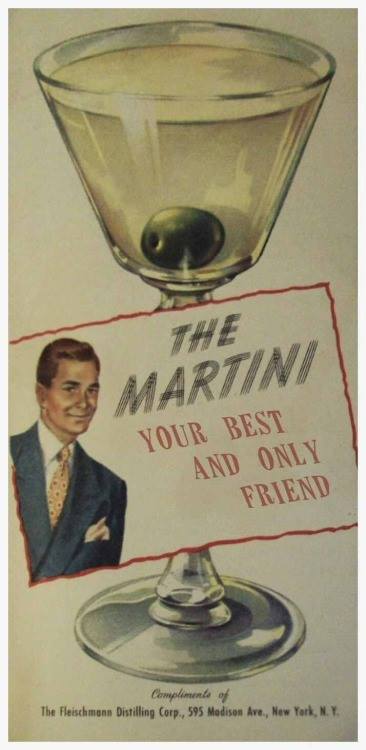
One of the responses to my post was this deeply wonderful ad for Fleischmann’s gin from Facebook pal Steve Duffy – “ a martini your best and only friend.”  


But now that I think about it - if a martini's my ONLY friend, then by definition it's got to be my BEST friend, but that's not necessarily saying much, is it?  It must also be said that the martini is the kind of friend that’s sometimes led me astray, just as well I’m the forgiving sort of friend.

And then movie-lover Anne Billson sent me a clip from YouTube showing Luis Bunuel making a martini – he actually uses a few drops of bitters, an increasingly rare presence in the modern martini, I find.  Thus:


I’d read Bunuel on the martini in his autobiography My Last Sigh but had never seen him in action. In that book he writes:
“To provoke, or sustain, a reverie in a bar, you have to drink English gin, especially in the form of the dry martini. To be frank, given the primordial role played in my life by the dry martini, I think I really ought to give it at least a page. Like all cocktails, the martini, composed essentially of gin and a few drops of Noilly Prat, seems to have been an American invention. Connoisseurs who like their martinis very dry suggest simply allowing a ray of sunlight to shine through a bottle of Noilly Prat before it hits the bottle of gin. At a certain period in America it was said that the making of a dry martini should resemble the Immaculate Conception, for, as Saint Thomas Aquinas once noted, the generative power of the Holy Ghost pierced the Virgin's hymen "like a ray of sunlight through a window — leaving it unbroken."


Despite being raised a Catholic, Bunuel has, like many before him, got the doctrine of the Immaculate conception all wrong here.  It’s the Virgin Mary who’s immaculately conceived, not Jesus.  I didn’t know this either until I read it in the works of the atheistic Christopher Hitchens.  Hitchens was no stranger to the martini though I haven’t been able to find a picture of him drinking one.  I had to make do with this instead:


Monday, June 1, 2015

SPIRAL SCRATCHINGS


Do you know how to get a good martini in Utah?  No, to be honest, neither do I. 


First thing to say, a lot of people imagine it’s impossible to get any sort of martini whatsoever in Utah, because of the Mormons.  That’s simply not true.  The liquor and licensing laws of Utah may be complicated, but they’re not so arcane as to stop you getting a drink.  The Bible reckons it’s OK.

When it comes to hard liquor however, a standard pour in bar is one and half ounces.  Now I always say a small martini (or perhaps two small martinis) is preferable to one stonking big martini.  A “classic” five ounce slug is likely to get warm and unpleasant long before you get to the bottom of it.  And a couple of five ounce slugs are likely to leave you (or anyway me) incoherent.


So a small drink, a one and a half ounce martini, is not in itself a bad thing.  But the martinis I had in Utah last month left me confused, and also left me curiously sober.  None of them (and in the end I didn’t drink all that many of them, because I stopped ordering them after a while) delivered much bang for the buck.  And the fact is, they also seemed downright watery.


And here I think may be the real problem.  The ice that got put into the cocktail shaker to make the martini always seemed to be sitting there in a tub behind the bar; small cubes, lots of melt, consequently shaking them created even more melt.  So you were essentially getting a small glass of diluted gin, which is not the point of a martini

The other problem, and this may be a more personal thing, is that one of the greatest joys of a martini is that little meniscus that forms over the rim of the full glass.  No chance of that with a standard size glass and a small pour. Really just another reason to dig out your small, antique martini glass, thus:


But I don’t mean to carp, even less to be a martini bore.  There was some fine drinking to be done in Utah, not least this favorite, the Spiral Jetty, named in honor of Robert Smithson’s piece of land art.  Apparently there’s been some kind of legal dispute between the brewers and the Dia Art Foundation which holds the copyright on the Spiral Jetty jointly with the Smithson estate, but it’s obviously been settled.


I thought it was a pretty good beer; strong (6.6%), hoppy, malty, serious, and bitter in the English beer sense of the world.  Here’s a bottle sitting on the window ledge of my hotel room in Ogden, Utah:


Ogden is a fine town, and is now forever etched in my memory as the place I ate yak tartar, at a restaurant named Hearth, on 25th Street.  It was the best yak I ever ate.  The Loved One also had yak, but hers was cooked and afterwards she wished she’d had it raw.  Indeed.  Next time.